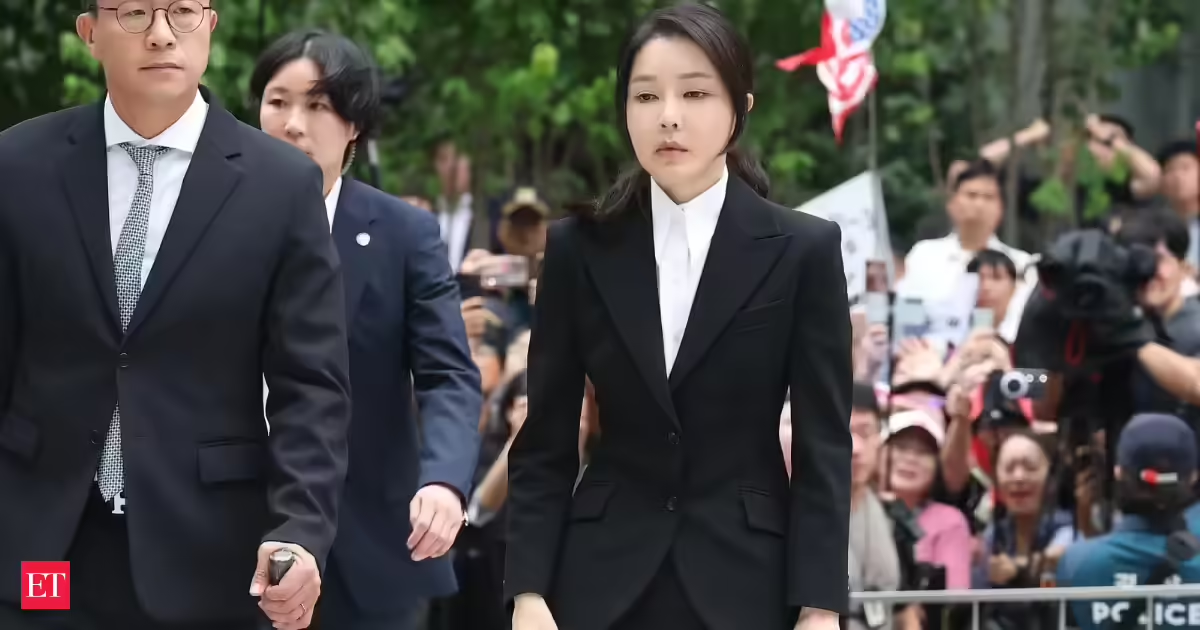
Court convicts Kim of accepting luxury gifts in exchange for influence over public appointments Live television coverage of the verdict in the trial of former first lady Kim Keon Hee is shown at Seoul Station on Friday. (Yonhap) Former first lady Kim Keon Hee was sentenced to seven years in prison Friday after a Seoul court found her guilty of accepting luxury gifts in return for exerting influence over government appointments, in a high-profile influence-peddling case that prosecutors described as a “sale of public office.”The Seoul Central District Court found Kim guilty of peddling influence under the Act on the Aggravated Punishment of Specific Crimes, ruling that she knowingly accepted valuables from businesspeople and public figures in exchange for using her position as the president’s spouse to influence personnel appointments.“The defendant must have recognized that the gifts went beyond ordinary social courtesy and were given in anticipation of a quid pro quo,” the court said in its ruling.“Lee’s requests gradually evolved from implicit expectations to explicit and specific solicitations over the course of three separate transfers of valuables, and the defendant clearly recognized that the gifts were linked to those requests while accepting them,” the court added. “A comprehensive quid pro quo relationship existed throughout the entire process of receiving the jewelry.”Kim was indicted in December on allegations that she accepted about 103.8 million won ($68,000) worth of luxury jewelry, including a Van Cleef & Arpels necklace, a Tiffany & Co. brooch and Graff earrings, from Suh Hee Construction Chairman Lee Bong-kwan between March and May 2022.Prosecutors alleged the gifts were provided in exchange for assistance in securing a government appointment for Lee’s eldest son-in-law.The court ruled that all three pieces of jewelry were given in return for the requested personnel favor.In explaining its reasoning, the court said Lee first sought to build ties with Kim shortly after former President Yoon Suk Yeol became the presidential nominee of the conservative People Power Party in November 2021, hoping to benefit from her influence over matters affecting his construction company.The court said Kim, who had operated art exhibition businesses for years, would have understood Lee’s intentions and that the pair had not developed the kind of close personal relationship that would explain gifts worth tens of millions of won.It also noted that Lee presented Kim with a necklace worth about 55.6 million won only six days after Yoon won the presidential election in March 2022.“The purpose of providing the necklace was not simply to congratulate or express friendship, but to establish a connection with the defendant and utilize her influence in resolving potential business issues in the future,” the court said.The judges further pointed to evidence that after receiving the necklace and later a brooch, Kim asked Lee whether there was anything she could help him with, concluding that she accepted rather than distanced herself from his requests.The court also convicted Kim over another appointment-related allegation involving Lee Bae-yong, who later became chair of the National Education Commission.Judges found that Kim accepted a gold turtle figurine worth 2.65 million won and a replica of the famous painting “Sehando” in connection with Lee’s request to be appointed chair of the National Education Commission.“The gold turtle was provided for the purpose of influencing the president’s appointment authority, and the defendant accepted it while recognizing both the intent of the gift and its quid pro quo nature,” the court said. It added that the “Sehando” replica, sent about 40 days later, was also clearly linked to the same appointment request.Kim had denied wrongdoing throughout the trial, acknowledging that she received some gifts but claiming they were exchanged out of personal friendship and were unrelated to any official favors.Her lawyers maintained that no specific requests had been made and that the gifts did not constitute criminal influence peddling.Special prosecutors had sought a prison term of seven years and six months, describing the case as one in which Kim repeatedly treated the authority associated with her status as first lady as “a private commodity for sale.”
Former first lady gets 7 years in influence-peddling case
Former first lady Kim Keon Hee was sentenced to seven years in prison Friday after a Seoul court found her guilty of accepting luxury gifts in return for exerti
670 words~3 min read