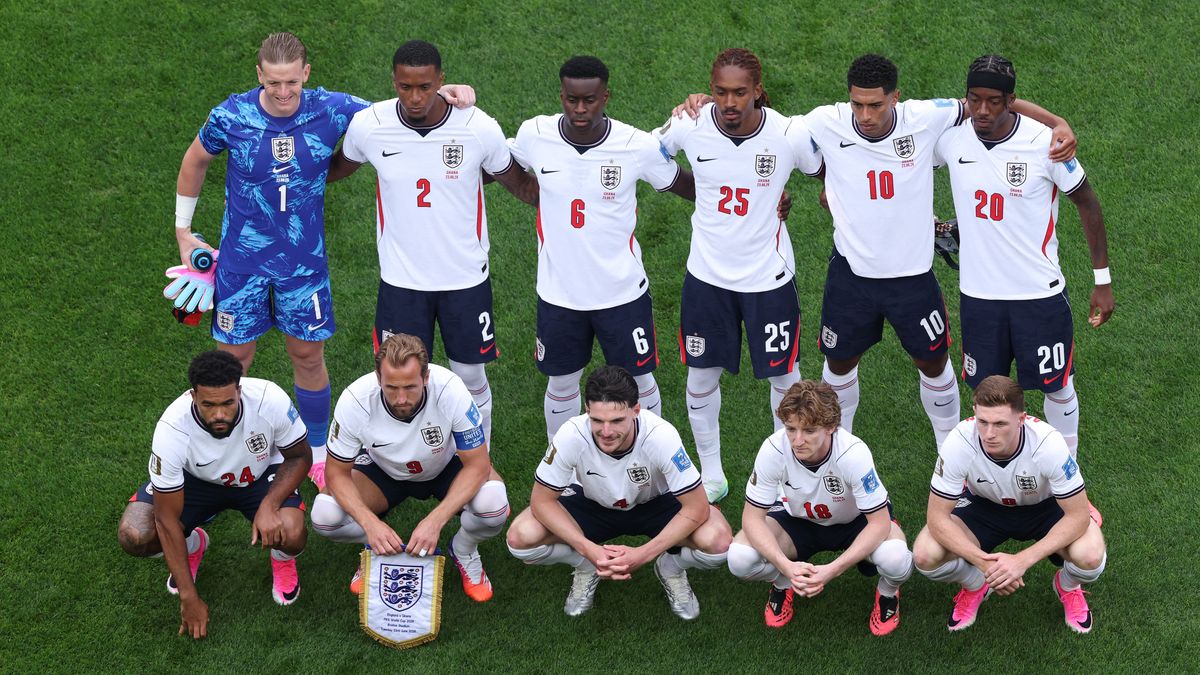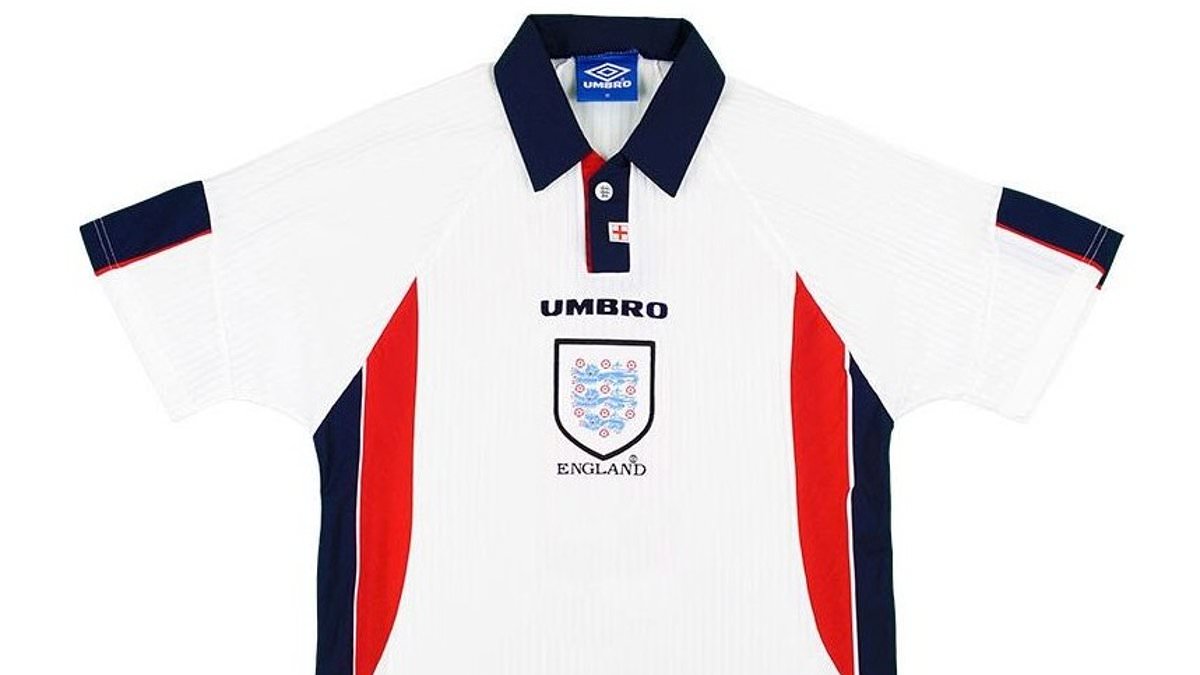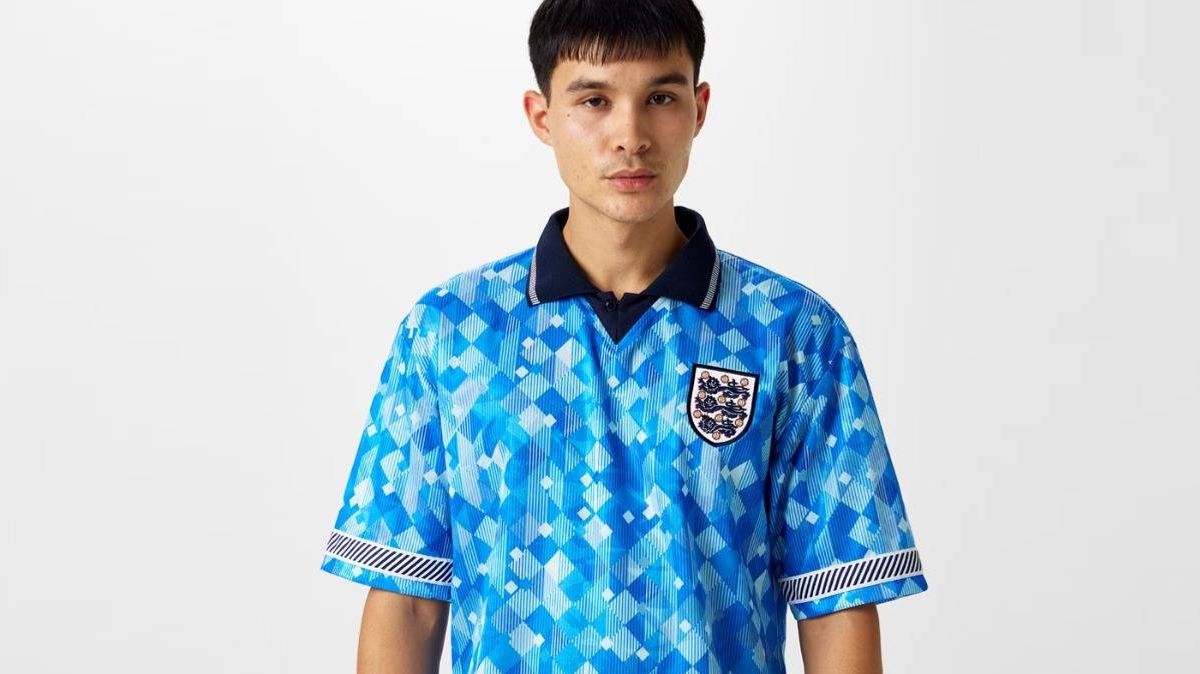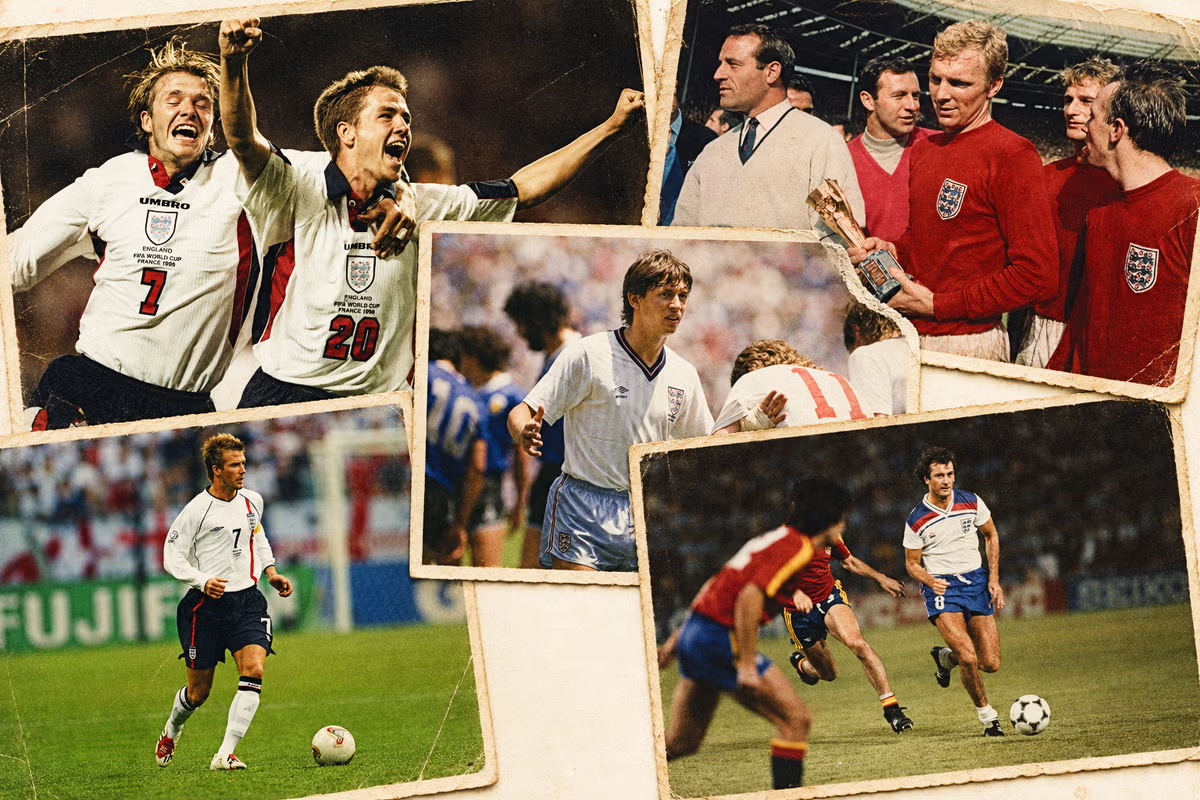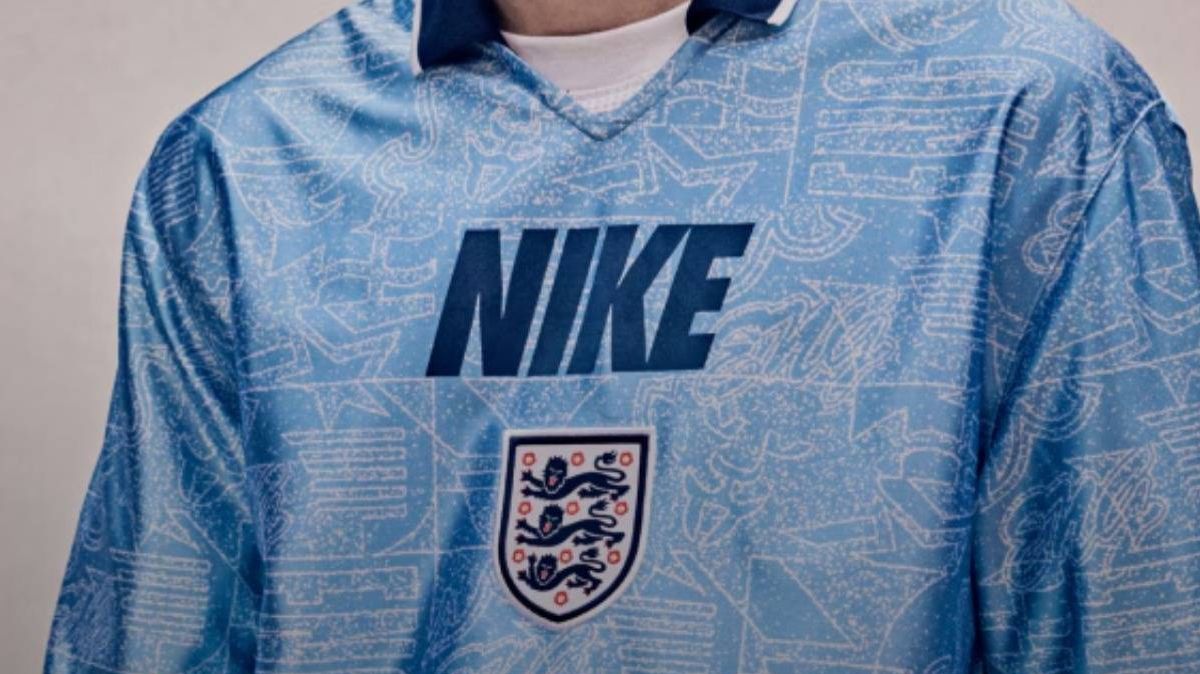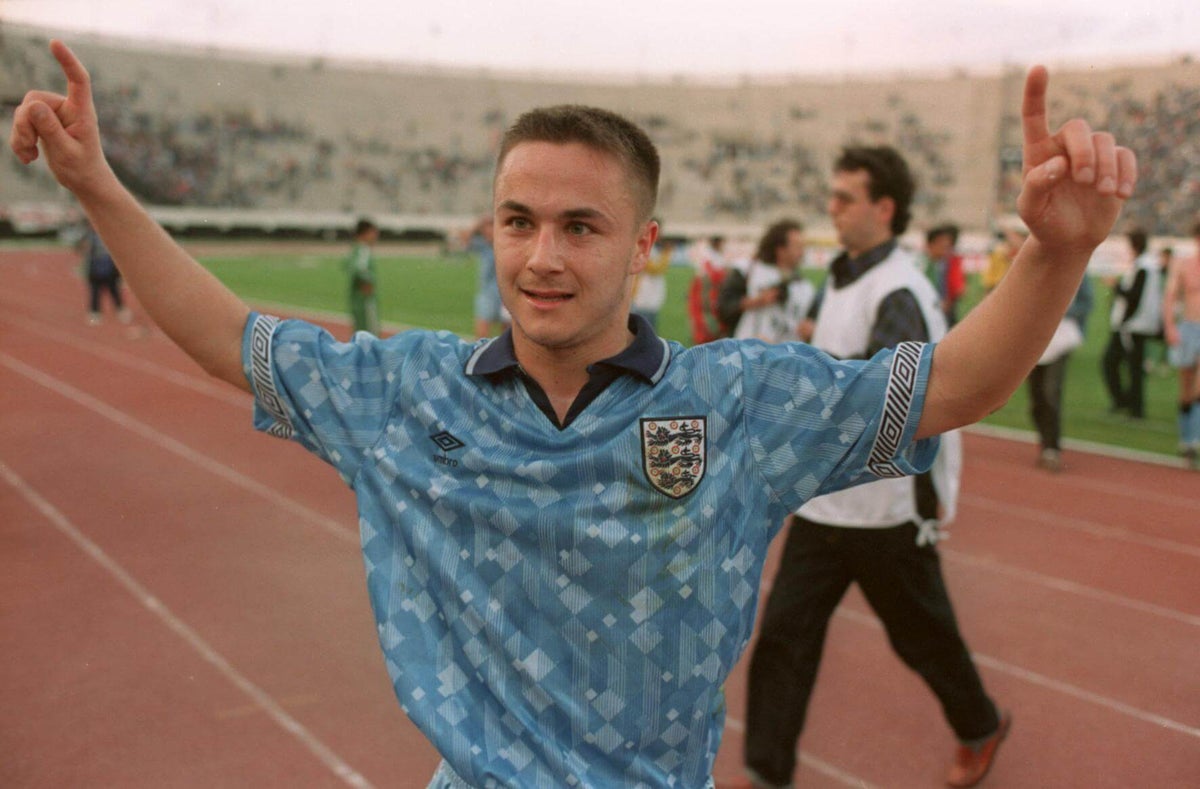
This article is part of our Style of Play series, an exploration of World Cup kit culture.If you’re watching an England game in public during this World Cup, you’re going to see a lot of people wearing a wide range of the national team’s shirts.Plenty will have the current version, home or away, but the recent explosion of the market for retro kits will mean you’ll see a huge amount of tops from years gone by, too.Many of them will be tied to iconic England teams and tournaments: the white Italia 90 shirt, the grey Euro 96 one — possibly with ‘Shearer’ on the back — and the 2002 World Cup edition.Among them will be one that isn’t associated with any of those tournaments. It wasn’t worn at any tournament. In fact, it was only ever worn in one game, but you will still see it more than you’d expect, considering those facts. After you spot it once, you’ll keep seeing it everywhere.Get free access to the most comprehensive World Cup coverage in The Athletic appThe jersey in question is a blue third shirt released for that 1990 World Cup. It’s the same design as the home top England wore throughout the tournament in Italy, and the red away one which they didn’t wear then but did sport eight times over the following few years on a variety of inauspicious occasions, including the infamously calamitous summer tour to the United States in 1993.The blue shirt was worn in just one game: a European Championship qualifier in May 1991, away against Turkey in Izmir. On his debut, Dennis Wise of Chelsea scored the only goal of both the game and his international career as England won 1-0.And that was it. One game, 90 minutes, a brief outing never repeated. But still, you’ll see many more of them in England crowds than some of the jersey designs that the team wore dozens of times.It was in the stands for England’s opening two group games of this tournament in Arlington and Foxboro. It was on an England fan in a Houston bar this week, which is particularly unusual considering England are not and will not be playing in that city during this World Cup. It’s even in Budweiser’s Jurgen Klopp-fronted advert for this World Cup, worn by a man struggling to carry four pints of beer through a busy crowd, and later seen celebrating a goal and drinking his plastic cup of Bud.So what gives? Why is this incredibly obscure shirt, worn in only one match by the England senior team, so popular?John Barnes wears a future collectors’ item that 1991 day in Turkey (Shaun Botterill/Allsport/Hulton Archive/Getty Images)The first point is that its obscurity contributes to its popularity. There is a certain kind of football fan who want to express their support but also avoid being obvious about it, those who wear it in a ‘Please ask me about my shirt’ way. It’s not only retro, but it’s obscure, a double dip for the discerning football pseud/hipster. Gary Bierton from the website Classic Football Shirts calls it a “counter-cultural appeal”, which ironically enough is diluted the more people try to adopt it.But there have been plenty of rarely-worn shirts, so why is this one so popular? It comes down to its association with Italia ’90, and how deeply that World Cup is still embedded in the English consciousness.“It holds a place in popular culture,” says Bierton. “We as football fans have taken some time to understand just how powerful football was in that moment.”The shirt and its associations were linked to that World Cup, and how the perception of the game in England began to shift. “It was the summer football became cool,” says Rob Warner, a former creative director at Umbro and founder of design agency Spark. “It started to step away from this horrible, ‘You can’t go to football because there are riots and trouble’ idea. That 1990 World Cup was like a big coming-out party for football.”This specific top’s place in popular culture was partly cemented by one of the few times it was actually seen in the public eye: the video for England’s 1990 World Cup anthem, World In Motion. New Order singer Bernard Sumner wore it in the promo, and thus it was tied to yet another cultural moment: along with Three Lions, it is England’s most famous and beloved football-adjacent pop song. Some time later, Umbro even released a special New Order version of it, with a World In Motion logo replacing the three lions national crest.“From a cultural perspective, historically, pop songs related to football were rubbish,” says Warner. “Then, all of a sudden, you’ve got New Order, and Bernard Sumner’s wearing that particular shirt in the video.”The time it came out, in the evolution of football shirt design, also adds something: only a decade or so before 1990, football shirt designs — especially international ones — were relatively uniform, but that developed throughout the 1980s and helped transform football kit from sporting wear into fashion items. To have a well-thought-out England shirt was still a relative novelty.“We all know the rise of the more distinctive designs, from Denmark in 1986 and the Netherlands in 1988,” says Bierton. “This is the first time you’ve really got an England kit representing that switch forwards. That’s the first England kit, and maybe the only England kit, that has such a striking design and tone.”On a more basic level, the shirt just works aesthetically: as well as the design being so iconic, the colour gives it something extra too. “It’s not white. It’s not red. It’s more of a ‘lifestyle’ colour,” says Warner. “It goes well with a pair of jeans. It just ticks so many boxes.”Needless to say, barely any of the examples of the shirt you’ll see in stadiums, pubs and box parks during this tournament are originals from the early 1990s. It became a mass-market item after Umbro reissued it, but also when Score Draw, a company which specialises in reproductions of retro kits, released its own interpretation. It’s one of their most popular designs, to the point that it has since produced a version of its successor, a similarly niche and also blue third shirt, this one with three lions arranged diagonally across its chest and shoulders.“It’s been adopted by England supporters as something of an alternative uniform,” says Mickey Phillips from Score Draw. “It’s got all the distinguishing ingredients to elevate that consumer, perhaps to differentiate them from a guy who might just buy any old replica shirt.”An England fan wearing THAT shirt poses for a photo in the build-up to this week’s 0-0 draw with Ghana (Mattia Ozbot/Getty Images)So that’s the replicas, but where are those super-rare, match-worn shirts now? In theory, only 11 legitimate ones exist from that game against Turkey: the 10 outfield starters and the one substitute who got on, Steve Hodge.The Athletic asked some of England’s players on that day if they still had their blue shirt.Gary Pallister’s is in storage somewhere, with the rest of his old shirts. Alan Smith looked for his recently but it seems to have gone missing somewhere along the line. Stuart Pearce’s is with his other shirts — in a box under the stairs. It was Geoff Thomas’ first senior cap, so his is signed, framed and on display at home. Similarly, Wise has his up on the wall, pride of place, to commemorate his only international goal. Lee Dixon’s daughter has his — apparently she wears it out and about.Geoff Thomas’ match-worn shirt from England’s May 1991 game against Turkey (Geoff Thomas)Based on photos from after the final whistle, at least three were swapped with the Turkish players, and their right-back Recep Cetin bagged the biggest prize, Gary Lineker’s No 10 shirt. Cetin still has it, hanging in a wardrobe at home.So that’s most of them accounted for.Gary Lineker’s No 10 shirt from England’s win away to Turkey during Euro 92 qualifying (Recep Cetin)Thinking of trying to buy one? Beware: it’s not particularly easy to identify which are the kosher, match-worn shirts, and which are replicas sold at the time or made since. In those days, the modern practice of stitching the details of each game onto the front of players’ shirts wasn’t common for non-tournament fixtures, so there’s no definitive, obvious proof on the kit itself.“There’s an endless process of elimination,” Bierton says, when asked how to identify genuine, match-worn items. “The big thing is photo matching, and trying to get any evidence that exists from any of these games. I imagine there isn’t a ton of HD footage from the Turkey game. So you then ask who it’s come from, what’s the chain of possession? A shirt is match-issue because it possesses the features: the embroidered badges, the capitalised Umbro, the stitched number on the back, but you’ve almost got to hear the story from someone.”This shirt is rare, but that doesn’t necessarily translate to big money. Really valuable, match-worn shirts have to hit the sweet spot between rarity value and prestige: worn by a particularly iconic player, or on a particularly iconic occasion, for example. This one has the rarity value, but not the prestige. Put it this way: if you approached Sotheby’s and said you’ve got a shirt worn in a forgotten European Championship qualifier from 1991… well, it’s not exactly Diego Maradona’s ‘Hand Of God’ shirt, is it?Still, if you do somehow have a genuine one in your possession, the price you’d get will be better than a kick in the pants. “I don’t know what the audience would be for it, but I’d still expect it to fetch high hundreds, or low four-figures,” estimates Warner.Bierton is a bit more optimistic. Replicas from the time on Classic Football Shirts go for £300 to £400 ($395-$530), but for a match-worn version? “I think you’ve got to be talking more than £5,000, minimum, just because it’s a one-off. But the sky’s the limit for an item like this.”The ones you’ll see at England games this summer and beyond probably aren’t valuable collector’s items. But they do represent a particular place in football culture, one that has endured for over three decades.It isn’t just the shirt England wore in a forgotten 1-0 win 35 years ago. It represents something more.The Style of Play series is sponsored by the Active Cash Visa® Credit Card from Wells Fargo.The Athletic maintains full editorial independence. Partners have no control over or input into the reporting or editing process and do not review stories before publication.
England wore this shirt only once – so why is it everywhere at the World Cup?
The blue England third shirt released for the 1990 World Cup is one of the most popular fashion choices among fans following the team
1,761 words~8 min read