Until market power stops crowding out enterprise, India will continue financing a notion of growth it never quite achieves
| Photo Credit:
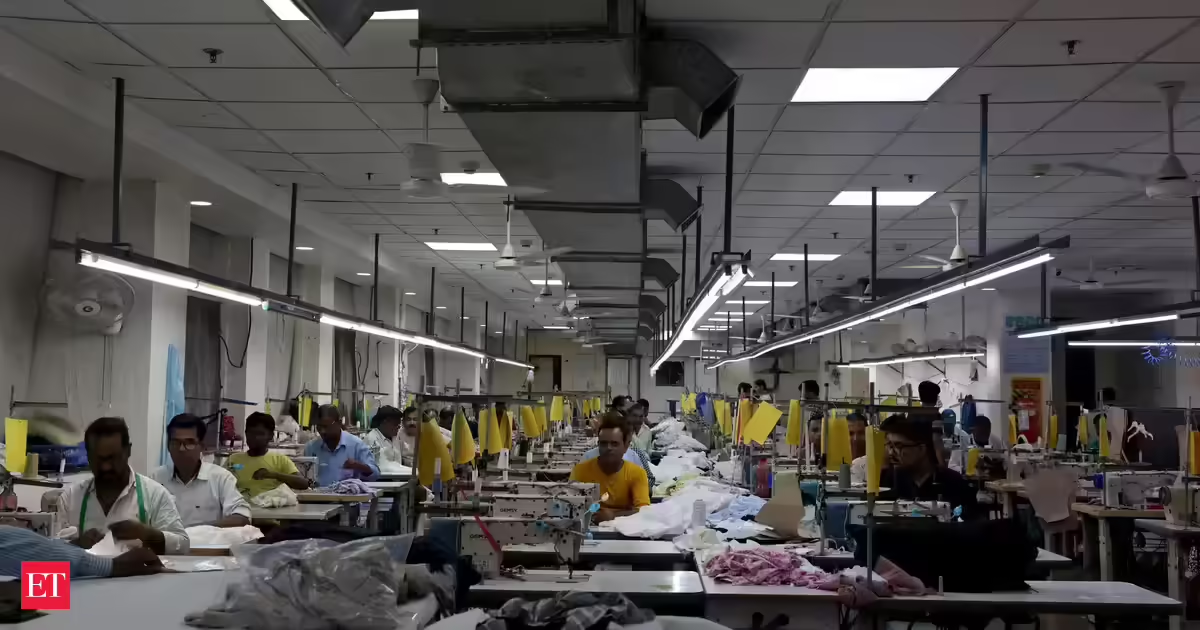
India is investing enough for 8 per cent growth and getting 6 per cent because competition no longer forces capital to create output. ICOR (Incremental Capital Output Ratio), the amount of capital needed to generate one unit of output, has risen from 3-4 in the mid-2000s to 5-6 today, cutting the growth yield of each rupee of investment by roughly a third.Consumption holds at 60 per cent of GDP and capacity utilisation in manufacturing sits at 75 per cent levels that historically trigger capex cycles. Yet private investment remains stuck near 30 per cent of GDP. If demand were weak, utilisation would be low and consumption soft. Neither is true. The missing variable is market structure. In concentrated sectors, firms do not respond to incremental demand by building capacity; they absorb it through pricing. Investment no longer scales with demand. At a 30 per cent investment rate, an ICOR of 3.5 supports 8-9 per cent growth; an ICOR of 5.5 supports 5-6 per cent. India’s realised growth of 6-7 per cent sits between these outcomes because capital is deployed defensively — protecting margins rather than expanding output.Across India’s foundational sectors, competition no longer expands supply; it manages scarcity. In steel, post-IBC consolidation has created a handful of “national champions” who control 60 per cent of capacity. Instead of “flooding the zone” to lower costs for MSMEs, incumbents use capital to acquire rivals or chase high-margin exports. Cement shows the same substitution: during upcycles, prices rise 8-12 per cent while volumes grow only 4-6 per cent. This gap feeds the GDP deflator; pricing power replaces volume expansion, and the ICOR rises as more capital is required for each unit of real output.The efficiency of scarcityAviation and telecom now mirror this structure. With two dominant carriers controlling 90 per cent of the sky, fares leap 20-30 per cent during demand spikes while aircraft orders are phased to protect yields rather than pre-empt demand. In telecom, the incentive to overbuild has vanished; capacity expansion now trails consumption instead of shaping it. Healthcare completes the pincer: hospital chains have pivoted to ARPOB (Revenue per Occupied Bed), deploying capital into high-margin robotics rather than expanding bed counts.Across telecom, cement and aviation, firms do not build capacity to win demand — they price scarcity to protect margins. In every instance, profits recover faster than capacity expands. Capital is being used to build moats, not bridges. These moats do more than protect margins; they raise the drawbridge against the next generation of competitors.Entry is where this becomes structural. Manufacturing firm entry rates have dropped below 5 per cent annually, down from 8-10 per cent during the 2004-08 expansion. Incumbents control distribution, logistics priority, and vendor credit. A new firm faces higher working capital needs and limited market access from the outset. It does not scale slowly; it exits early. Fewer entrants mean fewer independent investment decisions, raising ICOR further.Firms don’t scale — they exitCredit amplifies this constraint. MSMEs borrow at rates 200-400 basis points higher than large firms and wait 60-90 days to collect receivables. Formalisation has tightened the pincer: firms now pay GST on invoices raised rather than cash collected, effectively forcing them to interest-free-finance the state for 10 per cent of their turnover while they wait for buyers to settle. This locks up to a third of annual turnover as working capital. Delayed payments by large buyers shift financing upstream and trap roughly ₹2-3 lakh crore within supply chains at any point. That is capital that could fund expansion but instead finances delay. Lower firm survival reduces job creation, narrows consumption, and weakens the next round of investment.Large firms in concentrated sectors add output with limited headcount. India needs roughly 8-10 million jobs annually. When entry is blocked and incumbents automate, employment elasticity falls, narrowing the income base that sustains demand.Global, domestic marketsThe issue is not concentration alone but where firms compete. In the US, firms operate in globally contestable markets, with capex and R&D at 6-10 per cent of revenue. High margins fund expansion. In India, incumbents deploy far lower expansion intensity because the contest is domestic. High margins fund balance sheet repair, not capacity. Global contestability converts concentration into expansion; domestic insulation converts it into rent extraction.Germany’s Mittelstand works because of financing and market access. Regional banks provide long-term credit, and export linkages anchor demand. Nearly 60 per cent of jobs sit in these firms, accounting for roughly a third of turnover. Fragmentation without credit and export integration will not lower ICOR.Policy choices sustain the equilibrium. The Competition Commission of India relies on slow processes and behavioural remedies. Sector regulators prioritise tariff stability. Public procurement rewards scale and past contracts, raising entry barriers.Growth fails the mathEnforcing 30-day payments could release ₹2-3 lakh crore of working capital, while opening logistics and tightening merger thresholds would lower entry barriers. But these changes redistribute margins, and incumbents will resist them.Capital intensity does raise ICOR. A semiconductor plant will always yield less immediate output than a software firm, and stronger balance sheets do reduce reckless capex. But this does not explain why consumer sectors with short investment cycles — cement, aviation, telecom — consistently price before they build. That is not prudence. It is market power.The trade-off is immediate. Margins will compress and some capex may pause. But the alternative is arithmetic. At an ICOR of 5.5, India needs an investment rate near 38 per cent of GDP to sustain 7 per cent growth; it is at 30 per cent. Higher ICOR reduces job creation, weaker jobs depress consumption, and weak demand suppresses investment.That loop is the cost of letting market power replace output — India will grow, but below what its investment has already paid for.The paradox is stark. We move money in seconds, collect taxes in advance and invest at a rate fit for 8 per cent growth, only to settle for 6 per cent. The missing link is not capital but fair competition. Until market power stops crowding out enterprise, India will continue financing a notion of growth it never quite achieves.An alumnus of NESA, Washington DC and IIT (ISM) Dhanbad, Ranjan is associated with Indian Institute of Public Administration, New Delhi as Registrar. Singh is an economist, columnist and public policy commentatorPublished on June 26, 2026