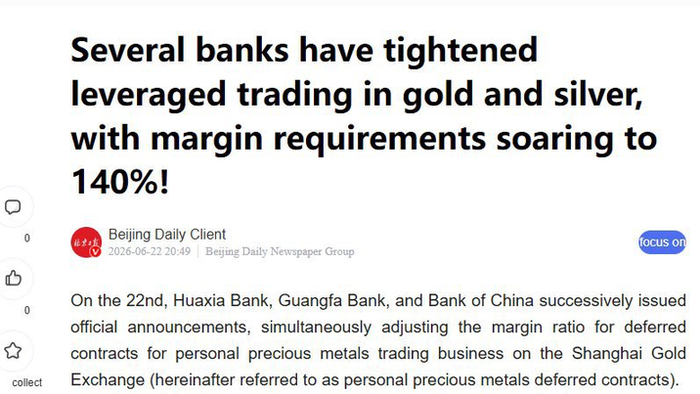
China is building the infrastructure to link RMB liquidity with gold liquidity through Hong Kong, the SGE, clearing, vaulting, and potential collateral use. Recent margin hikes may be pre-emptive risk control, discouraging leveraged speculation before gold becomes more financeable, repo-eligible, and central to RMB internationalization strategy. The margin hikes are merely preparation for the bigger event. Authored by Eric Yeung and Vince Lanci with contributions by Bai XiaojunChina’s effort to internationalize the RMB has often been analyzed through trade settlement, swap lines, bilateral payment systems, and the gradual development of offshore RMB markets. Those channels are important, but they do not fully address the central constraint facing any reserve-currency challenger: liquidity. A currency can be used for trade without becoming a reserve asset. To become a reserve asset, it must be supported by deep, trusted, and financeable instruments that foreign institutions can hold, pledge, borrow against, and convert under stress.The thesis developed by Eric Yeung and Vincent Lanci is that China’s gold strategy should be understood inside that liquidity problem. The argument is not that China is preparing a simple gold-backed RMB in the classical sense. The argument is that China is attempting to build a gold-linked liquidity architecture around the RMB, using physical gold, clearing infrastructure, offshore vaulting, and eventually collateral treatment to make RMB balances more acceptable outside the mainland.The latest developments in Chinese precious-metals margin policy and Hong Kong’s expected gold-clearing launch strengthen that framework. They do not prove that gold has been formally designated as high-quality liquid asset, or HQLA, collateral. They do, however, add another piece to a broader institutional pattern: China is building the market structure required for gold to move from reserve asset toward liquidity asset.What China's Margin Hikes Really Mean
What China’s Gold Margin Hikes Really Mean
Recent margin hikes may be pre-emptive risk control
1,492 words~7 min read