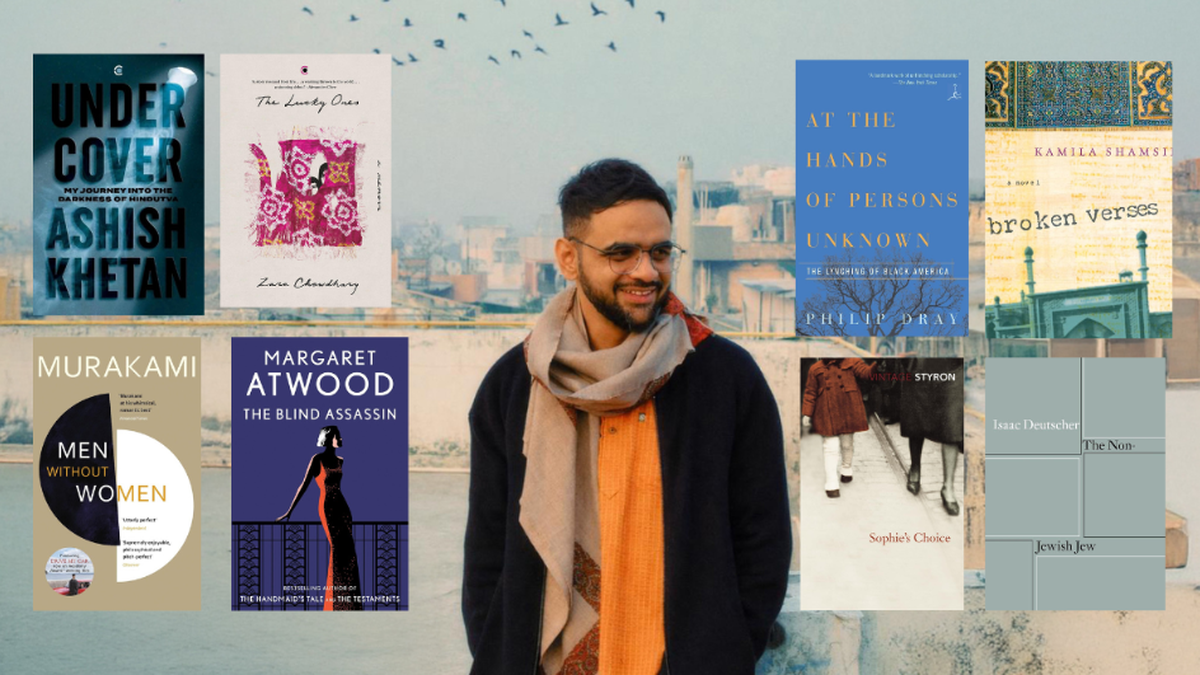
Once during his South Africa years, after being sentenced to a few months of imprisonment, Gandhi remarked that the first thought that crossed his mind after the judge pronounced his sentence was that he was finally going to get the time to read.In the months preceding my arrest, realising that time was something I was going to have in abundance soon, I had begun curating a reading list. In the last six years, I have voraciously read all that I could lay my hands on — crime thrillers, prison memoirs, historical works, journalistic accounts, graphic novels, old classics, 19th century novels — and yet I don’t think I have ticked even 10% of that original reading list I made in 2020. But at a time when life itself seemed to resemble an Orwellian dystopia, reading has been the only thing that has kept me sane, or so I would like to believe.Entering the different worlds within books allows me to escape the oppressive one around me. It has sustained me emotionally and intellectually, while ensuring that I take something worthwhile away from these otherwise drab and monotonous years. Here, then, are 10 books I would recommend.1. Desperately Seeking Paradise: Journeys of a Sceptical Muslim by Ziauddin SardarWritten sometime in the 1990s, Sardar takes us into the various worlds of contemporary Islam — from the mysticism of the Sufis to the devotion of those associated with the Tablighi Jamaat, from those obsessed with imposing the Shariah in General Zia-ul-Haq’s Pakistan to the politics behind the infamous fatwa against Salman Rushdie. He also historicises these various contemporary manifestations of what can broadly be called Islamic thought, and foregrounds the rich rationalist and argumentative tradition within the faith.The book can be read as the author’s deeply personal journey of grappling with existential questions of faith and reason, but it is also, at the same time, a rich intellectual history of Islam.Profound in its substance but written in an irreverent, almost conversational style, Sardar leaves us with a historically informed understanding of Islam — something that still continues to remain in short supply.2. The Non-Jewish Jew and Other Essays by Isaac DeutscherBetter known for his three-part biography of Leon Trotsky, Deutscher, a Polish communist of Jewish origins, reflects in this slim collection of essays on his Jewish identity and heritage. The editors of this compilation emphasise Deutscher’s consistency throughout a tumultuous phase of 20th century history, ranging from the Russian Revolution to the Holocaust, and later to the creation of Israel and its subsequent wars against Palestinians. But one can at the same time discern the subtle shifts within him as different events pulled him in different directions.Clearly sharing an ideological affinity with those who viewed the Jewish question as inseparable from the class struggle against capitalism, he later came to view the creation of Israel as a historic necessity. “If instead of arguing against Zionism in the 1920s and 1930s,” he writes in 1954, “I had urged the European Jews to go to Palestine, I might have helped to save some of the lives that were later extinguished in Hitler’s gas chambers.”Yet he could never reconcile with Zionism, and very quickly he could see the mockery that the state of Israel was making of the Jewish tragedy, as it invoked the memories of Nazi gas chambers in the service of its own genocidal wars against Arabs.This is Deutscher in 1967: “We should not allow the invocations of Auschwitz to blackmail us into supporting the wrong cause. I am speaking as a Marxist of Jewish origin, whose next of kin perished in Auschwitz and whose relations live in Israel. To justify or condone Israel’s wars against Arabs is to render Israel a very bad service.”The most arresting essay in this collection, “The Non-Jewish Jew,” is about the genius of some of the greatest revolutionaries of modern thought — Baruch Spinoza, Heinrich Heine, Karl Marx, Rosa Luxemburg, Leon Trotsky, and Sigmund Freud — essentially all Jews who went beyond the narrow confines of Jewry.Deutscher expounds their genius while also commenting on their extreme vulnerability. Whenever religious intolerance or nationalist emotion was ascendant, or whenever dogmatism and narrow-mindedness triumphed, they were the first victims.“They were ex-communicated by Jewish rabbis, persecuted by Christian priests, hunted by the gendarmes of absolute rulers, hated by pseudo-democratic philistines, and expelled by their own parties. All were exiled from their countries, and the writings of all were burned at the stake at one time or another.”Yet few could conceive of reality like them — for as opposed to those who live shut within one society, one nation, or one religion, those who live on the borderlines of various civilisations comprehend more clearly the great movement and the great contradictoriness of nature and society. By resisting the urge to essentialise, and keeping a historical analysis of power at centre stage, these essays offer methodological clarity in understanding persecution. And that is where their lasting relevance lies.3. Another India: The History of the World’s Largest Muslim Minority, 1947-77 by Pratinav AnilSince 2014, faced with the Hindutva juggernaut, liberal discourse has often mourned the demise of India’s secularism. In this provocative yet persuasively argued work, Anil counters this liberal nostalgia and demonstrates that there was never really a golden age for India’s Muslims.His focus is on the initial decades of the Indian Republic — the heyday of Nehruvian secularism — and he unsettles many commonly held assumptions. The Constituent Assembly debates, happening in the shadow of Partition, witnessed a systematic dismantling of any possibility of constitutional safeguards for India’s Muslims. And if the lead in this direction was taken by the Congress leadership of the time, they found a complicit ally in the Ashraf elite from within the Muslim community.The compromise worked out was this — the Muslims were to give up political questions, and the state in return would not interfere in their personal law. The protection of the Shariat came to substitute for substantive questions of democracy, decentralisation, and representation. The result was that the country’s largest minority was disorganised, demobilised, and depoliticised, and eventually left extremely vulnerable.Anil is scathing in his critique of the erstwhile secular elites. He has indicated that he intends to take the story of India’s Muslims forward in his future research.I look forward to his analysis of the subsequent decades that saw Hindutva become the hegemonic ideology of the republic.4. Undercover: My Journey into the Darkness of Hindutva by Ashish KhetanIf the struggle of people against power, to quote Kundera, is the struggle of memory against forgetting, this book brings into focus events that are being actively erased from political discourse, school textbooks, and collective memory.Khetan, formerly an investigative reporter with Tehelka, went undercover with a hidden camera to meet some of the worst perpetrators of the Gujarat riots of 2002.Mistaking him as one of their own, and unaware of the camera recording them, they gleefully narrated in chilling detail the bloody mayhem and mass murders they had unleashed, as well as the official impunity that protected their actions.Khetan narrates not only the entire process of going undercover but also his later depositions in court that secured the convictions of some of these figures. He also describes how his life never remained the same — his mind overtaken by fears for his family, constantly looking over his shoulder for someone trailing him.The darkness he first captured on camera, and now writes about, is mind-numbing. I often wonder why this book didn’t get the traction it deserved, though perhaps the reasons are not hard to guess. Last I checked, it was out of print.5. The Lucky Ones by Zara ChowdharyThis is about Gujarat 2002 again, but through the eyes of a 16-year-old Muslim girl as she experienced it.As Chowdhary stood on the balcony of her apartment in Ahmedabad in the days after the Godhra incident, she saw smoke rising from different parts of the city. As it inched closer, she wondered whether this fire would engulf them too. They were the lucky ones who survived — or were they?In one particularly evocative part of this memoir, Chowdhary describes her shock at the indifference of her friends when she meets them after a few months, after the violence had led to the closure of schools. For them, those months had been nothing more than an extended vacation. It was as if the smoke, the mobs, the violence simply hadn’t existed for them.It revealed to her something deeply disturbing — the difference in the worlds they inhabit. Her words hauntingly capture what such episodes do to childhoods, and the scars they leave behind. She combines the story of the violence with stories from within her own home to reflect on the larger question of homelessness. This is one of the most powerful works of non-fiction to have come out in recent times.6. At the Hands of Persons Unknown: The Lynching of Black America by Philip DrayMeticulously researched, this work looks at the enactment of violence as a public spectacle against Black people in 19th and 20th century America.From the Jim Crow years, the rise of the Ku Klux Klan, right up to the civil rights movement, Dray reconstructs several instances of lynchings, the mass participation and public sanction they attracted, and the moral codes through which they were justified.He also introduces us to several remarkable figures from within the Black community who stood up in resistance. His analysis confirms what we too came to realise in our campaign against the lynchings of Muslims and Dalits in India — that this violence is not mindless or spontaneous mob fury, but is connected to the larger project of subordinating a people.7. The Blind Assassin by Margaret AtwoodDo we really shape the course of our own lives? Or are our lives shaped by events far beyond our control? This Booker Prize-winning novel explores that question as it follows the lives of two sisters, with the tumultuous events of the first half of the 20th century serving as its backdrop.One part of the novel traces their lives as they unfold across those decades, while another has one of them looking back nearly 50 years later. The hindsight of the later narrative places the connections between personal lives and larger political events in a perspective that is hard to shake off.It takes a while to settle into the narrative style, but once you get a feel for it, the book is impossible to put down. I have read and re-read this novel, and it remains by far my favourite work of fiction from these years in jail.8. Sophie’s Choice by William StyronIn post-war America, Stingo, a young aspiring writer, meets Sophie, a Polish survivor of Auschwitz, who is trapped in an abusive relationship. As the dynamics between the three central characters unfold, Sophie lets Stingo into her past and the terrible choices she was forced to make.Styron takes us in and out of Nazi concentration camps, laying bare the mechanics of the machinery of mass murder. His writing makes you almost feel the smoke from the gas chambers and smell burnt human flesh, all the while telling a deeply personal story of pain and survival.Read this for the devastating clarity with which it holds both the historical and the human together.9. Broken Verses by Kamila ShamsieThis is the story of a feminist activist in Zia-ul-Haq’s Pakistan who, after a lifetime of fighting against oppression, simply vanishes one day. Is she dead or alive? Did she take her own life? Has she gone elsewhere?The novel explores these questions through her daughter’s gradual uncovering of her mother’s difficult and extraordinary life, and asks the larger question of whether activists too can give up — and it does so with empathy and without judgment.Read this also for the way the protagonist challenges the regressive and misogynistic moves of the Zia regime, made in the name of Islamisation, by drawing upon traditions and interpretations from within Islamic thought — a territory she refuses to hand over entirely to the state-backed maulvis of the time. I discovered this in the jail library.10. Men Without Women by Haruki MurakamiMurakami is one of the most compelling writers working today.In this collection of short stories, he explores loneliness, love, longing and desire — not tidily, not with resolution, but with all the messiness and complexity they actually carry.The stories stay with you long after you have finished them, which in a place like this, is no small thing.The writer is the author of upcoming book Fractured Communities, published by Juggernaut Books.
Umar Khalid’s prison reading list
Umar Khalid shares 10 transformative books that provided solace and insight during his six years of incarceration.
2,088 words~9 min read