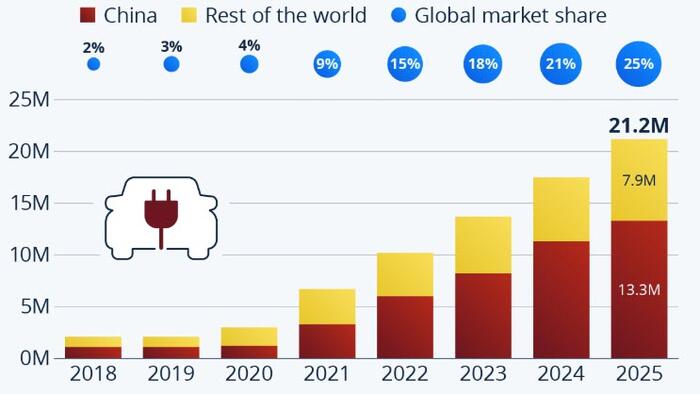
In 2025, one in four new cars sold globally was electric. According to the Global EV Outlook 2026 published by the Paris-based International Energy Agency (IEA) in May, sales exceeded 20 million units, displacing about 1.2 million barrels per day of oil, and are on track to reach 23 million units this year. The numbers are remarkable. But they tell only part of the story. Beneath the growth, the global electric vehicle (EV) market is fracturing. What was once a relatively open, borderless industry is hardening into rival blocs, each with its own technology rules, data laws, artificial intelligence ecosystems and national security logic. Call it the “splinternet of mobility.” The EV is no longer just a product — it is becoming a sovereign asset.Deepening Trade WarWestern policymakers spent years encouraging the shift to EVs while underestimating how fast Chinese manufacturers were moving. According to the IEA, producing an internal combustion engine car in China already costs around 30% less than in Germany— and for EVs, where Chinese battery dominance compounds the advantage, the gap is even greater.The response from Washington and Brussels has been tariffs. But the trade war has since moved beyond import duties. China’s own export controls, announced in October 2025 and effective from November 2025, now cover lithium batteries, cathode materials, artificial graphite anode materials and related production equipment. The goal on both sides is no longer just to protect domestic manufacturers. It is to slow the transfer of knowledge itself.Chinese manufacturers, facing increasingly restrictive tariffs and market-access barriers in key Western markets, are responding by setting up local assembly in Southeast Asia, Latin America and Europe. The problem is that as the physical supply chains pull apart, the software that runs them is being pulled apart, too.What is emerging is not merely a fragmented supply chain but increasingly distinct mobility ecosystems, each with their own software stacks, cloud infrastructure, AI training data, cybersecurity standards and regulatory requirements.Cars Are ComputersThe IEA’s 2026 report dedicates a full chapter to this shift. Battery EVs are described as “currently the most advanced” of a new class of software-defined vehicles, which “rely on more centralized control architectures” and can be continuously updated and improved through AI. This is not a minor technical upgrade. It is a redesign of what a vehicle fundamentally is.In a software-defined vehicle, the hardware is largely fixed at the factory. Everything else — battery management, driver assistance, performance tuning, security patches — is delivered over the air, managed by software and shaped by machine learning models that improve over time. Increasingly, competitive advantage will come not from hardware alone but from AI models trained on vast amounts of real-world driving data. The IEA notes that this shift “reduces wiring complexity and enables a greater share of vehicle functionality to be defined and updated through software, and expanded over time.”This matters because these vehicles are always connected. They collect location data, map roads, record video and send it all to the cloud. To a national security official, a foreign-made EV on city streets is not just a car. It is a data-collection device running on someone else’s software, connected to servers in another country.Building WallsThe anxiety is not one-sided. China’s Automobile Data Security Regulation, which came into force in October 2021, formally classifies any data capturing traffic flows or geographic information near military zones, government offices or national defense facilities as “important data.” Under the regulation, that data must be stored within China and cannot be transferred abroad without a government security assessment.Tesla is the clearest example of what this means in practice. In March 2021, Reuters reported that the Chinese military had banned Tesla vehicles from certain military complexes and housing compounds, citing security concerns over cameras installed on the vehicles and the potential collection of sensitive data. Soon after, Tesla announced on Chinese social media that it had established a dedicated data center in China — confirmed by the South China Morning Post and TechCrunch — to ensure all data generated by vehicles sold in mainland China would be stored domestically.While Chinese law prevents domestic driving data from leaving the country, US export controls limit the advanced AI chips available in China. The data-transfer rules in turn limit Tesla's ability to use Chinese driving data to train its global autonomous driving systems. The same company is being pushed toward separate, market-specific data and software architectures to satisfy two mutually exclusive sets of national rules.The Next FrontierThere is one more dimension that gets less attention: the power grid. Adding 23 million EVs to electricity networks in a single year creates demand spikes that physical infrastructure cannot handle through cables and transformers alone. The IEA’s 2026 report is clear: “vehicle-to-grid (V2G) technology enables EVs to provide grid-stabilization services through bidirectional power flow.” In plain terms, millions of parked EV batteries, managed by AI, can act as a giant distributed power plant — absorbing excess energy and releasing it back to the grid as needed.While this is an elegant solution, it also raises a security question. If a country’s grid stability depends on AI software managing millions of connected vehicles, whoever controls that software has a hand on the grid itself. The IEA is direct on this point, too, noting that “cyber risks extend to EV infrastructure” and that cyberattacks have already been shown to disrupt fast-charging sessions, “with potential implications for vehicles and power grids.” The logical extension — that a coordinated attack on AI-managed charging networks could destabilize regional electricity supply — follows from that, even if it remains a risk to be managed rather than a scenario already proven. Still, automotive cybersecurity is quietly becoming an energy security issue.Required ChangeGoing forward, building a better battery or cutting factory costs is no longer enough. The companies and governments that win the next phase of the EV transition will be those that take software architecture as seriously as manufacturing.Three things need to happen. Automakers need to design software that can be cleanly separated by jurisdiction from day one — not patched for compliance after the fact. Western regulators need a shared framework for software-defined vehicles, something like the EU's General Data Protection Regulation but for AI and data security in cars, established before foreign systems become embedded in critical infrastructure. And grid operators need to treat AI-managed charging networks with the same security scrutiny applied to power stations.The IEA’s 2026 figures confirm that electrification is happening fast. But the market taking shape is not the open, unified one the industry imagined. It is fragmented, contested and increasingly defined by rules that have nothing to do with range or charging speed. The splinternet of mobility has arrived — the question is whether our institutions are ready for it.Oliver Klaus is Energy Intelligence’s AI product development manager. Prior to that, he served as Dubai bureau chief for more than 10 years, leading coverage of the Mideast region. The view expressed in this article are those of the author.
The 'Splinternet' of Mobility
In this opinion piece, Oliver Klaus examines how AI and geopolitics are carving up the global EV market.
1,159 words~5 min read