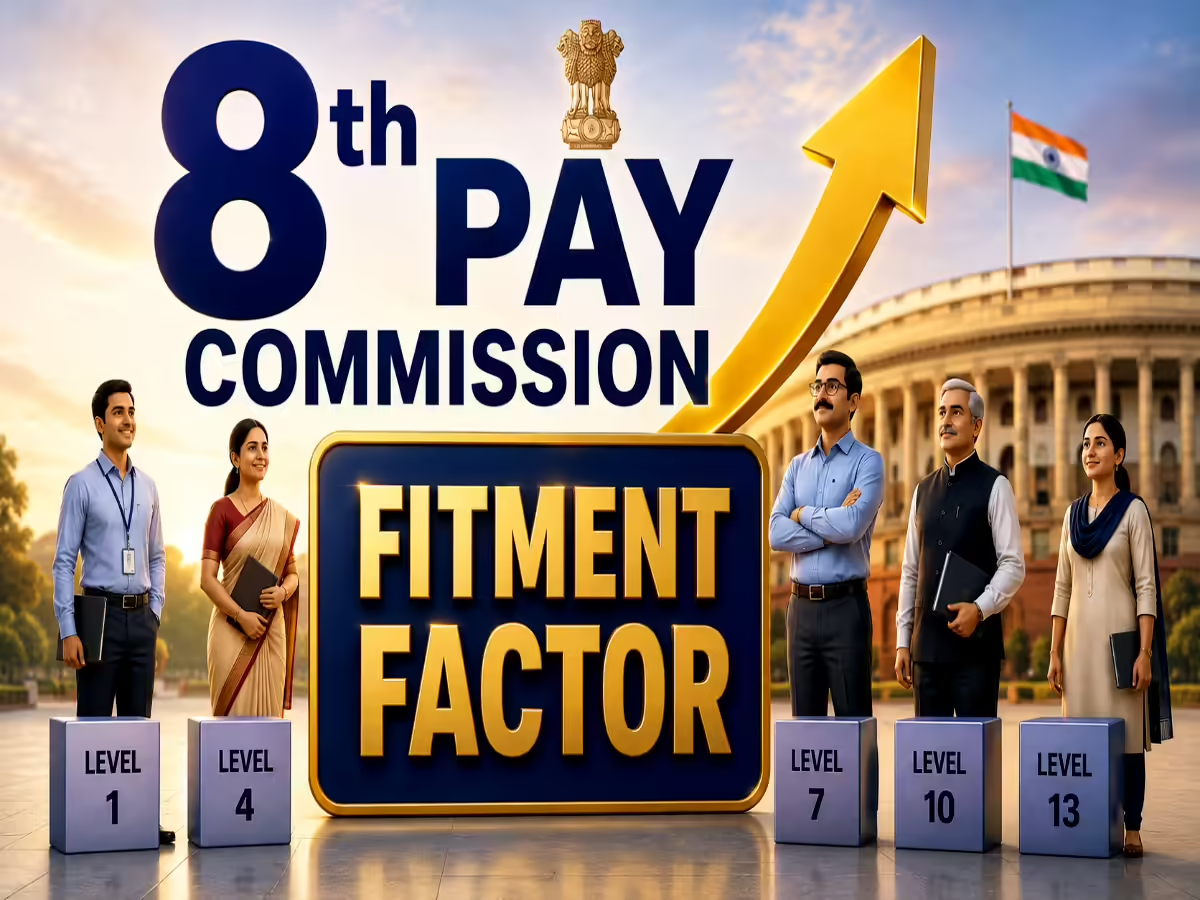
As the 8th Pay Commission’s Lucknow meetings concluded on Tuesday, many central government and pensioners are anticipating fast conclusion of the upcoming engagements, including 8th CPC’s July meetings in Bhubaneswar and Kolkata. Sooner the 8th Pay Commission files its report and the government approve it, sooner these employees and pensioners will get their increased payouts. Their increase will depend on the fitment factor, the multiplier for pay and pension revisions in a new pay commission. There are many speculations about the fitment factor. Some experts believe that it can be more than 2.57, the fitment factor for the 7th Pay Commission, while some believe considering the current economic situation, it can be a maximum of 2.0. The real magnitude of the fitment factor will be known only when the government approves it. But an expert’s calculations show that it can be in the range of 2.05 to 2.10. Manjeet Singh Patel, National President of the All India NPS Employees Federation (AINPS), says that considering dearness allowance (DA), house rent allowance (HRA) and transport allowance (TA) as on December 31, 2026, the fitment factor can go up to 2.1 without adding any growth factor. In his second scenario calculation, Patel shows that if the government agrees to the employee and pensioner bodies’ recommendation of increasing the family unit count for fitment factor calculation from 3 to 4.4, the fitment factor can easily go to 2.05 without adding any growth factor. A growth factor is a component that a pay commission may provide to central government employees to raise their standard of living as per the parameters defined by the United Nations’ Human Development Index. Scenario 1: How 8th Pay Commission’s fitment factor may be 2.10 Patel presents two scenarios of a 2.1 fitment factor in his calculations. In his first scenario, he takes the example of a Level 1 employee residing in a X category city- Basic pay as on December 31, 2025 (the last day of 7th Pay Commission)= Rs 18,000 Dearness allowance (DA) 58% (as on Dec 31, 2025)= Rs 10,800 House rent allowance (HRA) 30% (X category city)= Rs 5,400 Travel allowance (TPTA) Rs 1,800+58% of 1,800 (because of 58% DA)= Rs 1,800+Rs 1,080= Rs 2,880 Gross pay= Rs 37,080 Fitment factor= Rs 37,080/18,000= 2.06 If the government considers the nearest single point after decimal, a 2.06 fitment factor can be 2.10. Based on the 2.1 fitment factor, a Level 1 employee’s gross salary as of January 1, 2026 (also showing a 2% DA hike in the same month) Basic salary= Rs 18,000×2.1= Rs 37,800 DA (2% of Rs 37,800)= Rs 756 HRA (36%, assuming the new HRA rate for an X category city will be increased to 36%)= Rs 13,608 TPTA Rs 9,000 (assuming it will be the new rate for a X category city in the 8th CPC)+(2% of Rs 37,800)= Rs 9,180 Gross salary= Rs 61,344 Overall hike in salary= 65% Scenario 2: How 8th Pay Commission fitment factor can be 2.10 Patel’s second fitment factor calculation is based on the number of family units. In the 7th Pay Commission, the family unit count was 3 (employee 1.0, spouse 0.8, first child 0.6, second child 0.6). Patel says if the government also takes parents as 1.2 units (0.6+0.6) in the 8th Pay Commission, the family unit count will increase to 4.2 (3.0+1.2). A 4.2 family unit means, a 46.66% increase from 3.0 family units. If 46.66% is added to 158% (100% basic salary+58% DA as on December 31, 2025), it will be 205% or a 2.05 fitment factor. If the government considers the nearest single point after decimal, a 2.05 fitment factor can be 2.10. Note: These are illustrative calculations based on the fitment factor 2.1 model attributed to AINPSEF president Manjeet Singh Patel. The actual recommendations of the 8th Pay Commission have not been finalised.
8th Pay Commission fitment factor: Expert explains how fitment factor may reach 2.10; check salary hike calculation - The Economic Times
Central government employees and pensioners are eagerly awaiting the 8th Pay Commission's report, with discussions around the crucial fitment factor intensifying. While some experts predict a factor around 2.0, others, like AINPS President Manjeet Singh Patel, suggest it could reach 2.10. Patel's calculations, considering DA, HRA, TA, and family unit counts, illustrate potential scenarios for increased payouts, sparking anticipation for the final government decision.
641 words~3 min read