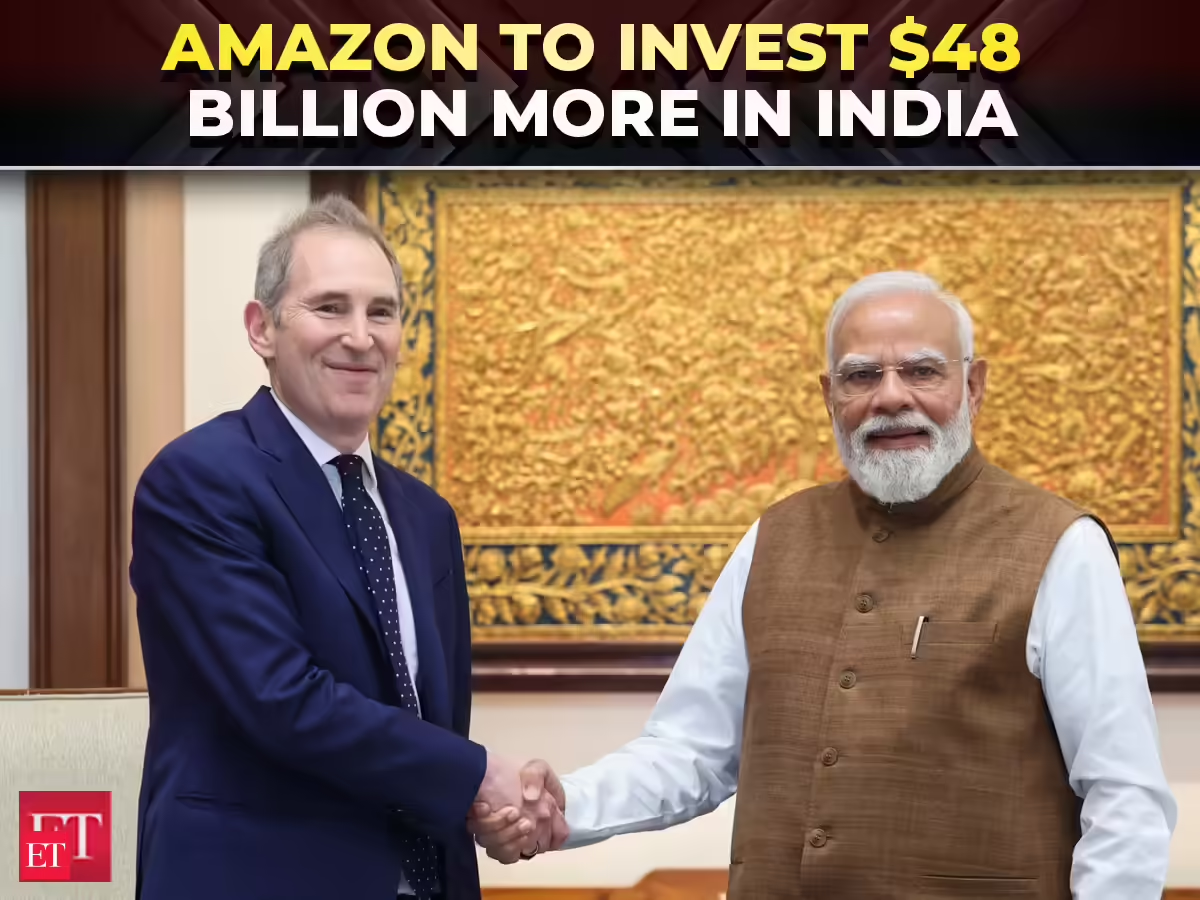
Amazon CEO Andy Jassy’s meeting with Prime Minister Narendra Modi in New Delhi is significant because it joins two expensive, very different bets: data centres for India’s expanding AI workloads, and a rapid-delivery retail network built to compete for the next grocery order. Amazon has announced an additional US$13 billion investment in AI and cloud infrastructure by 2030, taking its planned India investment from 2026 to 2030 to more than US$48 billion. Of that, more than US$21 billion is earmarked for AI and cloud infrastructure across AWS regions in Mumbai and Hyderabad.The investment is Amazon’s clearest statement yet that India is no longer simply a large e-commerce market in its global portfolio. It is becoming a place where Amazon wants to sell computing power to enterprises and governments, move more Indian goods into global markets, deepen Prime usage, and make its app relevant when customers need detergent, vegetables, skincare or a phone cable within minutes.That ambition is large. The execution challenge is larger.Key TakeawaysAmazon has added US$13 billion for AI and cloud infrastructure in India by 2030, on top of its earlier commitment of more than US$35 billion across its India businesses. The company now says it plans to invest more than US$48 billion in India between 2026 and 2030. Amazon says the new money will expand AWS data-centre capacity in Mumbai and Hyderabad, taking its planned AI and cloud infrastructure investment in India to more than US$21 billion between 2026 and 2030. Amazon Now is set to expand to more than 300 cities, with Amazon claiming that orders have doubled every quarter since launch. The service remains much smaller than Blinkit and Swiggy Instamart on independently reported local-network and order-volume estimates. Amazon will add more than 20 fulfilment centres and over 100 last-mile delivery stations this year, seeking faster service in tier 3 and tier 4 cities as well as established urban markets. Its new Sammaan programme promises scholarships, insurance, access to public-benefit and financial-inclusion schemes, road-safety measures and 250 Ashray rest centres. The move comes as India’s quick-commerce companies face pressure over delivery-speed marketing and rider safety. The investment headline needs some arithmeticThe US $13 billion announcement should not be read as Amazon’s entire India plan. Nor is it a replacement for the US$35 billion India commitment the company announced in December 2025.Amazon says the new US$ 13 billion is additional investment for AI and cloud infrastructure. Added to the earlier US $35 billion plan, it brings its planned India investment from 2026 to 2030 to more than US $48 billion. Within that number, Amazon says more than US $21 billion is directed towards AI and cloud infrastructure. The company also says its cumulative investments in India, counting the period from 2010 through 2030, will exceed US $88 billion.Amazon figureWhat it coversWhy it mattersUS$13 billionNewly announced AI and cloud infrastructure investment through 2030Expands AWS capacity in Mumbai and HyderabadMore than US$21 billionPlanned AI and cloud infrastructure investment from 2026 to 2030Shows AWS is a central part of Amazon’s India spendingMore than US$35 billionEarlier, India's investment commitment was announced in December 2025Covers broader business expansion, AI-led digitisation, exports and jobsMore than US$48 billionTotal planned investment in India from 2026 to 2030Combines the December 2025 commitment with the new US$13 billionMore than US$88 billionCumulative investment from 2010 to 2030Amazon’s stated long-term aggregate figureThe distinction is more than an accounting exercise. It tells us what Amazon wants from India.Its cloud business needs long-duration capital spending. Servers, chips, power systems, land, network links and physical facilities are paid for well before the company knows how much revenue each new unit of capacity will generate. Quick commerce works at almost the opposite tempo. It is a daily contest of local stock availability, delivery density, customer habits, and basket economics.Amazon is committing to both at once.That is the tension behind Jassy’s visit. The company is trying to build infrastructure that will matter over a decade while competing in a retail category where customers can switch apps within minutes.Jassy’s quote sets out Amazon’s political and commercial caseJassy’s statement after meeting Modi was not a narrow AWS announcement. He linked Amazon’s expansion to the government’s objectives around AI access, small-business digitisation, job creation, exports and the language of Viksit Bharat and Atmanirbhar Bharat.“We came to India over a decade ago and have since been serving customers, sellers, developers, start-ups and enterprises through our different businesses. The response has been tremendous, with strong growth especially across our ecommerce, AI, and cloud businesses. As we grow Amazon in India, our business priorities continue to align with India’s priorities of democratizing access to AI, digitising small businesses, creating jobs, and enabling exports. We are investing over $48 billion in the coming five years to meet the strong demand across our business in India and to help the country achieve these priorities. We are inspired by Prime Minister Modi’s vision of a Viksit and Atmanirbhar Bharat, and we are committed to being a long-term partner in India’s growth story.”The phrase “across our business” matters. Amazon is not presenting AWS, Amazon. in, Prime, Amazon Now, seller services, exports and logistics as isolated operations. It is making the argument that they reinforce one another.AWS can sell cloud capacity to Indian enterprises, start-ups and public bodies. Amazon. in can bring more sellers online. Global Selling can push Indian goods into overseas markets. Prime can make Amazon a repeat destination for shopping and entertainment. Amazon Now can turn that relationship from a planned purchase into a daily retail habit.It is a coherent commercial argument. It is not a guarantee that every layer will succeed.Amazon’s plans and targets should still be treated as company commitments, not achieved outcomes. The company says it has digitised 12 million small businesses, enabled more than US$20 billion in cumulative e-commerce exports, supported 2.8 million jobs and trained more than 10 million Indians in cloud skills. It has pledged to support 3.8 million jobs, enable US$80 billion in cumulative e-commerce exports, bring AI benefits to 15 million small businesses and provide AI education to four million government-school students by 2030.Those figures give a sense of scale, but their value will depend on the underlying detail. “Supporting jobs”, for example, is broader than direct employment. “AI benefits” could cover anything from a seller using automated listing tools to a business deploying a production AI system. The useful test is whether Amazon later publishes enough evidence to show how these benefits are counted and whether they are sustained.Why the AWS expansion matters beyond data-centre headlinesData centres are easy to describe badly. They are often treated as distant, industrial buildings whose importance starts and ends with a large investment number.That misses the real issue.For companies building AI products, local cloud capacity can affect latency, reliability, data handling, access to computing resources and the cost of scaling. A start-up building an AI customer-support tool, a bank running risk models, a hospital network analysing records or a government platform serving millions of users all need computing infrastructure that can handle demand without forcing them to build their own physical systems.Amazon says the new investment will expand AWS capacity in Mumbai and Hyderabad, providing access to custom AI chips, managed AI services, developer tools and secure cloud technologies. The company says customers will be able to store data within India and control where it resides, who accesses it and how it is secured.AWS documentation confirms that Mumbai and Hyderabad are separate Indian AWS Regions, with services such as Amazon Bedrock available in both locations. AWS defines a Region as a physical geographical area containing multiple isolated Availability Zones, designed to improve resilience and limit the impact of failures at a single facility.That technical structure matters in practical terms. A bank does not choose a cloud provider merely because its tools appear sophisticated in a presentation. It needs to know where workloads will run, what happens when systems fail, whether data can be kept in required jurisdictions, how costs will be managed and whether internal teams can maintain the systems over time.For Amazon, cloud capacity in India is an attempt to make AWS more useful to organisations that want the performance of large-scale cloud services without sending important workloads outside the country. It also gives AWS a stronger answer to rivals making similar arguments around local capacity, AI tools, skills and sovereignty-ready infrastructure.The timing is not accidental. The global AI spending cycle has turned cloud capacity into a strategic asset. Companies do not only need access to models; they need computing resources to build, test, run and monitor applications at scale. The winners will not necessarily be the companies that make the loudest AI promises. They will be the ones that make AI workloads affordable, available and dependable enough for Indian businesses to use every day.Amazon’s investment is a wager that demand will continue to rise.It is also a wager that Indian customers will choose AWS over other cloud providers often enough to justify the physical expansion.The real question: what will Indian companies run on this capacity?Amazon says hundreds of thousands of Indian enterprises, start-ups and government agencies use AWS to build, train and deploy AI workloads. It names the National Health Authority, Government e-Marketplace, Apollo Tyres, Delhivery, Physics Wallah, Axis Bank and HDFC Bank among customers using AWS services.These examples point to the range Amazon is chasing.A public platform may need scale and security. A logistics company may want prediction systems for routes, demand and delivery timing. An education company may want AI tutoring or content tools. A bank may want fraud detection, risk analysis and internal assistants. A manufacturer may want computer vision, forecasting or automation.Yet cloud investment is valuable only when customers convert it into real workloads that produce revenue, lower costs or improve service. A data centre can be full of equipment without producing the promised economic effect. The gap between cloud availability and useful AI adoption remains wide for many smaller businesses, which may lack clean data, trained staff, budget certainty or a clear commercial case.That is why Amazon’s pledge to bring AI benefits to 15 million small businesses deserves close attention. The target is ambitious. It will require more than giving businesses access to an AI-labelled feature. It will require tools that work in Indian languages, fit existing business practices, solve simple operational problems and offer a return that a small retailer, manufacturer or exporter can understand.Amazon’s own interest is obvious. The more sellers use Amazon tools for listings, advertising, demand planning, inventory, payments, exports and customer communication, the more of their business activity flows through Amazon’s systems.The company calls this digitisation. Its investors would call it deeper platform usage.Both can be true.Amazon Now is the other half of the India planThe cloud announcement received the largest investment figure. The more immediate consumer battle is happening in rapid delivery.Amazon says Amazon Now will expand to more than 300 cities, after becoming available to more than 50 million customers in over 15 metro and non-metro cities. It says orders have doubled every quarter since launch, making Amazon Now the fastest-growing e-commerce business unit in Amazon India’s history. It also says Prime members who start using Amazon Now triple their shopping frequency. These are Amazon’s own measurements.The company wants to build what it calls India’s largest “delivery in minutes” network, offering a mix of groceries, frozen food, personal care, beauty, fashion, small appliances, home products and kitchen goods. The aspiration is clear: Amazon Now should not be a narrow grocery service. It should become a large local retail channel.Amazon’s rapid-delivery push has a logic that goes beyond chasing a fashionable category.Traditional e-commerce is well-suited to planned buying. A customer compares prices, reads reviews, waits for a sale, chooses between brands and accepts delivery the next day or later. Quick commerce serves a different moment. Something has run out. A child needs supplies for school. A guest arrives unexpectedly. A phone charger breaks. The kitchen is missing an ingredient. The buyer is willing to pay for convenience because the need is immediate.The service wins when it is dependable, not merely fast.That changes how inventory must be managed. In a conventional warehouse, Amazon can hold a large catalogue and send items over longer distances. In quick commerce, the relevant product must already be nearby. The company needs the right assortment in the right neighbourhood, at the right hour, with an accurate stock count and a delivery associate available to move the order.Every mistake is visible. If a product is missing, the customer opens another app.Amazon is expanding into a market where others already have scaleAmazon is entering the quick-commerce contest with advantages: a recognised brand, Prime membership, a national logistics network, seller relationships and significant capital. It is still behind the market leaders in local rapid-delivery infrastructure.Reuters, citing Datum Intelligence, reported that Blinkit has more than 2,200 stores in India, Swiggy Instamart has more than 1,100, Flipkart Minutes has around 1,000 and Amazon has about 500. The same data put Blinkit at around three million daily orders, Swiggy Instamart at 1.25 million, Flipkart Minutes at 820,000 and Amazon Now at about 470,000.ServiceReported local fulfilment networkReported daily ordersWhat it means for AmazonBlinkitMore than 2,200 storesAbout 3 millionThe scale leader in the comparisonSwiggy InstamartMore than 1,100 storesAbout 1.25 millionStrong local-delivery presence and food-delivery adjacencyFlipkart MinutesAbout 1,000 storesAbout 820,000A fast-growing rival with a particular focus on smaller citiesAmazon NowAbout 500 facilitiesAbout 470,000A later entrant with wider Amazon logistics behind itNetwork and daily-order estimates are based on Datum Intelligence data reported by Reuters on June 24, 2026. This does not mean Amazon Now is insignificant. It explains why Amazon is spending heavily.In rapid delivery, scale creates a difficult loop for new entrants. More local facilities improve speed and stock availability. Better availability encourages customers to order more often. More orders can make each facility more efficient. That improved density can support a broader range of products and faster delivery times, which attracts more orders.Breaking into that loop is expensive.Amazon’s response is to combine micro-fulfilment centres with larger urban fulfilment centres. The company says its newer, larger-format sites will bring a broader range of products into the minutes-delivery network, including apparel, electronics, jewellery, footwear, luggage and small appliances. It says more than 100 such facilities will bring four times more selection to Amazon Now.The strategy is sensible because it attacks one of quick commerce’s limits: narrow selection.Groceries and household basics create frequent orders, but they can also produce low basket values and thin margins. Higher-value categories can improve the economics if Amazon can place the right products locally without carrying too much slow-moving inventory.That “if” is expensive.A quick-commerce network cannot simply add every Amazon. in product to every locality. It needs to predict what will sell in each neighbourhood. Demand in a business district may look very different from demand in a student-heavy area, a family suburb or a smaller city where local stores remain central to everyday shopping. Amazon’s earlier description of Amazon Now says its inventory systems adjust product placement based on hyperlocal demand.This is where Amazon’s technology heritage could help. Forecasting systems can identify local demand patterns, manage replenishment, reduce stock-outs and decide which product substitutions make sense. They cannot erase the basic cost of rent, inventory, riders and discounts.Quick commerce is still a physical business wearing a software interface.Tier 3 and tier 4 cities are Amazon’s opportunity, and its harder testAmazon says it will add more than 20 fulfilment centres and over 100 last-mile delivery stations this year, with a focus on faster and more reliable delivery across the country, particularly in tier 3 and tier 4 cities.That is an important part of the announcement because Amazon has spent years building a national e-commerce network. It has a stronger base in smaller cities than many rapid-delivery companies that began in large metros. Amazon says 85 per cent of its new customers and more than 65 per cent of its orders come from tier 2 and tier 3 cities. It also says more than 70 per cent of new Prime members come from non-metro cities. Those are company figures, but they explain why Amazon believes it can take Amazon Now beyond the biggest urban markets.The problem is that national e-commerce reach and rapid-delivery economics are different things.Delivering a package to a smaller city next day can be profitable with a centralised warehouse, route planning and enough order volume. Delivering an item within minutes requires stock close to the customer and a steady flow of nearby orders. A city can be large enough for standard e-commerce yet still lack the local demand density required to support multiple fast-delivery hubs.Amazon needs to prove that customers in smaller markets will use rapid delivery often enough to make the network work.Flipkart is making a similar wager. Reuters reported that 70 per cent of Flipkart Minutes’ coverage is in smaller urban markets, where it sees larger average order values than in major metros.That points to a more interesting future for quick commerce. The category may not be limited to affluent metro customers buying imported fruit and last-minute snacks. It could become a broader retail service for essentials, appliances, beauty, electronics and household purchases.But only if the economics survive outside the most densely populated, higher-income neighbourhoods.Amazon’s larger operations network gives it more room to experiment. The company can connect standard fulfilment centres, last-mile stations, Fresh operations, micro-fulfilment centres and urban fulfilment centres. Amazon itself says its grocery infrastructure feeds both Amazon Fresh and Amazon Now, with much of the upstream system shared.That can lower some costs. It does not remove the cost of serving the final kilometre quickly.Sammaan is a labour promise that will need evidenceAmazon’s Sammaan programme is the human side of a strategy built around speed.The company says the programme will provide scholarships for delivery associates’ children, assistance in accessing government benefits and financial-inclusion programmes, insurance coverage, road-safety measures and other welfare support. It will expand Ashray rest centres to 250 locations this year, and says those centres will be open to delivery associates across the industry, not only those working in Amazon’s network. A portion of its previously announced US$300 million operations and associate-wellbeing investment will be directed towards the programme.The announcement deserves credit for making delivery-associate welfare part of the expansion narrative rather than a footnote. It also deserves scrutiny.Quick-commerce companies depend on riders and delivery associates to make their speed claims real. Their work sits at the intersection of traffic risk, unpredictable weather, incentives, order density and customer expectations. The faster the promise, the greater the pressure on the people making it possible.Reuters reported in January that India’s Labour Ministry had urged quick-commerce companies to avoid promoting “10-minute” delivery claims amid safety concerns.Amazon’s latest language talks about delivery “in minutes” rather than centring a single time target. That is a less exposed formulation, particularly when regulators and the public are increasingly alert to whether speed promises encourage dangerous behaviour.The company should eventually publish more details about Sammaan: eligibility conditions, insurance coverage, scholarship scale, benefits actually delivered, safety outcomes and the share of delivery associates who use Ashray facilities. Announcing a welfare programme is easier than proving it materially changes work.There is also a commercial reason to take this seriously. A rapid-delivery service can spend heavily on marketing and infrastructure, but customer trust can be damaged quickly by recurring stories of unsafe delivery conditions, poor worker treatment or erratic incentives. Associate welfare is not separate from the service promise. It is part of whether that promise can be sustained.Amazon’s investment claims need the right labelsAmazon says it is India’s largest foreign investor, largest enabler of e-commerce exports and one of the country’s biggest job creators. Those are the company's claims in its release, supported by its interpretation of investment and impact data.They should be reported as Amazon’s position, not converted into an unqualified fact.The company’s export ambition is easier to see in commercial terms. Amazon says it has enabled more than US$20 billion in cumulative e-commerce exports and now aims for US$80 billion by 2030. That would require a much larger pool of Indian sellers capable of dealing with quality requirements, cross-border logistics, tax compliance, returns, product discovery and competition in international markets.Amazon Global Selling can help with some of that. It also makes Amazon the intermediary between Indian sellers and global buyers.The company’s target to bring AI benefits to 15 million small businesses has similar dual effects. It could help businesses automate tasks and reach customers. It could also deepen their use of Amazon’s seller, advertising, cloud and fulfilment services.That is not a criticism in itself. Companies invest to expand commercial activity. The relevant question is whether smaller businesses gain enough value to stay profitable and independent while using those tools.India has become important to Amazon because it offers a large consumer base, a large developer base, a fast-growing digital economy and a complicated operating environment. The company has to deal with price-sensitive customers, fierce local rivals, public policy pressures, logistics variation and changing expectations around data, labour and AI.The reward is large enough that Amazon is prepared to spend billions to stay in the contest.What to watch after the announcementThe meeting, the photographs and the investment headline will move quickly through the news cycle. The more revealing signs will come later.First, watch AWS capacity and customer usage. Amazon’s US$13 billion commitment will matter only if enterprises, start-ups and public bodies deploy important workloads on its Indian infrastructure. The key signal is not a new data-centre announcement. It is whether customers build useful systems that stay on AWS.Second, watch Amazon Now’s city expansion against actual local density. Reaching 300 cities is a large distribution goal. The harder question is how many of those cities have enough repeat demand to support minutes-delivery economics without permanent subsidy.Third, watch whether Amazon’s broader catalogue improves quick-commerce basket values. Groceries create frequency. Fashion, electronics, beauty and small appliances can improve revenue per order, but only if local inventory is accurate and the service remains dependable.Fourth, watch the labour evidence behind Sammaan. Rest centres, insurance and scholarships are meaningful only when delivery associates can access them easily and when the programme changes day-to-day working conditions.Finally, watch whether Amazon’s India targets turn into measurable outcomes. The company has attached its plans to jobs, exports, small-business digitisation and AI education. Those claims will become more credible when Amazon explains the methodology, publishes progress consistently and allows readers to distinguish a target from an achieved result.Jassy’s announcement is not merely a promise of more investment. It is an admission that Amazon’s future in India will be decided by whether it can operate at two very different speeds.AWS must build patiently, expensively and with enough reliability to become part of India’s AI infrastructure. Amazon Now must move quickly, locally and cheaply enough to become part of everyday buying behaviour.Amazon has committed the money.Now it has to make both clocks run.end of article
Andy Jassy: Why Amazon CEO Andy Jassy Met PM Modi & What $48 billion India AI investment means
Amazon CEO Andy Jassy’s meeting with Prime Minister Narendra Modi in New Delhi is significant because it joins two expensive, very different bets: data centres for India’s expanding AI workloads, and a rapid-delivery retail network built to compete for the next grocery order. Amazon has announced an additional US$13 billion investment in AI and cloud infrastructure by 2030, taking its planned India investment from 2026 to 2030 to more than US$48 billion. Of that, more than US$21 billion is earmarked for AI and cloud infrastructure across AWS regions in Mumbai and Hyderabad.
3,804 words~17 min read