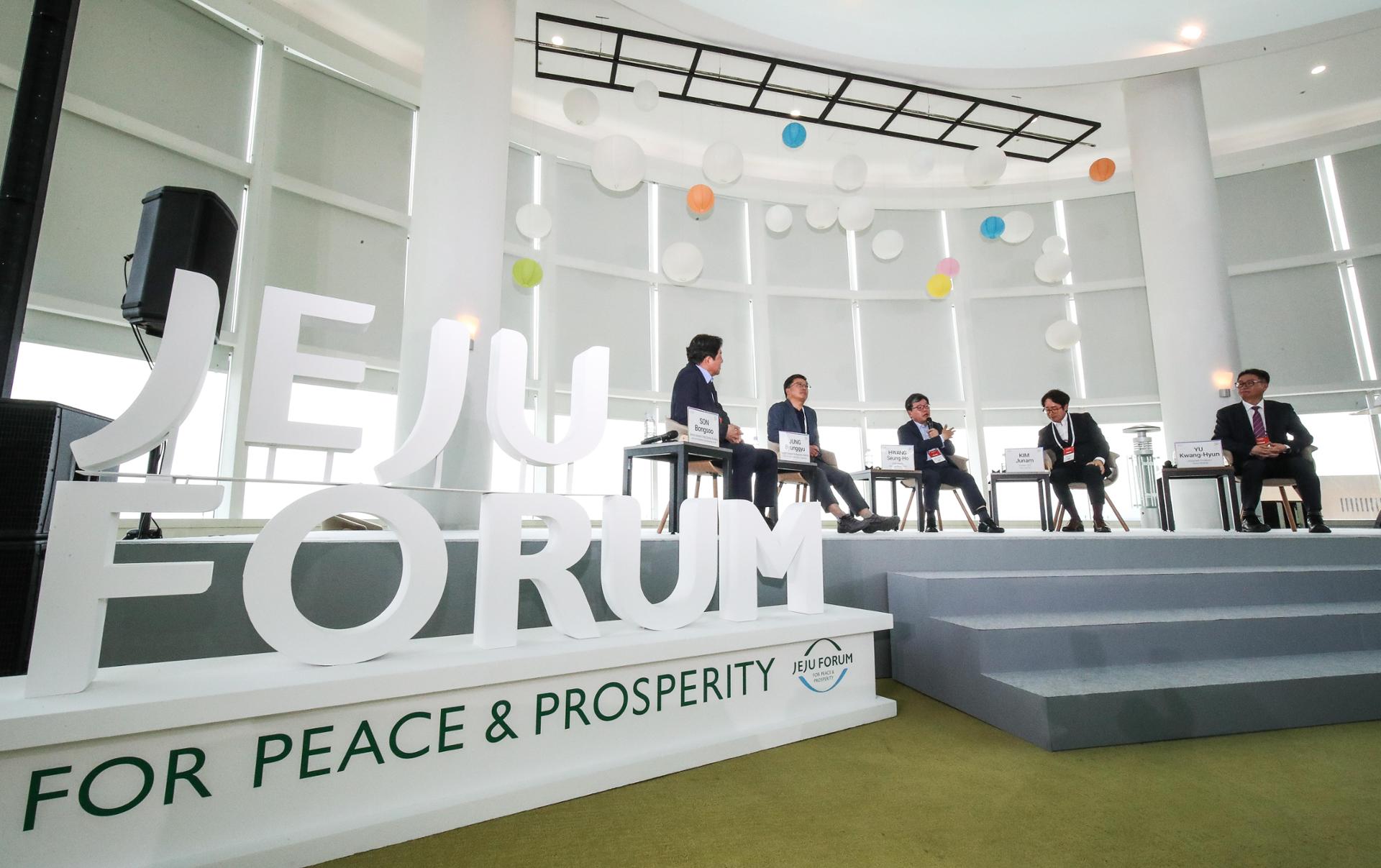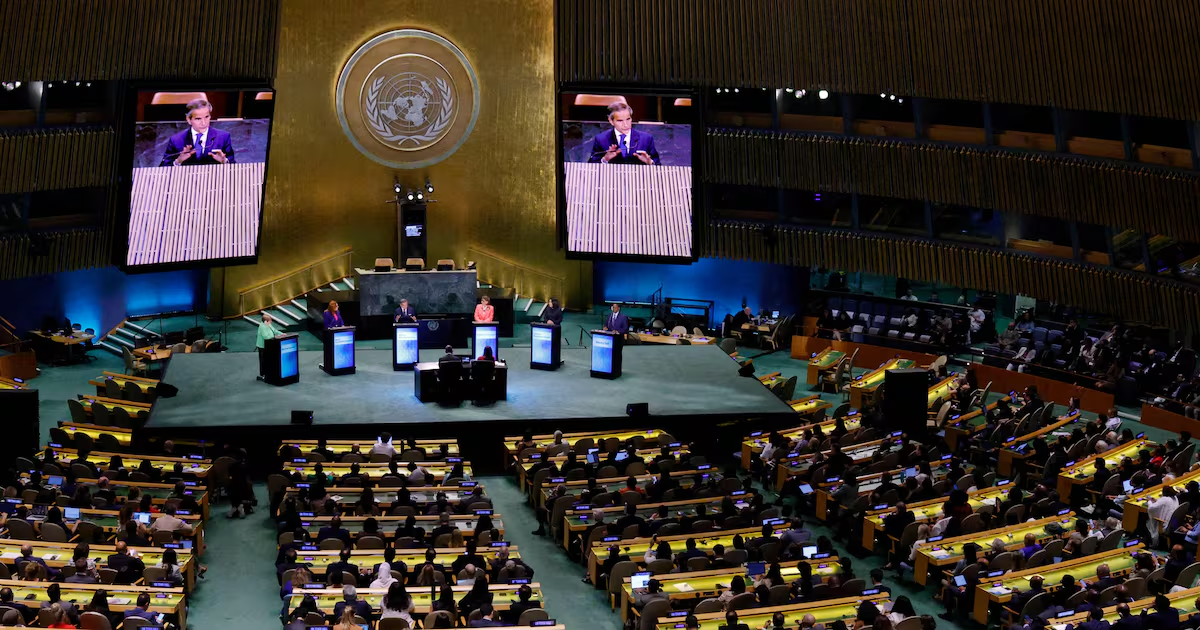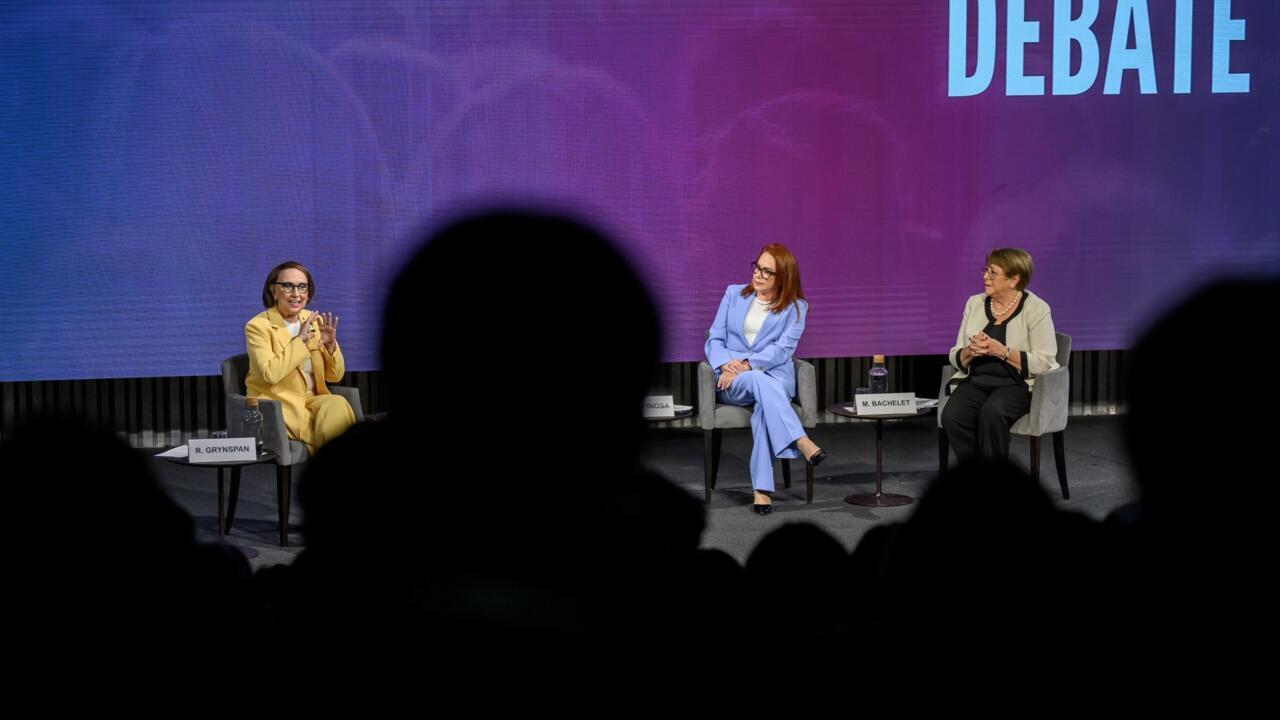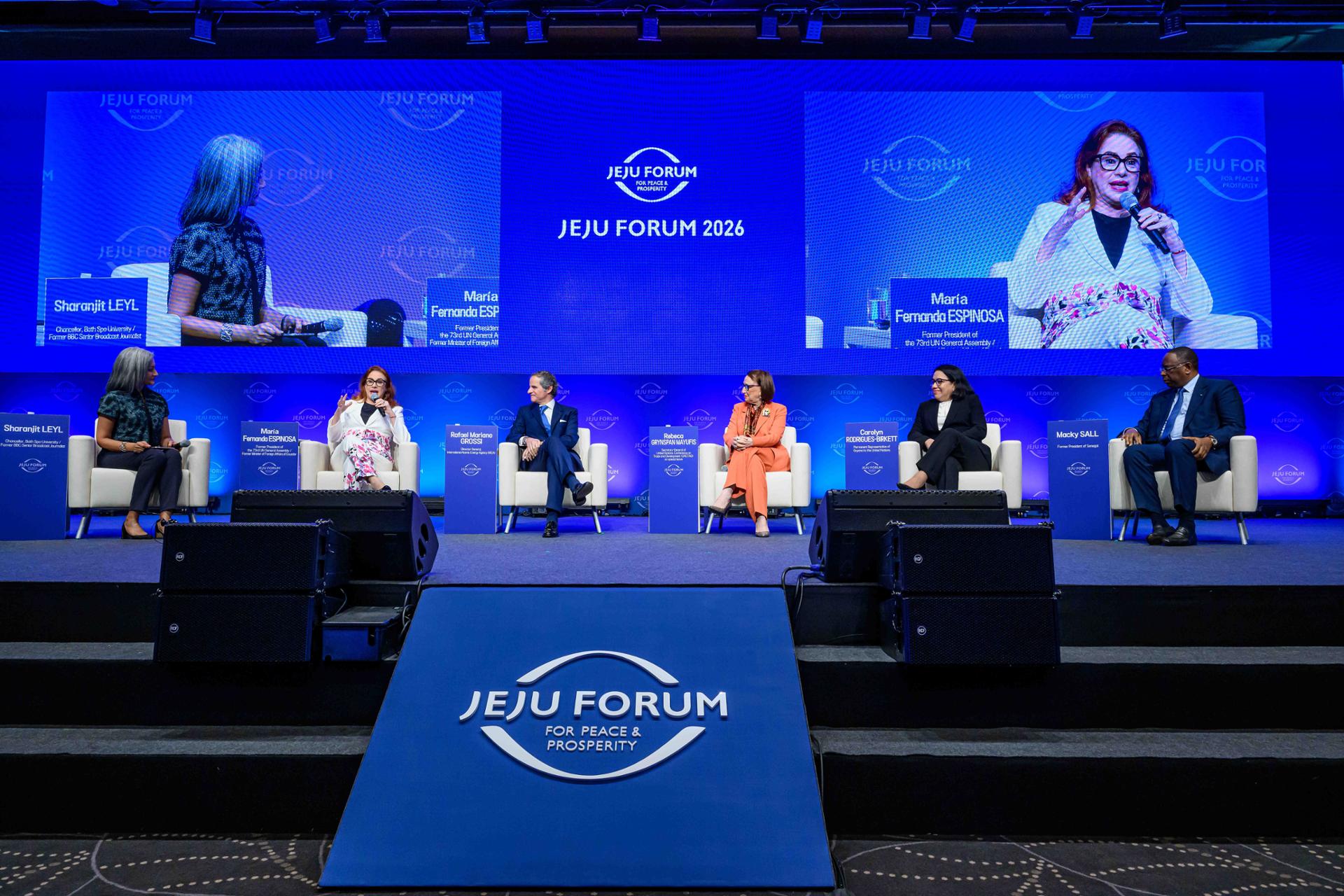
Candidates for the next United Nations secretary-general attend a plenary titled "Reimagining Multilateralism: A Dialogue with U.N. Secretary-General Candidates" during the Jeju Forum for Peace and Prosperity held at Haevichi Hotel & Resort Jeju in Seogwipo, Jeju Island, Thursday. From left, Bath Spa University Chancellor Sharanjit Leyl; María Fernanda Espinosa, former president of the 73rd U.N. General Assembly and former minister of foreign affairs of Ecuador; International Atomic Energy Agency Director General Rafael Grossi; U.N. Conference on Trade and Development Secretary General Rebeca Grynspan Mayufis; Permanent Representative of Guyana to the United Nations Carolyn Rodrigues-Birkett; and former President of Senegal Macky Sall. Korea Times photo by Shim Hyun-chulSEOGWIPO, Jeju Island — Candidates vying to lead the United Nations gathered at the Jeju Forum, Thursday, to call for a renewal of multilateralism at a moment when the international body's influence is waning and global cooperation is fracturing under the weight of conflict.The session, titled "Reimagining Multilateralism: A Dialogue with U.N. Secretary-General Candidates," brought together Maria Fernanda Espinosa, former president of the 73rd U.N. General Assembly and former minister of foreign affairs of Ecuador, as well as International Atomic Energy Agency Director General Rafael Grossi, U.N. Conference on Trade and Development Secretary General Rebeca Grynspan Mayufis, Permanent Representative of Guyana to the United Nations Carolyn Rodrigues-Birkett and former President of Senegal Macky Sall.Michelle Bachelet, former president of Chile and former U.N. high commissioner for human rights, could not attend in person due to a scheduling conflict and instead sent a video message.The session came as the U.N. faces severe funding shortfalls and a growing number of global conflicts, from the war in Ukraine to the crisis in the Middle East, fueling what many describe as a crisis of multilateralism. Whoever is elected will begin a five-year term on Jan. 1, 2027, succeeding António Guterres.The candidates each laid out their vision for the organization. In her video message, Bachelet framed multilateralism as dialogue in action. "Multilateralism is dialogue in practice," she said. I am building consensus, when even what seems impossible is what I've done my entire life. The question is not whether we need multilateralism. The question is what kind. One that prevents crisis they explode. One that amplifies the voices of all the member states of the U.N. One that is anchored in the principles and values of the U.N. Charter." Espinosa said restoring trust — among member states and between the secretary-general and the secretariat — is the essential first step.“We really need to rebuild trust in the organization ... If you are perceived as an impartial owner's broker, impartiality means you can be legitimate to all, serve all in bringing all the parties together,” she said.Foreign Minister Cho Hyun speaks a plenary titled "Reimagining Multilateralism: A Dialogue with U.N. Secretary-General Candidates" during the Jeju Forum for Peace and Prosperity held at Haevichi Hotel & Resort Jeju in Seogwipo, Jeju Island, Thursday. Korea Times photo by Shim Hyun-chulGrossi argued that the U.N. remains the only truly global platform, despite its imperfections. "At the end of the day, the U.N. continues to be the only solely global platform. All (other) groupings, in all their beauty and effectiveness, cannot reflect global preoccupations —they reflect partial visions. That is why we have and we will continue to have the U.N.," the IAEA chief said. Grynspan Mayufis stressed the need for the U.N. to build genuine partnerships with the private sector rather than simply seeking funding from it.“We can fragment our actions but we cannot fragment our progress and that's why we have to get together to be able to solve the problems. When we are alone, we don't solve the problems … The U.N. has to learn how to partner with the private sector, not only in asking for resources but in partnership the capacities and the knowledge,” Grynspan Mayufis said.Rodrigues-Birkett called for evidence-based reform of U.N. institutions.“What is important to do is to make sure that member states have all the information that they need to make evidence-based decisions. So whether they decide to merge U.N. agencies or to merge functions, for example, that it must be guided by evidence-based information,” the Guyanese said.Sall drew on his experience as a former head of state and his work at the G20 to argue that rebuilding trust is achievable.“I'm not running for a career. I am running for impact as a former head of state. Previously in my country … working individually with all the leaders of the G20 and getting the position of Africa as the prominent member of G20 shows me it is possible to rebuild trust with the U.N.,” the former Senegalese president said, adding that there still are a lot of conflicts in Africa and he could work for rebuilding trust among them as well as with other parts of the world.Former U.N. Secretary-General Ban Ki-moon, who also spoke at the session, acknowledged that the role is often used as a "scapegoat" but said whoever takes the post next faces a consequential opportunity. “The next secretary-general of the United Nations will have the rare privilege of rebuilding shattered trust in multilateralism and demonstrating convincingly and concretely that the U.N. can still make a real tangible difference in the lives of ordinary people everywhere in this world,” Ban said.
UN chief candidates call for stronger multilateralism as global institutions weaken - The Korea Times
SEOGWIPO, Jeju Island — Candidates vying to lead the United Nations gathered at the Jeju Forum, Thursday, to call for a renewal of multilateralism...
878 words~4 min read