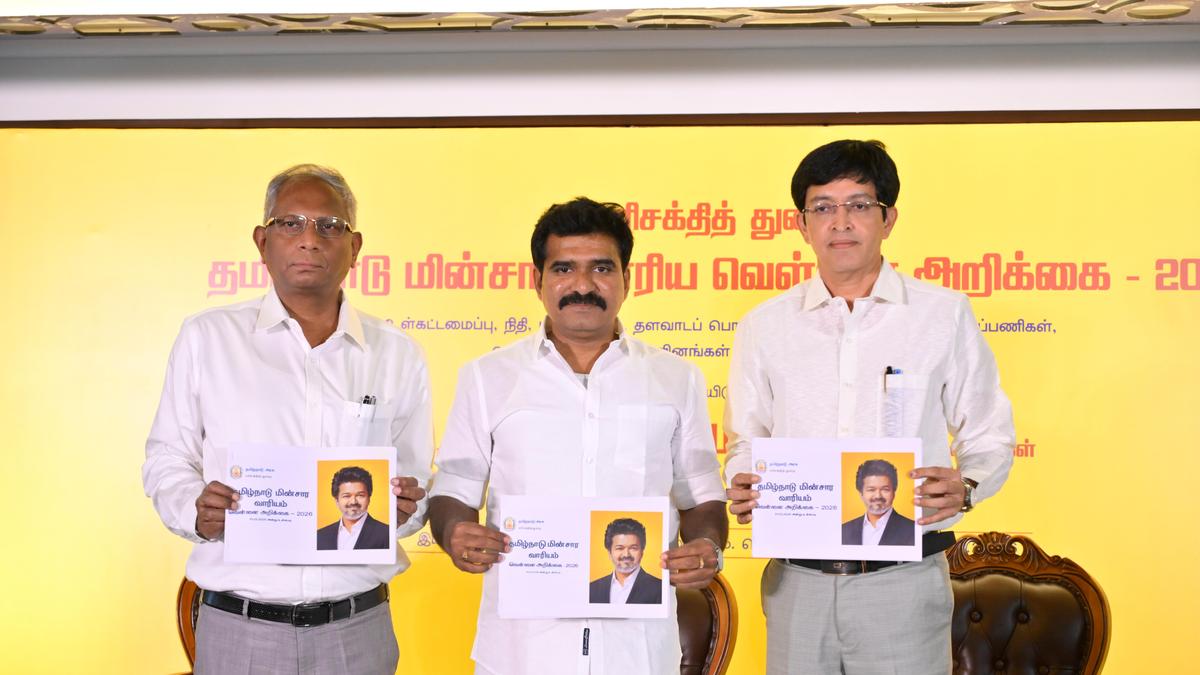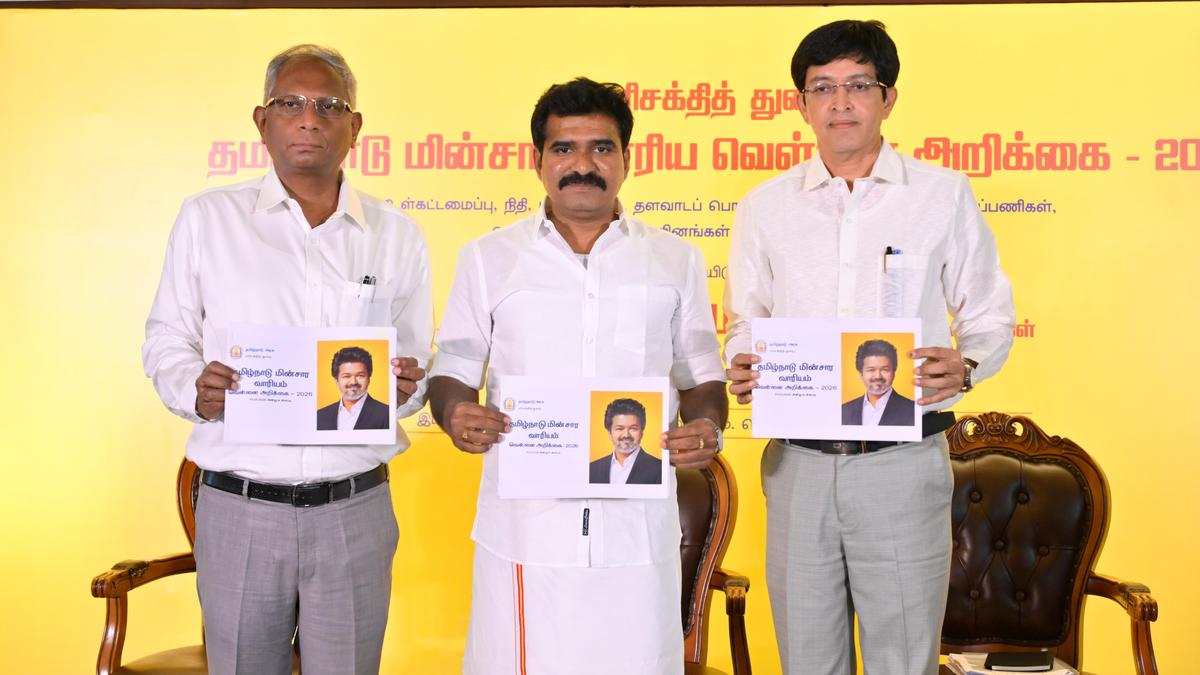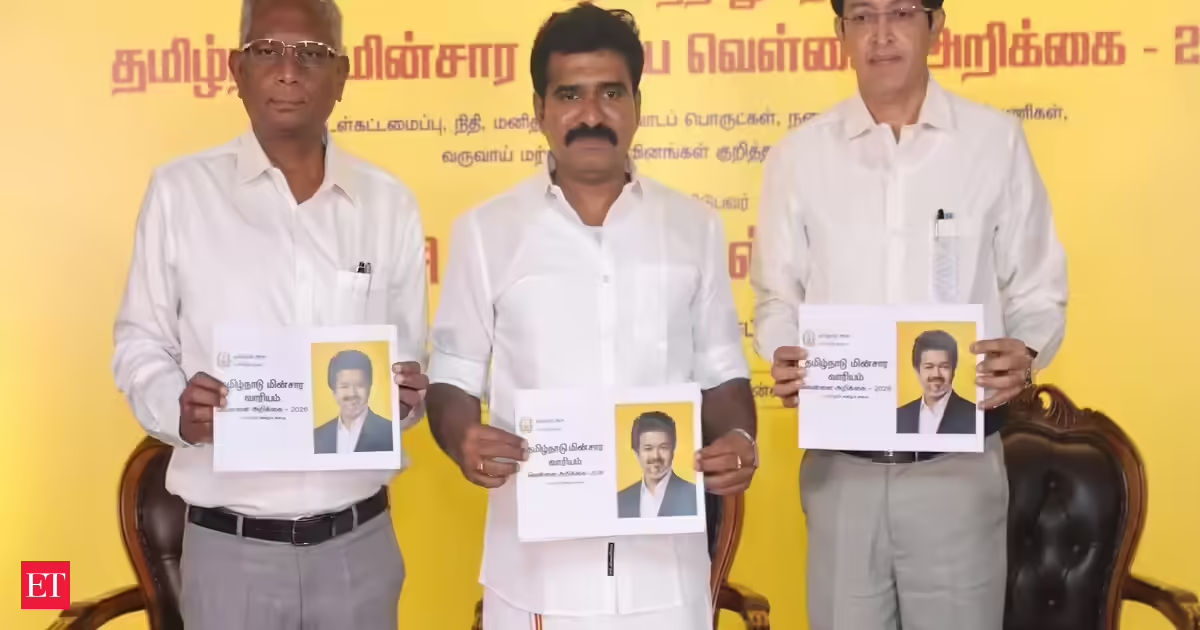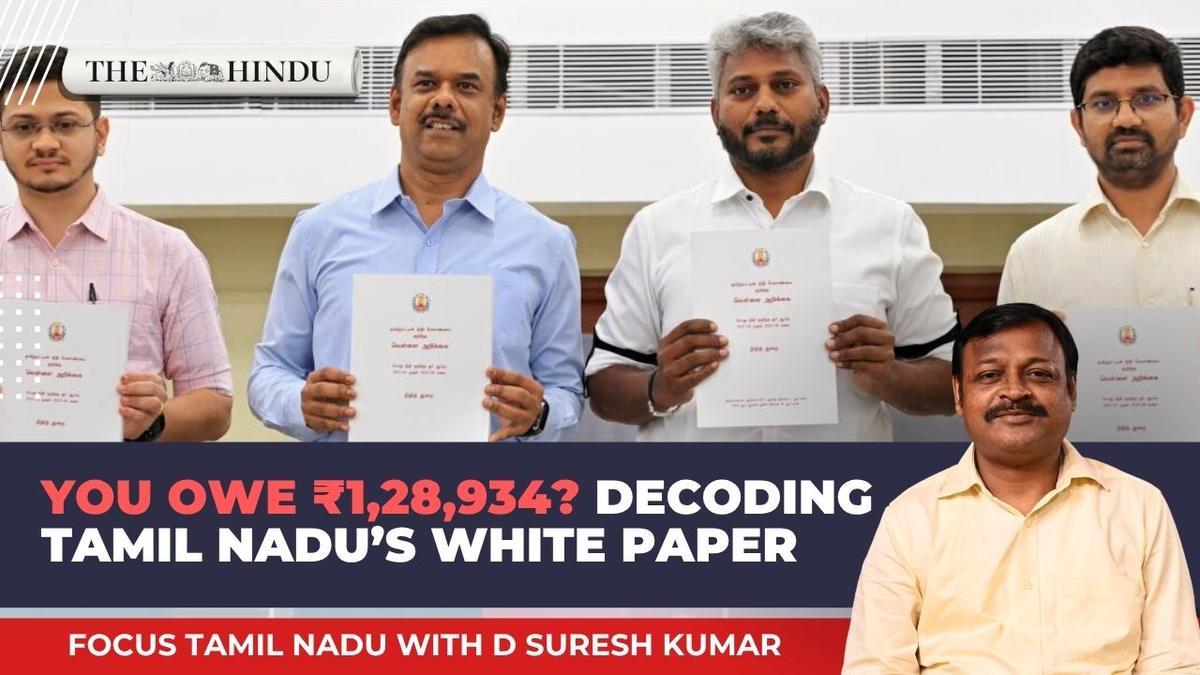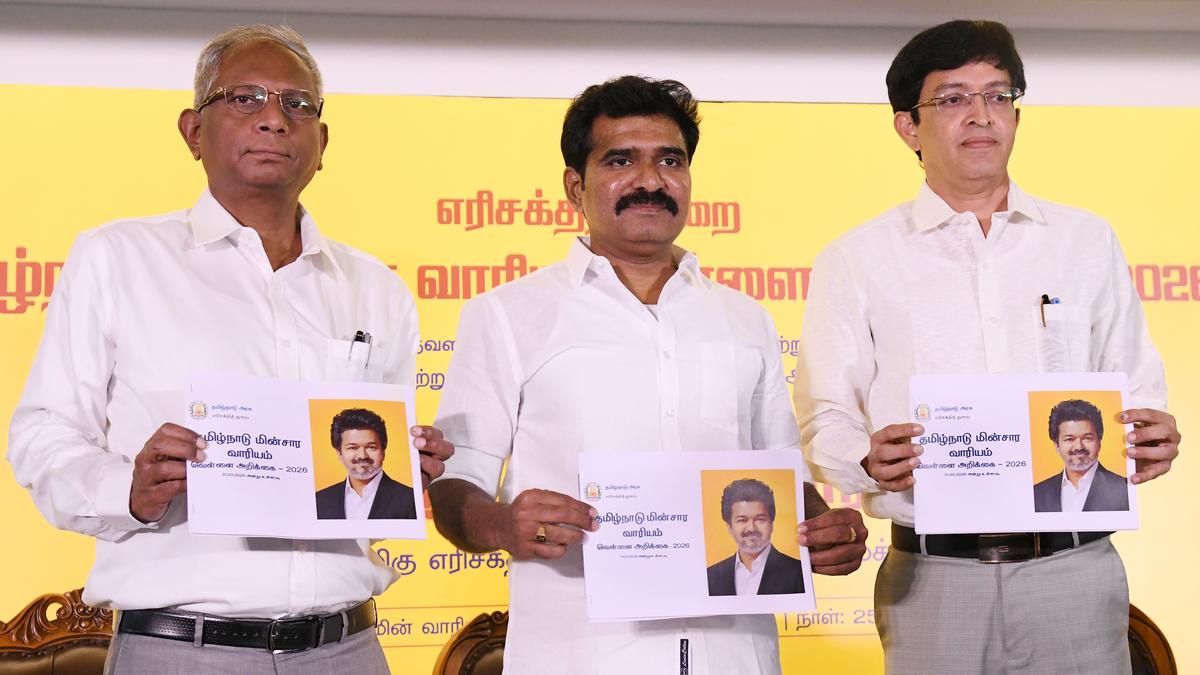
(L-R) Anil Meshram, Principal Secretary to government, Energy Department; Tamil Nadu Minister for Electricity, Energy Resources and Law CTR Nirmal Kumar and J Radhakrishnan, Additional Chief Secretary, Energy Department.
| Photo Credit:
Supplied
The Tamil Nadu Energy Department on Thursday released a White Paper on the State’s power sector, highlighting a debt burden of ₹2.47 lakh crore, severe manpower shortages and ageing infrastructure. The report outlined plans to spend nearly ₹49,500 crore on recruitment, infrastructure upgrades and generation projects to strengthen the electricity network and ensure uninterrupted power supply.The White Paper, which examines the performance of the four companies under the Tamil Nadu Electricity Board (TNEB), said that outstanding debt stood at ₹2.47 lakh crore as on March 31, 2026. Borrowings during 2021-26 rose to ₹87,399 crore from ₹67,652 crore in the previous five-year period.Releasing the report, Tamil Nadu Minister for Electricity, Energy Resources and Law CTR Nirmal Kumar alleged that the power utility had suffered from “complete mismanagement” over the past 25 years.“While revenue kept increasing through multiple tariff revisions, expenditure also increased in parallel without a corresponding increase in infrastructure or manpower,” he said, adding that there would be no tariff revision this year.According to the White Paper, the consolidated revenue-expenditure gap of the TNEB group narrowed sharply to ₹933 crore in 2025-26 (revised estimate), largely due to the tariff revision implemented from July 1, 2025. The deficit stood at ₹14,542 crore in 2020-21 and ₹12,669 crore in 2010-11. Revenue receipts increased to ₹1.23 lakh crore in 2025-26, while expenditure stood at ₹1.24 lakh crore.The report noted that Tamil Nadu’s peak power demand touched 21,307 MW, while the State’s total installed and tied-up generation capacity stood at 47,238 MW.However, the Minister pointed out that the State’s own generation capacity remains limited. TNEB-owned generation capacity stands at 3,495 MW, while intra-State generation connected to the TANTRANSCO network accounts for 4,246 MW and inter-State tied-up capacity totals 13,566 MW.“We are unable to produce sufficient power on our own and rely heavily on private and external sources,” he said.The White Paper also highlighted the cost advantage of long-term power procurement. While 3,028 MW is currently procured through short-term open access (STOA) at an average cost of ₹6.76 per unit, power sourced through long-term open access (LTOA) and medium-term open access (MTOA) costs ₹5.22 and ₹5.42 per unit respectively.The State plans to increase procurement through LTOA and MTOA arrangements, which could result in savings of around ₹215 crore per month during peak summer periods, the Minister said.Tamil Nadu’s consumer base has grown from 1.43 crore consumers in 2001 to 3.52 crore in 2026, while peak demand increased from 6,687 MW to 20,321 MW during the same period.One of the key concerns flagged in the report is the shortage of personnel. Against a sanctioned strength of 1.41 lakh posts across the power utilities, only 74,714 positions are filled, leaving 65,921 vacancies. Another 16,782 employees are expected to retire over the next five years.recruitment plansTo address the manpower gap, the government has proposed recruitment of 20,449 personnel, including 12,500 Multi-Purpose Field Assistants and 5,391 Gangmen.new infrastructureThe White Paper also identified ageing infrastructure as a major challenge. A total of 682 substations that are more than 25 years old require repair and modernisation at an estimated cost of ₹8,318 crore.The government has proposed establishing 469 new substations between 2026 and 2031, in addition to 121 substations already under implementation. For 2026-27, the Energy Department has projected revenue of ₹1.43 lakh crore, expenditure of ₹1.42 lakh crore and net borrowings of ₹11,893 crore.The State’s future strategy will focus on expediting long-pending generation projects, expanding energy storage facilities, reducing dependence on costly spot power markets and creating new revenue streams, including EV charging infrastructure, the Minister said.Published on June 25, 2026