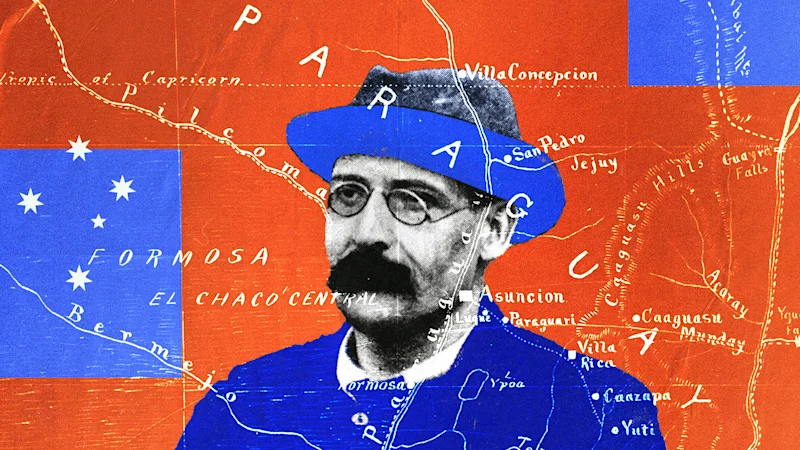
If you learn one thing before the Socceroos play on Friday, make it this: Paraguay is not the place to build a radical socialist commune. If it were, Tony Popovic’s squad might be facing some suspiciously Australian-sounding names in their third World Cup group game.Sometimes, though, things don’t work out the way they were planned. Like a 2-0 loss to the United States. Or a 70-day voyage to what was meant to be a South American utopia, but turned out to be harsh jungle, disease and stringent rules on booze and sex, which in hindsight probably did not suit a bunch of disgruntled Australian sheep shearers.New Australia leader and socialist propagandist William Lane attempted to create his own version of a perfect society in Paraguay.Artwork: Aresna VillanuevaThe latter of these mishaps is quite possibly the lesser known of the two, and yet the bizarre story of the 1893 New Australia settlement – featuring the controversial journalist and socialist propagandist William Lane and his contemporary, the activist, radical poet and literary icon Dame Mary Gilmore, who also appears on Australia’s $10 note – provides an unlikely rich historical thread linking two nations with their football campaigns on the line.Perhaps even stranger still is that, 133 years later, a couple of thousand descendants of these colonists live in Paraguay today, distinguishable mainly for their fish-out-of-water Anglo surnames. We do not know if they will watch from afar as the Socceroos and Paraguay embark on their first competitive meeting (five friendlies have been played) at Levi’s Stadium. We know only how they came to be there – and why there aren’t many more.Lane has a lot to answer for in this tale. The England-born reporter migrated to Brisbane with his family in 1885. His coming to Australia is not an unusual narrative in the context of this country’s immigration history; that he left within a decade searching for something better is. He was a prominent figure in the Australian labour movement, a one-time de facto editor of the Sydney Morning Herald and author of rabidly racist rants through his books and pieces in self-founded newspapers Boomerang and the Queensland labour movement’s Worker.A few factors culminated in Lane’s version of a communist paradise: he already possessed a dictatorial streak, he had no tolerance for alcohol (his father was an alcoholic), and he had mesmerising oration skills.The tipping point was the disastrous wave of strikes that started with the shearers in 1891 and went on to paralyse shipping, coal and other major industries, galvanising Lane to enact his imagined version of a perfect society: one in which white, English-speaking men could live on the land with their wives and children in equality, sobriety and social harmony. All land and industry would be owned in common, and the proceeds divided equally.A map of Paraguay, drawn by John Lane, the brother of William Lane. New Australia and Cosme were south-east of Asunción, the capital of Paraguay, while Nueva Londres was just north-west of Coronel Oviedo and Cosme was near Villarrica.WikipediaArticles, books and documentaries have traced what happened next. Gavin Souter’s 1968 text, A peculiar people: the Australians in Paraguay, offers detailed insight into how it came to be – and how it all fell apart.Gilmore, who was Lane’s main assistant in organising the movement, tried unsuccessfully to get a grant of land for their colony in Australia.“We asked all the state governments, but the only land offered was in the ‘Wilcannia desert’ district in the far west of New South Wales,” Gilmore wrote in the Herald in 1953. “I advised Lane to accept, but he decided that the conditions of the grant were unacceptable, and that South America offered the best prospects.”So Lane sought to set up his communist nirvana further afield. Paraguay’s population – particularly men – had been obliterated by the War of the Triple Alliance (1864-70), and its government was seeking foreign settlers in a bid to rebuild.Lane took up the offer of 450,000 acres of free, fertile land and set about rounding up members for his New Australia Movement. As per Souter’s book, membership was granted based on “mateship”. In this context, that meant excluding “any not knowing English”, “any person of colour, including any married to persons of colour”, “any of questionable reputation”, “suffering from any contagious disease” or “objectionable by reason to past disloyalty to the Labour movement”.Each male member was to contribute all the capital they possessed, at a minimum of £60. Women did not have to pay and, being a supporter of women’s suffrage and all, Lane appealed to single women by stating that neither men nor women would be compelled to marry. It came with the caveat that: “Every single girl who joins us can die an old maid, if it pleases her to be so erratic … but as our bachelors will be as fine a body of men as ever came together in any part of the world … the single girls who go will be less than human if one or other do not win their hearts and make them loving wives and happy mothers.”One of the strangest chapters in Australian history ended in Paraguay on July 18, 1986, with the death of 91-year-old William Wood. Wood was the last original link with Cosme, the Australian utopian colony established in Paraguay by the socialist journalist William Lane during the 1890s.
In 1893, Australians started a ‘socialist utopia’ in Paraguay. Now the nations meet at the World Cup
The bizarre story of the 1893 New Australia settlement provides an unlikely rich historical thread linking two nations with their World Cup campaigns on the line.
1,576 words~7 min read