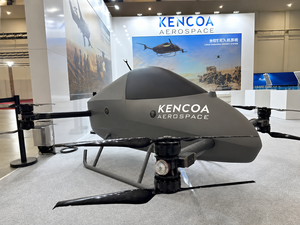
Inside Kencoa Aerospace, skilled technicians and collaborative robots work side by side to produce aircraft and space components for global manufacturers A UAM prototype sits inside a Kencoa Aerospace factory building in Sacheon, South Gyeongsang Province, on Tuesday. (Kencoa Aerospace) SACHEON, South Gyeongsang Province — Inside Plant 1 at South Korean aerospace manufacturer Kencoa Aerospace, large metal jigs hold aircraft parts in place before they are drilled, riveted and assembled into structures destined for global aerospace supply chains.The factory floor is filled not with finished aircraft but with the painstaking work that comes long before one takes flight.During a media tour on Tuesday, Kencoa showcased structures related to Embraer's C-390 military transport aircraft, selected by the South Korean Air Force under the Large Transport Aircraft II program. The company said it produces large internal structural components under an offset agreement tied to Korea's acquisition of the aircraft."These are assembly jigs," a Kencoa official said. "Parts are placed on them, drilled and riveted before they are assembled into structures."Visitors were cautioned not to touch the components because even a slight movement could affect the precision of the work. In aerospace manufacturing, accuracy is not simply about ensuring that parts fit together. The structures must meet strict safety standards and withstand decades of operation.Meticulous manufacturing lies at the heart of Kencoa's business, which spans aircraft structures, precision machining, composite assembly, defense aircraft maintenance, repair and overhaul, urban air mobility, and space components.One section of the facility houses a flyable urban air mobility model developed largely in-house. Kencoa said it handled the design, parts production, assembly jigs and wiring. Although the aircraft is not certified for passenger transport, it serves as a prototype for flight testing and manufacturing verification.Unlike semiconductor fabs, aircraft manufacturing is highly dependent on skilled labor."Aircraft assembly is very difficult to automate," a Kencoa official said when asked whether much of the work is still done by hand. "It is a business where skilled technicians build things piece by piece."That labor-intensive process is balanced by long production cycles."Once a contract is signed, it often continues for 20 to 30 years," he said.The company also demonstrated its production line for Boeing 737-related structures, where it builds, assembles and paints components used in the aircraft's horizontal stabilizer before shipment. A collaborative robot drilling system operates inside Kencoa Aerospace’s commercial business plant in Sacheon, South Gyeongsang Province, on Tuesday. (Kencoa Aerospace) Automation, however, is gradually entering the factory.A collaborative robot drilling system developed with Korea Aerospace Industries' robotics team now performs part of one of the most repetitive tasks in aircraft assembly. Equipped with a vision system capable of locating drilling points within 0.01 millimeter, it performs about 3,000 of the roughly 12,000 drilling operations required for each aircraft set."Most aircraft manufacturing is still done manually," a KAI robotics official said. "Industrial robots require fenced-off work areas, making it harder to respond to changing production volumes and requiring large upfront investment."Instead, the collaborative robot is designed to work alongside technicians."Compared with a person, the work time is similar or slightly faster, but the quality is more consistent and the working environment is safer," the official said.Even so, speed is not the goal."This is not a complete dark factory," he said. "People and robots work together. If even one process becomes much faster than the others, the balance of the production line is lost."Kencoa is also expanding into the space industry. The company supplies specialized aerospace materials, including titanium, to SpaceX and manufactures components linked to Blue Origin's BE-4 rocket engine, which powers New Glenn and United Launch Alliance's Vulcan rocket. It has also supplied structural components for NASA's Space Launch System, the heavy-lift rocket used for the Artemis lunar exploration program.According to Kencoa, its place in major US space supply chains was built through decades of supplying NASA."We had supplied parts to NASA for decades, and that network naturally extended to SpaceX," a company official said. "Over time, we built trust by maintaining strict quality control and meeting delivery deadlines."The unfinished aircraft structures on the tour represent only one step in a much longer journey. After painting, many of the pieces move through additional suppliers, including Korea Aerospace Industries, before eventually reaching manufacturers such as Boeing, where they are integrated with other components and become part of aircraft flying around the world.
How aircraft are still built largely by hand
SACHEON, South Gyeongsang Province — Inside Plant 1 at South Korean aerospace manufacturer Kencoa Aerospace, large metal jigs hold aircraft parts in place befor
720 words~3 min read