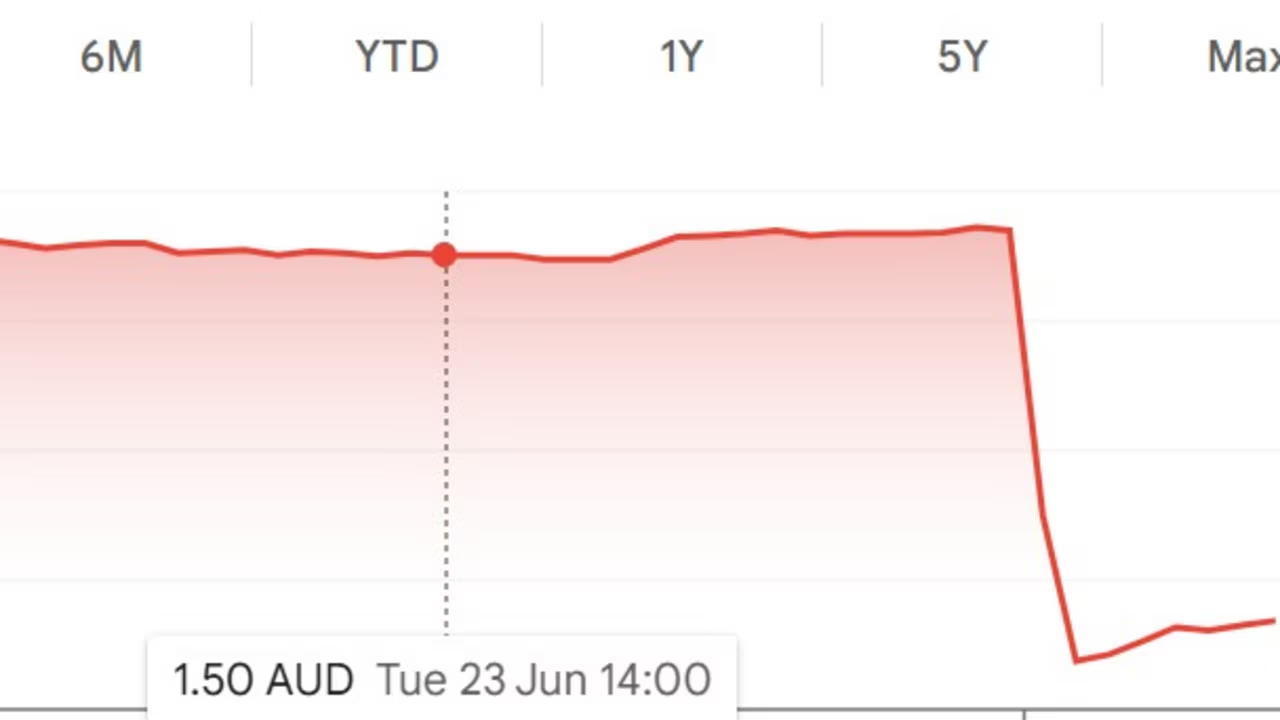
One of Australia’s banks has suffered a catastrophic share price collapse, wiping hundreds of millions of dollars in a matter of hours.Judo Bank is Australia’s only bank built for small and medium businesses. It offers business loans, lines of credit, equipment finance, finance leases, and bank guarantees.Its share price plummeted on Thursday following a surprise trading update that revealed a sharp spike in bad debts.At the time of writing this afternoon, its shares had dropped 38.96 per cent, slightly recovering from a drop of more than 40 per cent when the ASX opened this morning.The brutal sell-off was triggered by a shock ASX announcement that revealed worse than expected credit losses, three worrying loans, lower earnings for this financial year and a materially worse outlook than analysts expected for next year.Judo revealed its expected “cost of risk” for the 2026 financial year has ballooned to between $116 million and $122 million, which means this massive chunk of money is being sucked out of their potential profits to cover the struggling loans.Judo chief executive Chris Bayliss said three distressed business loans had emerged – one to a blind and curtain manufacturer, another to a financial planning customer and the third in construction services.He said those loans had deteriorated “very rapidly” and needed to be disclosed given the approaching June 30 balance date. He also pointed to challenges facing Australia’s economy at large.“While today’s update is partly a result of the macro environment, it is nevertheless disappointing,” he said. As a result of the loans going pear-shaped, Judo expects its 90-day-past-due and impaired loans to hit approximately 3 per cent of its total gross loans by 30 June.Mr Bayliss stressed that the credit blowups were isolated to a “small number of customers” that the bank is actively working with.However, because Judo specialises in lending to Australian small-to-medium businesses — a sector currently doing it incredibly tough under high inflation and rising interest rates — investors quickly sold shares in the bank en masse, perhaps out of fear of worse to come in the wider economy.Despite the dismal reaction to the news Mr Bayliss insisted the outlook for Judo remained strong.“We remain confident in the strength of our underlying business and the quality of the portfolio,” he said. “We have a proven customer value proposition, are profitable and well capitalised, and have a clear path to achieving a return on equity in the low-to-mid teens”.Judo is scheduled to hand down its full financial year results on August 18.Ominous signs as ‘big short’ builds on Aussie banksJudo may be a lot smaller than the big four banks — CBA, Westpac, NAB and ANZ — but the big fishes are not immune to the pressure mounting on the Australian economy.Earlier this month, it was revealed that shorters had placed a record level of bets against the big four, amid concerns they are seriously overpriced and dangerously exposed to a housing slump brought on by new tax rules.Shorters, usually working as part of hedge funds, have doubled their short positions in the past six months to almost $11 billion.It’s the biggest short position since the corporate regulator, the Australian Securities and Investments Commission (ASIC), began collecting data on hedge funds in July 2010.Commonwealth Bank is the overwhelming focal point of the bears, commanding $5.66 billion, or more than half, of the entire short campaign. Westpac sits as the second most targeted at $2.12 billion, with National Australia Bank close behind. Meanwhile, ANZ has largely been spared, accounting for 8 per cent of the shorted capital.The true size of the short position is likely significantly higher than reported as hedge funds are executing their bearish bets via over-the-counter (OTC) derivatives, such as total return swaps, which completely bypass ASIC’s standard reporting requirements.
Aussie bank’s shares in catastrophic collapse
One of Australia’s banks has suffered a catastrophic share price collapse, wiping hundreds of millions of dollars in a matter of hours.
625 words~3 min read