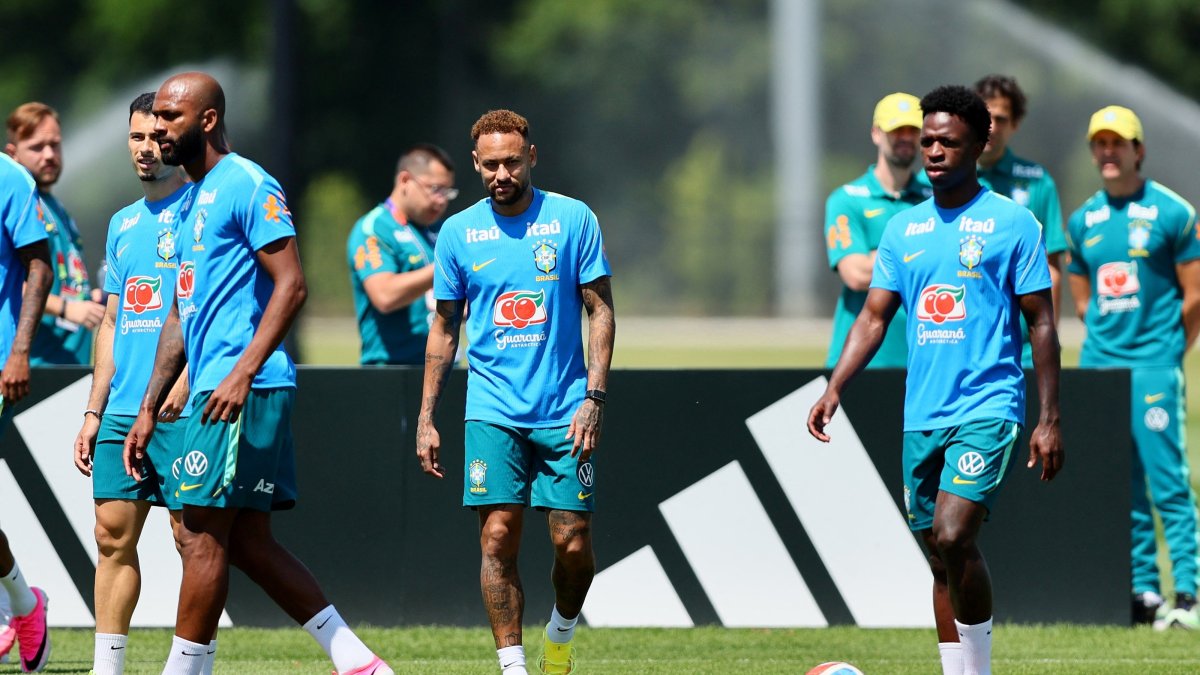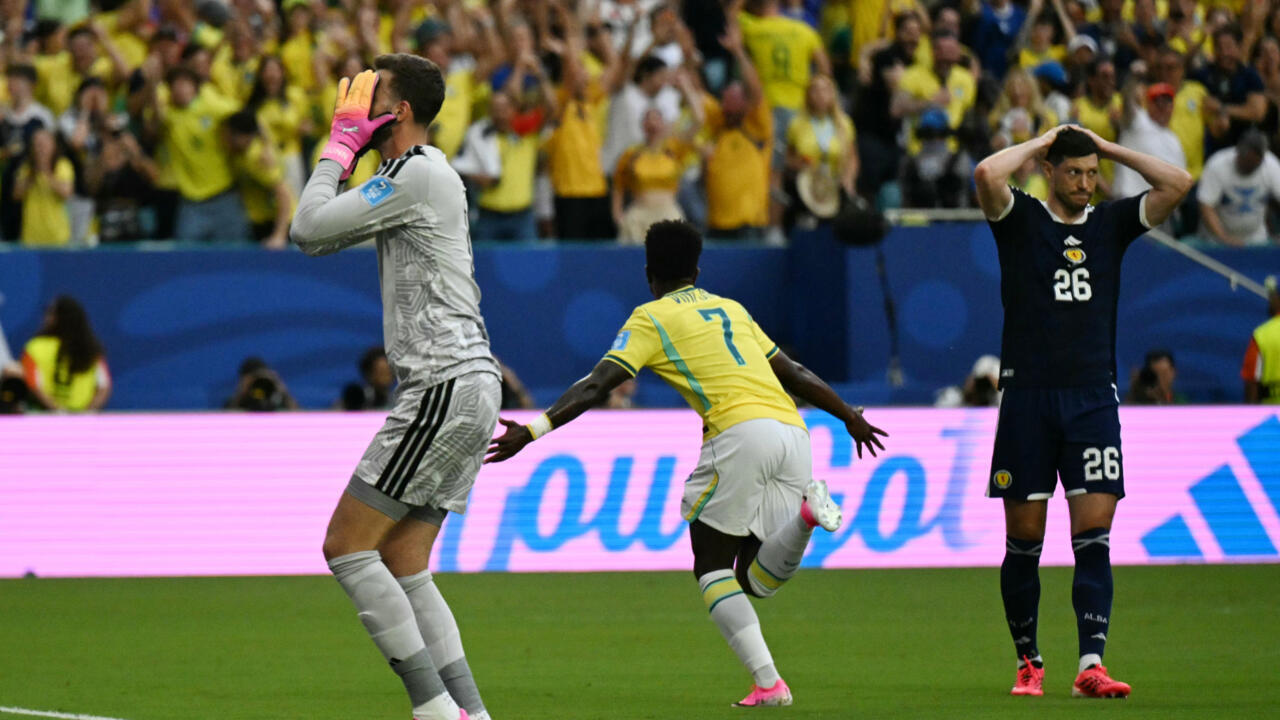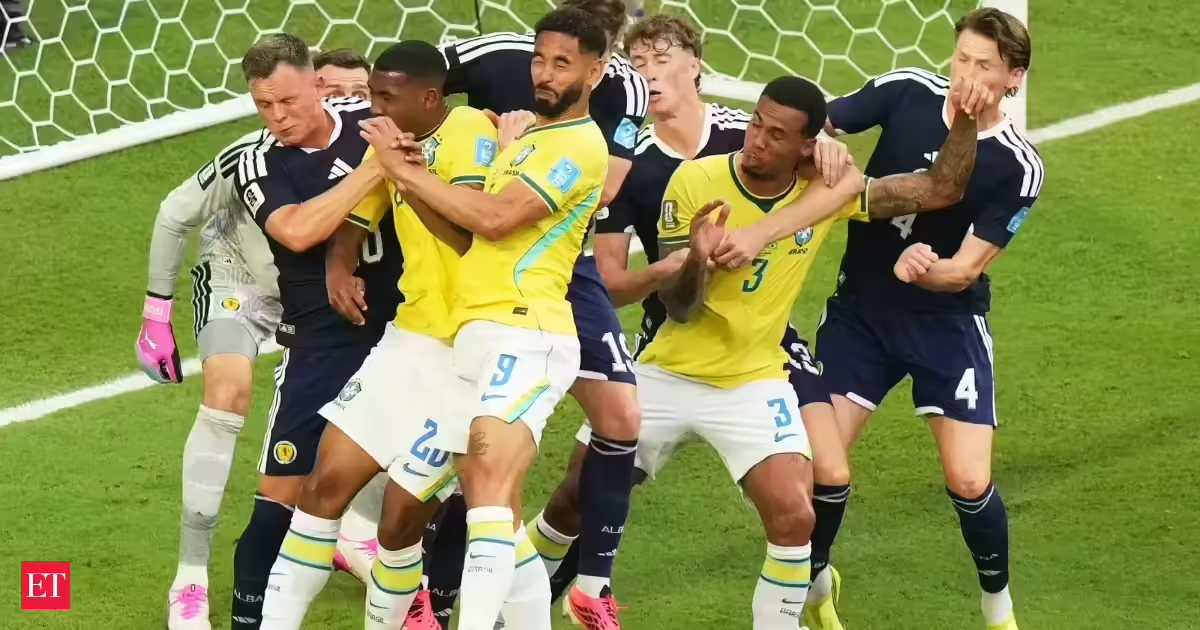
It’s day 14 of the 2026 World Cup, and Brazil rounded off their group stage in efficient style, beating Scotland 3-0 and securing top spot in Group C.The Scots finished third after Morocco beat Haiti to take the other automatic spot, and now face a tense wait to discover whether they will go through.As do South Korea, after they lost 1-0 to a South Africa side who go through to the knockout rounds for the first time in their history. Mexico completed a superb group phase after beating the Czech Republic 3-0, going through with all three wins without conceding a goal.Their co-hosts, Canada, are also through, but in second place in their group after a 1-0 defeat to Switzerland. Jesse Marsch’s team face South Africa in Los Angeles on Sunday June 28, the first match of the knockout stage.Switzerland finished top of Group B, and will almost certainly be joined in the next phase by Bosnia and Herzegovina, who finished third with four points after a 3-1 win over Qatar.Get free access to the most comprehensive World Cup coverage in The Athletic appHas Ancelotti created a problem by giving Neymar and Endrick minutes?On the face of it, Brazil’s 3-0 win over Scotland was a good job efficiently done.A solid victory, top spot in the group confirmed, with seemingly no additional injuries. Sorted.However, because this is Brazil, things might not be quite so simple.Two of the prevailing narratives around this Brazil side have been Neymar’s presence in the squad and Endrick’s absence from the team.Let’s deal with the second one first: Endrick has become a fairly loud cause celebre among many in Brazil, who believe that he has the magic to liven up a team that, one or two players aside, is perceived to be fairly prosaic.Endrick and Vinicius after the win against Scotland (IMAGN IMAGES via Reuters/Sam Navarro)Ancelotti has given talk of starting the youngster fairly short shrift, and there was even a sense that he only included him in the squad with a hint of reluctance, the striker having forced himself into the reckoning with some stellar pre-tournament cameos.And then there’s Neymar. Ancelotti was definitely reluctant to take him, largely because of fears over his fitness (fears that were realised by the injury that made him unavailable for Brazil’s first two games), but also the fact that his best years are behind him.Ultimately, Neymar was named in the 26-man squad for his influence over the rest of the players as much as anything, or perhaps as a ‘break glass in case of emergency’ option, thrown on in desperate times in the hope he can roll back the years one more time.The trouble is, both men came on and played pretty well: not so well that they demanded inclusion in the next round, but well enough to keep the debate around the pair of them on a rolling boil.Out of all the coaches at this World Cup, you’d back Ancelotti to cut out the noise and just do what he thinks is best. But by doing something ostensibly sensible, giving two fringe players a few minutes in a game that was won, he might have made the noise a bit louder.Have Canada thrown away their home advantage?Canada’s defeat to Switzerland, which meant they qualified for the knockout rounds of the World Cup as the second-placed team in their group rather than first, looked annoying for a couple of reasons.Firstly, top spot would have pitted them against one of the third-placed teams in the round of 32, whereas finishing as runner-up gave them a theoretically much tougher game, although South Africa finishing second in Group A might have taken the edge off that one.But secondly, and perhaps just as importantly, it meant they surrendered home advantage. Had they won the group, they would have played in Vancouver, but as it is, they must travel to Los Angeles, making them the first ever World Cup hosts to play a game ‘away’.(REUTERS/Agustin Marcarian)Admittedly, there has been only one previous co-hosted edition, and both Japan and South Korea stayed home throughout their runs in 2002. But it’s pretty rare in other international tournaments too.It’s never happened at the European Championships or the Copa America, and while it has occurred at the Gold Cup (for Central and North American nations) and the OFC Nations Cup (Oceania), those examples have been due to the vagaries of the tournaments’ structure, rather than as a consequence of results.The only other example of a host having to play outside of their country as a direct result of not winning their group came at the 2007 Asian Cup, which was co-hosted by four countries — Vietnam, Malaysia, Indonesia and Thailand. After finishing second in their group, Vietnam had to play their second round game in Bangkok rather than Hanoi. They lost 2-0 to Iraq.Hosting a World Cup has its pros and cons. The hosts haven’t won since 1998, but that’s partly because most of the World Cups in the 20th century have been held in nations who wouldn’t have been expected to triumph anyway. Nevertheless, better-than-expected performances by South Korea in 2002 and Russia in 2018 were undoubtedly influenced by having home advantage.Canada have lost that advantage, and while they would’ve played in America at some point had they gone deeper into the tournament (there are no games north of the border beyond the round of 32), they have spurned a huge opportunity.The co-hosts of the 2026 World Cup now have to negotiate a tricky away tie.How will the third-placed teams cope with their excruciating wait?Anyone who has ever camped by the letterbox or constantly refreshed their email, because they’re expecting big news about a job, or exam results, or medical tests, will sympathise with Scotland and to a lesser extent South Korea this week.After disappointing results in their respective final group games, those teams finished third in their groups and must now wait until Saturday night, when all the group matches are done and dusted, to find out whether they have progressed to the knockout stages.Bosnia and Herzegovina must also technically wait, but with four points, they will, barring something incredibly unlikely, be one of the eight best third-placed teams.Korea’s prospects are decent. With three points and a -1 goal difference, The Athletic’s third-place tracker gives them a 96 per cent chance of progressing.For the Scots, it’s a different matter: they have three points with a -3 goal difference, and our forecast puts their chances at 50-50.These next few days are going to be excruciating. All they can do is sit and wait. They can’t even plan with any great certainty because they don’t really know where they will be playing, even if they do qualify.It could be against Germany in Boston on Monday. It could be against Mexico in Mexico City on Monday. Or — and this is the least likely option — it could be against France or Norway in New York on Tuesday.Five potential opponents, three potential destinations, two potential dates, one absolutely yawning chasm of uncertainty.“Hopefully the journey’s not over,” the Scotland midfielder John McGinn told ITV after the game.The wait to see if it is will be horrible.What to know about Thursday’s gamesThere’s little but pride at stake in one of Group D’s games, as the USA takes on Turkey: the former will finish top of the group, the latter bottom, so the only significant question ahead of the encounter in Los Angeles is about the state of Christian Pulisic’s calf.There’s plenty of peril in the other game, though: Australia and Paraguay are both on three points before they face each other in San Francisco, so whoever wins that one will join the U.S. in the next round, while the losers will have to wait. This is one of the games where there is a potentially mutually beneficial result. If they draw, Australia will advance automatically, but four points will almost certainly be enough for Paraguay to go through as one of the best third-placed teams.In Group E, Germany’s place at the top is sealed, but their opponents, Ecuador, only have a point to their name and need a win to have any chance of going through, either automatically or as a third-placed team. However Ivory Coast only require a draw against Curacao: if they finish level on four points with Ecuador, they will advance on head-to-head record.Finally, it’s Group F, where pretty much anything can happen. Tunisia are out: even if they beat the Netherlands and Sweden lose to Japan, the Swedes have that opening game 5-1 win in their back pockets, which will see them through.But beyond that, the Dutch and Japan are on four points and Sweden on three, so all three teams could finish in any of the three places, depending on how things shake out. It could be chaos: tune in.Thursday’s fixtures
Have Brazil created a Neymar problem? What do Scotland do now? Day 14 recap
Have Canada thrown away their home advantage? And here are the stories to look out for on Day 14...
1,520 words~7 min read