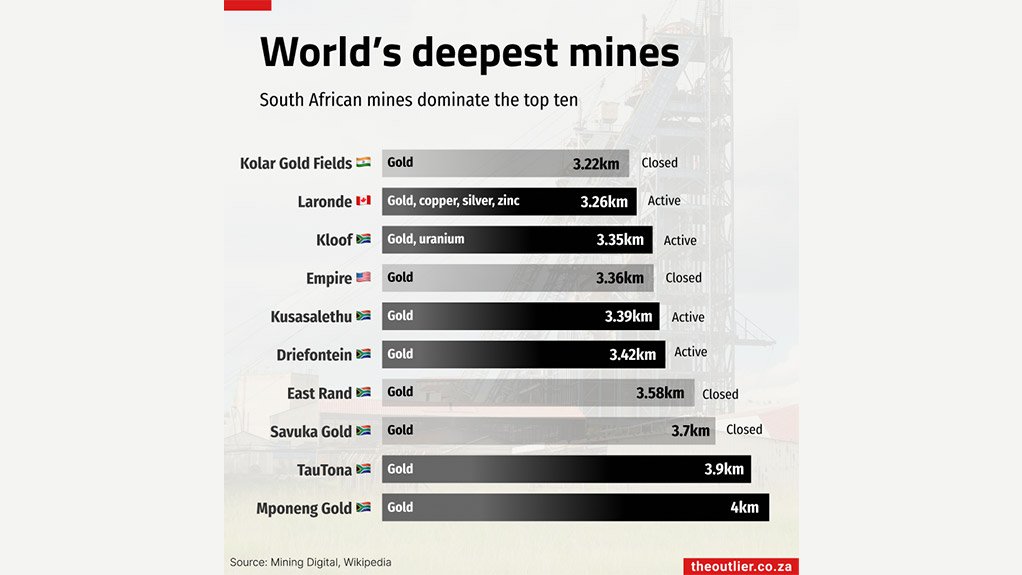
Start with a number: R738m. That is what South Africa spent exploring for gold in 2025 on Earth’s largest remaining gold endowment, in the most extraordinary price environment recorded history has produced. In the same year, Australia spent the equivalent of more than R50bn hunting for gold across geology that is, on the most generous comparison, perhaps a fifth as prospective as ours. Canada spent R40bn and the US R25bn. The ratio between Australia and South Africa is about 70 to one. Markets do not produce numbers like that when the asset underneath is the Witwatersrand. This is not a market outcome; it is a policy verdict, and the policy that produced it is still in place. The story is that our gold is finished: peak output of 1,000 tonnes in 1970, a quarter of all the gold then mined on Earth, followed by a 90% decline as the shallow high-grade reefs ran out. That story confuses the exhaustion of the easiest material with the exhaustion of the resource. Peer-reviewed work in the South African Journal of Geology estimates that about 48,100 tonnes of gold remain in the Witwatersrand Basin, almost exactly the 50,200 tonnes already extracted since 1886. The system that produced 40% of all the gold ever mined still holds, at a documented minimum, about what it has already given up. And it is a minimum: no-one drilled systematically at 5,000m when gold was $400/oz. The reefs do not stop. The exploration did. (Karen Moolman) Nor is the Witwatersrand the whole story. At Barberton, Pan African Resources’ Fairview mine has produced continuously since 1886 — 140 years, still economic proof that intelligent mining endures across every price cycle. The greenstone belts of Limpopo and Mpumalanga have not been followed to depth with modern methods. Above ground, about 1,600 tonnes sit in surface tailings across Gauteng, plus up to 420 tonnes a Stellenbosch University study found locked in sulphides ― recoverable by the BIOX bacterial-oxidation process invented here, at Fairview, in the 1980s and now running on four continents. The technology to recover what we discarded exists. We built it. This matters because the world is running out of new gold. Significant discoveries peaked in the early 1990s; since 2000 the average new find has shrunk by about 60% and the lag from discovery to production has stretched past 17 years. Global mine supply has been flat since 2018 at 3,300-3,600 tonnes a year, even as the price more than doubled. In any normal commodity that would summon new supply within a few years. Gold has not responded, because the discoveries are not there. The World Gold Council says the industry must add about 100-million ounces of new production this decade simply to stand still. The pipeline does not support it. South Africa’s endowment is therefore not a legacy asset in a tired sector; it is the most significant gold resource left on Earth at the tightest moment for supply in modern memory. This matters because the world is running out of new gold. Significant discoveries peaked in the early 1990s; since 2000 the average new find has shrunk by about 60% and the lag from discovery to production has stretched past 17 years.There is a currency argument too, one our financial community has avoided. For most of its modern life the rand was the world’s gold currency metal and money, moving together. That link was severed not by geology but by the production collapse, after which the rand became a generic emerging-market risk proxy. Consider Norway, whose krone was rebuilt into one of the world’s most stable currencies because the state took its oil endowment seriously. Our geological position in gold is more dominant than Norway’s ever was in oil, yet the rand is priced as though the Witwatersrand were a historical curiosity rather than the largest gold endowment on Earth at the most important monetary moment for the metal since Bretton Woods. The technology, meanwhile, is moving in our favour. Every great mining transition ― mechanised drilling, cyanide leaching, bacterial oxidation ― was dismissed as incremental before it proved a phase change. Autonomy is the next. Human mining hits a ceiling near 4,200m, where heat, seismicity and cooling defeat us; remove the human, and that ceiling moves to 5,500m-6,500m. Labour is about half of deep-level costs and cooling a further fifth. A genuinely autonomous deep operation does not trim that bill; it eliminates most of it, turning reefs we once called marginal into reefs that look exceptional. So how did the custodian of all this come to spend R738m? Not through a single error but a pattern by the government and the investment community at once. The 2002 Mineral and Petroleum Resources Development Act vested discretionary power in the minister rather than in published rules; the mining charter’s equity terms changed three times in 15 years; the Treasury lifted the offshore retirement-fund limit to 45% in 2022, just as domestic productive assets became most attractive, a mistake since admitted but not reversed; and the 2025 proposal to extend that same discretionary regime to tailings retreatment targets the one segment that unambiguously works. Capital was complicit, not merely victimised. About R800bn in retirement savings went offshore and much of what stayed bought the JSE Top 40 companies ― earning more than 80% of their revenue abroad ― domestic allocation in name, offshore exposure in fact. Each failure justified the next and the loop ran one way for 20 years. There is more at stake than gold. In retreating their tailings, DRDgold and Pan African are doing precisely what global environmental, social and governance capital most wants to fund: turning a toxic, century-old industrial legacy into productive assets while repairing the damage left behind. It is the circular economy in near-perfect form and South Africa did not follow that movement; it created it. To regulate this sector under the framework that collapsed exploration, precisely because it is succeeding, would surrender a positional advantage decades in the making. The verdict is simple and double-edged. The world’s largest gold endowment is also its most underexplored, underfinanced and undervalued major mineral asset. That is either the greatest policy failure in our economic history or the greatest investment opportunity in it. At today’s price, with this technology and this supply picture, it is both at once. The geology is real and the arithmetic is sound. The only open question is whether we have the institutional will to stop repeating the pattern that brought us here. • Dr Da Silva is MD of Northbound Processing.
DUARTE DA SILVA | SA sits on the world’s largest gold endowment but refuses to look for it
The country is spending less to try to find gold than a single Australian district
1,091 words~5 min read