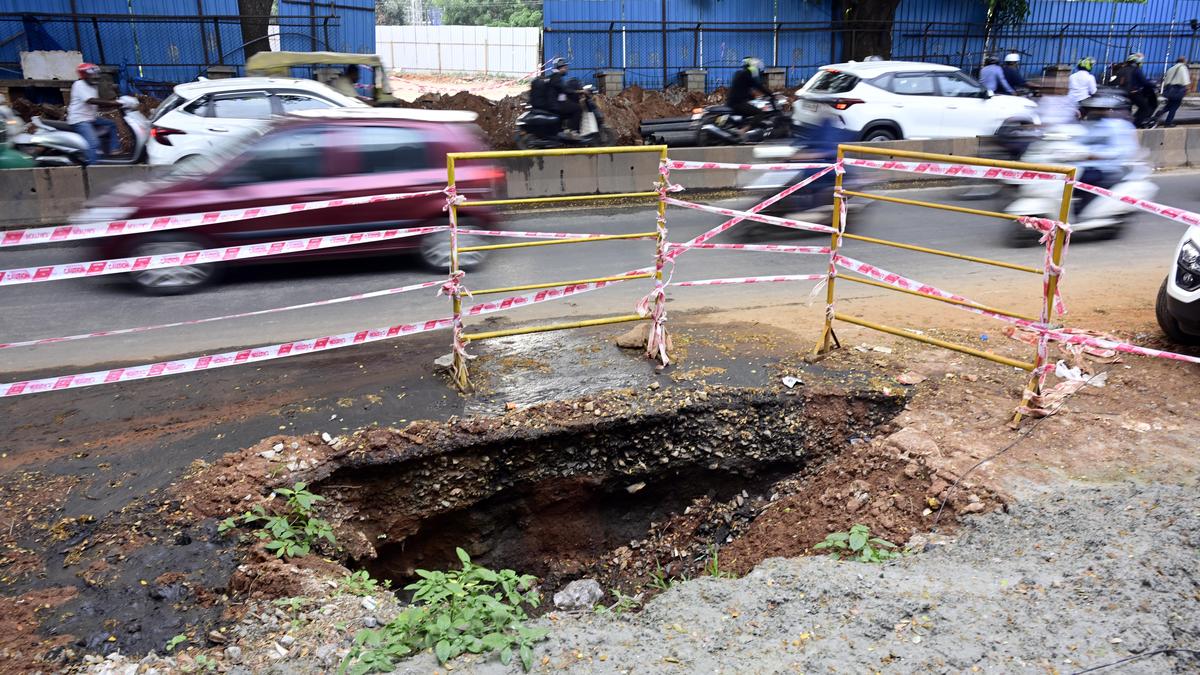
For decades, Bengaluru spread its outward geographical tentacles in bizarre, unregulated ways triggering absolute chaos. The messy network of roads, drains, water supply, power and gas lines that mushroomed without any plan or rule had the city in a twister of woes. Every plan of the past lay in ruins. Will the now-proposed master plans by the Greater Bengaluru Authority (GBA) and the Bengaluru Development Authority (BDA) be any different?The problem starts right at the drafting stage. First, the GBA is tasked with preparing a fresh GIS-based Master Plan for the 686.82 sqkm core city area. The BDA, handling the ‘doughnut-shaped’ outer peripheral area around the GBA boundaries, will draft its own Master Plan for 540.66 sqkm. While the GBA plan has a 2047 vision, the BDA has its vision limited to 2041. The GBA boundary could expand in the future, as articulated by Karnataka’s Chief Minister D. K. Shivakumar himself, intruding right into the BDA plan’s jurisdiction.These master plans will be superimposed by an Economic Master Plan for the entire Bengaluru Metropolitan Region (BMR) extending to a wide expanse of 8,000 sq km across the three districts of Bengaluru Urban, Rural and Ramanagara. The State Government has already inked a Statement of Intent with ISEG Foundation to jointly prepare this plan, charting Bengaluru’s growth priorities up to 2037.Economic Master Plan: Grand visionThe Economic Master Plan’s vision is grand: Double Bengaluru’s economy by 2032 and boost the quality of life, sustainability standards and job creation to stand alongside the likes of Tokyo, London and Singapore. Under NITI Aayog’s G-Hub programme, Mumbai Metropolitan Region, Surat, Pune, Visakhapatnam, Varanasi and Bhubaneswar have already prepared such a plan.Multiple plans by multiple agencies inevitably adds to the complexity. Unlike in the past, the master plan, covering a total area of 1,227.48 sq km will now be prepared by two different agencies. Earlier, the BMR was designed through a structure plan under the BMRDA Act, 1985. This acted as a framework for the city master plan. While the existing structure plan is now due for revision, the announcement of an Economic Master Plan for BMR adds another layer of confusion.‘Legally flawed’All these have inevitably led to seasoned urban planning experts raising objections. While the Citizens Action Forum (CAF) has taken the legal route, urbanist Ashwin Mahesh dubs the effort to create master plans as ‘legally flawed’. His rationale: They bypass the Metropolitan Planning Committee (MPC), the only body with the lawful authority to lead such initiatives. He contends that the government is only going through the motions without the necessary internal capacity or genuine intent to implement these strategies.Agencies such as the BDA, he says, lack the internal capacity to plan. Challenging the expertise of official planners, he notes that the ‘member planning’ roles are filled by people unrecognised in the professional world of planning.Since the current process is not as per the law, he says it creates a vulnerability where any citizen can challenge the plan in court. This explains why the entire planning process has been stalled for years. The authorities should first address who is responsible for the planning process, and how the entire process is legally structured.‘Leave planning to MPC’In its legal challenge, CAF had taken the same approach. Vijayan Menon from the Forum cites the 74th Amendment to assert that the planning authority should rightfully belong to the MPC. Since the municipal elections have been repeatedly delayed, he says the legal and operational status of these local bodies remains in total disarray.“The administration,” says Vijayan, “is very clear that they want to have central control of planning for Bengaluru, which is a big money place, through BDA or GBA. BDA is answerable to the State, not to the people or the municipality. This is not going to happen just like that. We have quite a few cases about this in the High Court of Karnataka. The confusion will only stop if the High Court or Supreme Court makes a judgment and clarifies this whole thing once and for all.”Centralisation of power has continued in tandem with the weakening of even existing local governance. Ashwin cites the Mandur landfill as an example of how local bodies are being stripped of power. In Mandur, dumping of the city’s mountains of waste was forced upon the local panchayat who had virtually no say in the matter.Despite the opposition and legal challenges, the master plan process is already in motion. In May, GBA finalised an agency through global tenders to draft the first-ever master plan for the city with a 20-year horizon. But questions still remain about two master plans, disconnected from this being one region.“Master planning should treat the metropolitan region as one functional urban system, not as disconnected jurisdictions. When separate consultants prepare plans for different parts of the same city, the shared context and integrated vision are often lost,” notes Jaya Dhindaw, Executive Director, Sustainable Cities Programme at the World Resources Institute (WRI) India.Is there a way out?She explains, “If different agencies must commission separate plans, the RFPs (Request for Proposal) should explicitly require consultants to build on one another’s work, and demonstrate how the plans align. Integration has to be baked into the process, and made explicit. It won’t happen automatically.”Single agency to develop planJaya feels, ideally, a single agency should lead the preparation of the master plan for the entire functional urban area, taking into consideration the new reality (five corporations within GBA with their own priorities), even if implementation is shared across multiple authorities. “Different agencies can implement different geographies, but the planning vision must remain coherent. Where a single planning agency isn’t feasible, procurement processes should require agencies and consultants to plan for one interconnected urban region rather than multiple isolated jurisdictions.”On the Economic Master Plan for the BMR, Ashwin notes it is a strategic imperative rather than a legal mandate. He proposes a geographic hierarchy where a State guidance document informs divisional plans, which then inform district and local plans. Each division can comprise seven or eight districts. For the BMR, it would be equivalent to a metropolitan district plan. “BDA, GBA and all should make plans pursuant to the metropolitan district plan, and the local plans should adhere to this as well. That logic will make sense.”Typically, as Jaya puts it, economic master plans do not speak to either industrial development policy or city level master plans. “But this time, they are using the existing and previous master plan, the climate action plan, the structure plan, and the regional structure plan because the economic development plan is not going to respect administrative boundaries, or economic development is not going to be within certain economic boundaries. It’s going to be spread out. It’s going to be regional. So, you have to consider the regional context,” she explains.WRI India has recommended that mobility be a key aspect of the plans with priority to public transport and walkability. ‘Even as you’re looking at economic development plans, 70% or more of our workforce is informal. The blue-collar people, they’re probably going to use two-wheelers, or walk, or use public transport. So, how do you make their access absolutely seamless should be the metric by which you measure the success of a plan that you’re going to put out’, is what the WRI recommends.
A master planning dilemma for Bengaluru
City faces a master planning crisis as conflicting plans by multiple agencies complicate urban development and governance.
1,214 words~6 min read