Financial webhooks are deceptively simple on the surface. A third-party payment gateway sends an HTTP POST to your endpoint. You process it. You respond. The transaction is recorded.
In practice, this description conceals a category of engineering problems that only reveal themselves under production conditions: duplicate delivery during network instability, malformed payloads from legacy client versions, floating-point arithmetic errors in financial calculations, and cascading failures when a downstream compliance API degrades. Each of these failure modes, left unaddressed, produces outcomes ranging from duplicate tax invoices to silent data corruption in a financial ledger.
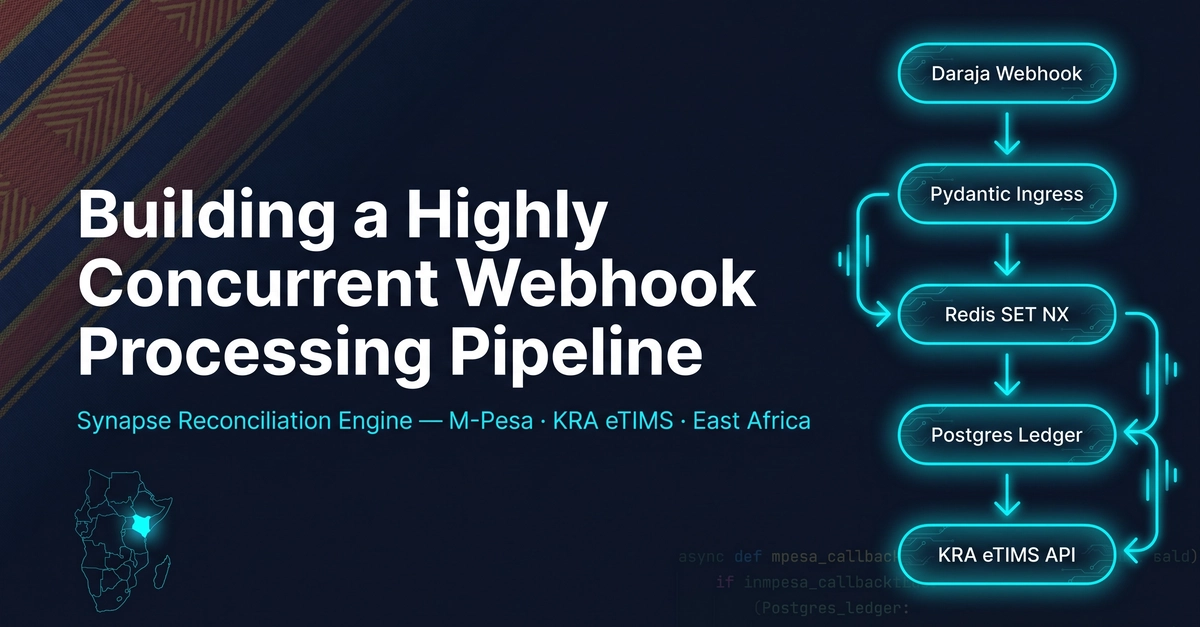
The Synapse Reconciliation Engine was built to bridge two of East Africa's most critical financial infrastructure components — Safaricom's M-Pesa Daraja API and the Kenya Revenue Authority's eTIMS compliance gateway. This article documents the architectural decisions made at each stage of the ingress-to-compliance pipeline, with a focus on the concurrency model, schema integrity, and graceful degradation strategy that define its production posture.
*Ingress & Idempotency
*