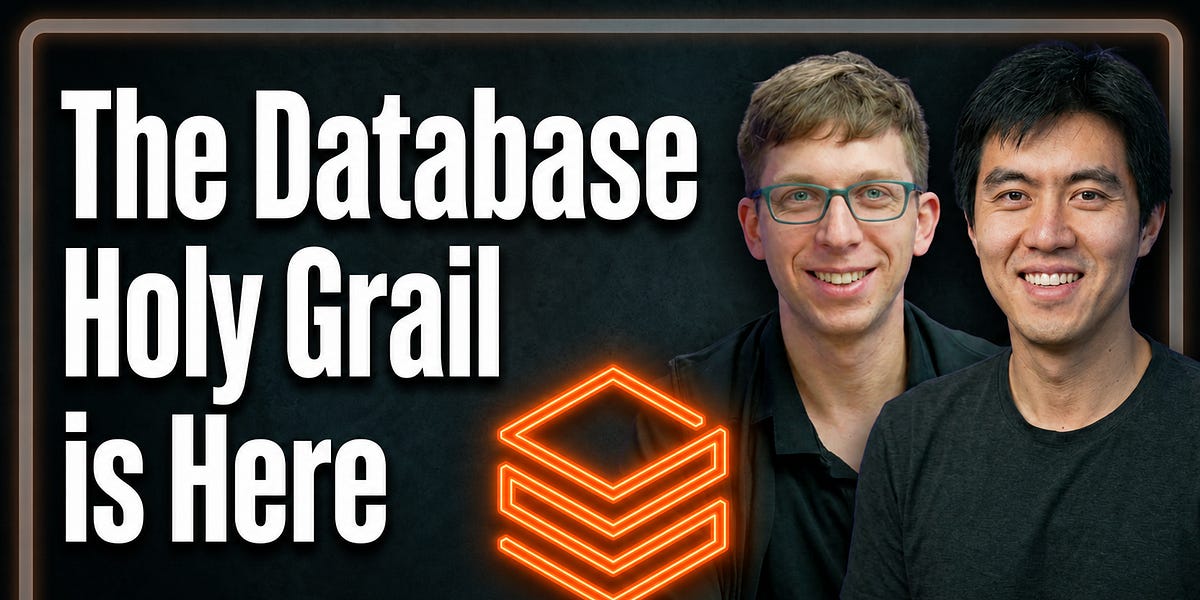
We’re excited to have Databricks join us at AIEWF, among hundreds of the top companies in the AI Engineer ecosystem. LS subscribers can use their discount to get past the late bird pricing and access over $50k in sponsor offers! Everyone is still talking about Satya’s Frontier Ecosystems post, but few have actually built a (now $175 billion) frontier ecosystem and cloud like our guests today.From open-sourcing the layer above coding agents to rethinking databases for the agent era, Databricks cofounders Matei Zaharia and Reynold Xin are pushing the company beyond the lakehouse into a full data-and-AI operating system. In this episode, Matei and Reynold join swyx at the 2026 Data + AI Summit to unpack Omnigent, LTAP, Lakebase, agent security, open formats, Mosaic, and why databases may matter more than ever once AI agents start doing real work.We go deep on Omnigent: Databricks’ open-source meta-harness for combining, controlling, and sharing agents across Claude Code, Codex, Cursor, Pi, custom agents, and internal tools. Matei explains why coding agents and enterprise agents run into the same problems: portability, collaboration, session history, security, spend controls, and the need for a common API above every harness.Then Reynold walks through Databricks’ database dream: why CDC is brittle enough to joke that it means “continuous data corruption,” why HTAP has been the holy grail of database engineering, and why Databricks thinks LTAP gets most of the benefits by unifying the storage layer instead of collapsing every query engine. We also cover Databricks’ infrastructure scale, the culture behind rapid prototyping, the difference between tech and enterprise customers, Databricks vs Snowflake, whether vector databases should have ever existed, the Mosaic model strategy, Genie, AI Runtime, RL fine-tuning, and the thesis that traditional software gets rewritten once the data is in the right place and agents sit on top.Matei Zaharia@matei_zahariaGenie has transformed how Databricks users work with data, with 3x the accuracy of generic agents. We're sharing some of the research behind it and what makes building data agents challenging. Super proud of our research team's impact with this! databricks.comPushing the Frontier for Data Agents with Genie | Databricks Blog3:52 PM · May 8, 2026 · 106K Views8 Replies · 44 Reposts · 276 LikesDatabricks began as a company for the big data era. The origination of Spark from the Berkeley AMPLab which eventually turned into the product Lakehouse convinced enterprises that they didn’t need a separate data lake, warehouse, ML platform, and governance layer. They just needed one open foundation where all of their data could live and be reasoned over.Since then a lot has changed, but data has only become more important. Data is no longer something you keep track of and analyze ad hoc, it’s the necessary context agents need in order to act. So the framing has shifted from “where do we put all of our data?” to “how do we expose the right slice of state, history, permissions, and business logic to an AI system at the exact moment it’s doing work?”If frontier model performance becomes commoditized, the durable advantage then becomes the company-specific context around them: proprietary data, governed access, operational state, transaction logs, workflows, and feedback loops. Which makes Databricks positioned perfectly.Now coming fresh off the Data + AI Summit 2026, the company is moving just as fast to keep up, announcing Genie One, Omnigent, LTAP, and many more, indicating a central mission in its newer work: Databricks is trying to become the operating system for enterprise agents.Matei Zaharia@matei_zahariaReally excited to open source a new project: Omnigent, a meta-harness for AI agents.
Why the Frontier Ecosystem must be Open — Matei Zaharia and Reynold Xin, Databricks
In a rare double-interview, the Databricks technical leaders riff on what it will take for every company to build Agent Clouds
15,446 words~70 min read


 aws.amazon.com