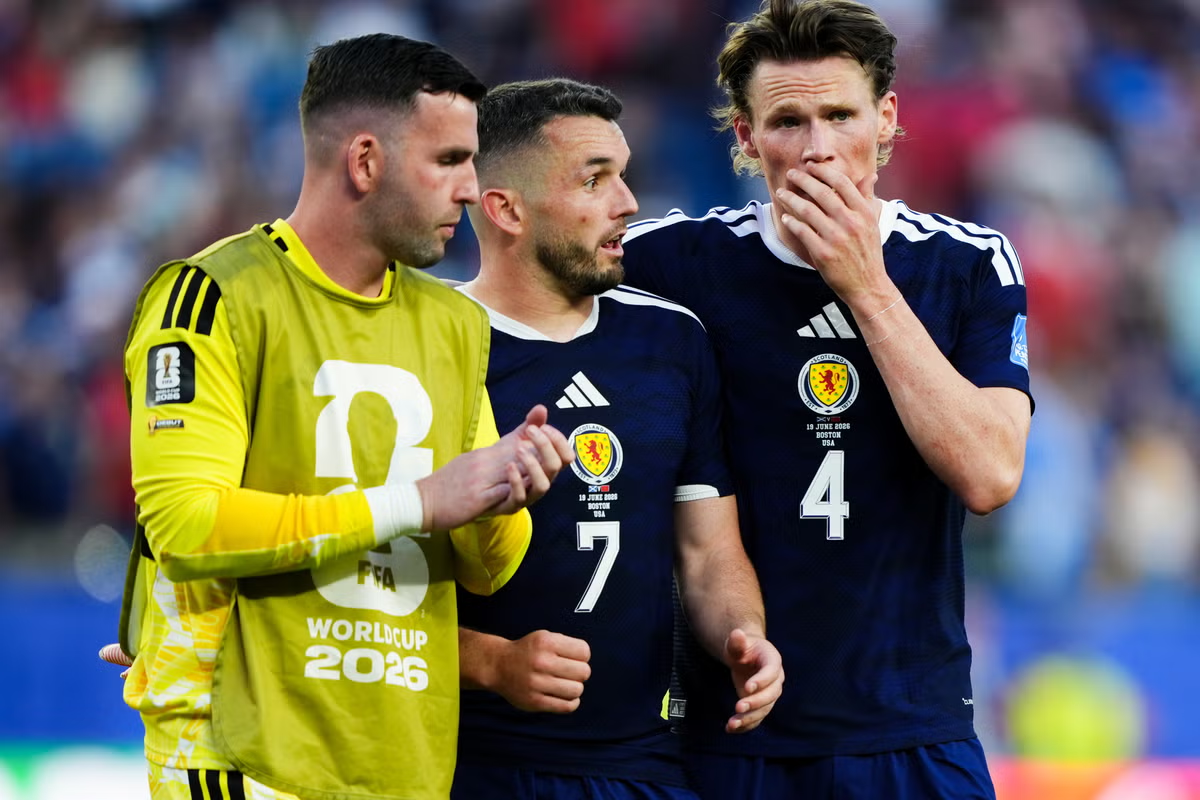
Get free access to the most comprehensive World Cup coverage in The Athletic app.In the 97th minute, chasing an equaliser from a corner kick, Scotland hit the first man, botched the clean-up job and found themselves on the retreat.Achraf Hakimi squeezed past Anthony Ralston and a three-v-one situation unfolded as Morocco approached the halfway line. With the situation looking close to a certain goal, Ralston committed the most cynical of fouls and pretty much rugby-tackled Hakimi. The referee simultaneously blew for a foul and full time. Scotland lost by one goal at Gillette Stadium last Friday rather than two.In any other World Cup, it would have been a frustrating ending in a costly defeat. At this expanded 48-team edition, in which eight of the 12 third-placed teams progress to the knockouts with the 24 first- and second-place finishers, Ralston’s act of sabotage may be the difference between qualification and elimination.Scotland’s Anthony Ralston grabs Achraf Hakimi to halt a late Morocco break (Mattia Ozbot/Getty Images)With three points and a neutral goal difference after two of their three matches, Scotland can now likely afford another narrow defeat by Brazil on Wednesday and still reach the World Cup’s knockout stage for the first time at their eighth attempt. Had they conceded again against Morocco, the margin for error would have been more precarious.In the final knockings of that match, if there had been a buzzer available to press which guaranteed a goal but did not reveal which side it would be for, few Scotland fans would likely have triggered it. Indeed, a 1-0 defeat had been widely agreed upon as a palatable outcome going into the game.And so those last 25 minutes served as a bizarre risk-management experiment that is likely to be a harbinger of what is to come in this tournament.In fairness, Scotland did press higher and committed men forward in their desire to gamble on the point that would have virtually guaranteed progression. But they still attacked with an element of insurance and even some Tartan Army members in the stands could be heard shouting not to leave themselves too exposed when breaking forward.Is this healthy jeopardy or a perverse reward for failure? Should manager Steve Clarke’s motto of “Don’t get humped” really be enough for them to make it through? Scotland will not care one jot if they reach the knockout stage but when losing two games out of three in your group is no longer terminal, it does fundamentally lessen the stakes and alter the psychology of winning and losing.Cristiano Ronaldo breaks another goalscoring record | World Cup Daily BriefingMegan Feringa and Amitai WinehouseIt looked like Scotland may be on course for a ruinous evening in Foxboro, near Boston, when Ismael Saibari pinged in the opener for Morocco after just 71 seconds. Clarke’s team looked spooked and enfeebled, barely engaging with the opposition until they had to.Perhaps that explains why, despite the whole message from the camp the past two weeks has been about not leaving this tournament with a sense of regret, like the last two meek European Championship finals campaigns, Scotland have displayed a similar passiveness and lack of expression in the United States. Having won the must-win game against Haiti, the task was as much about avoiding a heavy defeat as it was finding a way to score.They face the same predicament today (Wednesday) in Miami. As per The Athletic’s projections model, a 1-0 defeat against Brazil gives Scotland an 89 per cent chance of making the knockout stages. A 2-0 loss still gives them a 77 per cent chance of getting through to the round of 32. Even a 3-0 reverse gives them a 62 per cent chance.What may that do to the team’s mindset?“Absolutely nothing, because we want to win the game; and if we can’t win the game, then we don’t want to lose it,” said Clarke.Austria are another nation who could progress to the knockout stages with a matchday three defeat (Michael Steele/Getty Images)But the number of teams still able to progress opens up the possibility of non-aggression pacts in this final round of group games, evoking memories of West Germany vs Austria at the 1982 World Cup.Playing the day after Algeria had completed their three group games, leaving them tied on four points with Austria, both teams knew that a West Germany win by fewer than three goals would see them both qualify at the expense of the North Africans. After Horst Hrubesch scored in the 10th minute, the match in Gijon, Spain, did not witness another goal. Both sides had little reason to risk attacking with any purpose and in Algeria, the game became known as the ‘Disgrace of Gijon’.FIFA has changed the rules so that head-to-head records decide placings when points are tied in the group stage rather than goal difference. Even with that modification, however, there is the opportunity for Algeria to be on the right side of their cruel 1982 fate this time. Their final Group J game against Austria, along with Group D’s Paraguay-Australia match, looks ripe for inaction.Both feature two teams on three points who know a draw would take them to four and guarantee mutual progression. Of course, there is the motivation that the winners will finish second but the goal for those nations at the start of this World Cup was simply to qualify. Why risk losing and potentially being eliminated as one of the worst four third-placed teams?There are also games in which a slender win and a slender defeat could be suitable for both parties. Scotland’s next match is one of them. Brazil drew with Morocco, so if both teams win their final games, who tops Group C will come down to goal difference. Carlo Ancelotti’s men have a two-goal advantage there, so if they go 2-0 up this evening, it would leave Morocco needing to beat Haiti by four goals to draw level on goal difference. Would either team feel the need to force the issue?The same goes for Japan vs Sweden in Group F.A victory for Japan, sitting on four points, could take them top, depending on whether the Netherlands beat Tunisia. The sides are tied on four points, head-to-head and goal difference. Victory for Sweden could still see them finish top but, with Graham Potter’s side on three points, another heavy defeat to go with their 5-1 demolition by the Dutch could also still see them eliminated on goal difference.Another consideration is that the winners of that group face the runners-up of Group C — Brazil or Morocco — with the team in second place facing its winners. The gap between both teams appears negligible, so the risk of Japan losing and potentially finishing third, meeting France in the last 32, is also on the cards. A 1-0 Japan win would assure both get through stress-free.Even in Group G, on the presumption that Belgium beat New Zealand and move to five points, a draw between Egypt and Iran — on four and two points — may suit both parties. Defeat for Egypt would see them finish third, and a loss for Iran would see them eliminated. A draw would mean Belgium would have to beat New Zealand by a few goals to leapfrog Egypt in top spot and Iran would finish on three points and level goal difference, almost guaranteeing progression in third place.It would be classic Scottish misfortune for them to confound the probabilities and be eliminated when three points and a goal difference of minus two seems to be a sufficient benchmark. It may be tempting to go out there and try to rope-a-dope their way to the round of 32 but if they arrive at Hard Rock Stadium with a “Don’t get humped” mindset, it could well engender the opposite outcome.For the sake of spectacle, let us hope that not too many of these final games descend into damage-limitation exercises or losses of convenience.
How losing can still be winning at a 48-team World Cup
If the stars align, a defeat could become a win for a number of teams bidding to reach the knockout stages of this World Cup
1,323 words~6 min read