Math.random() returns a number between 0 and 1, and roughly nobody reading this could explain what happens between the call and the return. That is fine, fine right up until the output decides who gets money, and then it becomes one of the genuinely hard problems in applied software, the kind that regulated industries build entire testing labs around.
Start with the thing most people get wrong: a sequence that passes for random and a fair sequence are different claims, and your users cannot tell them apart by staring at outputs. The users will never catch the difference and that is the whole problem in one sentence. This is why fairness in any real-money system, an online casino being the sharpest example, is a verification problem long before it is a math problem.
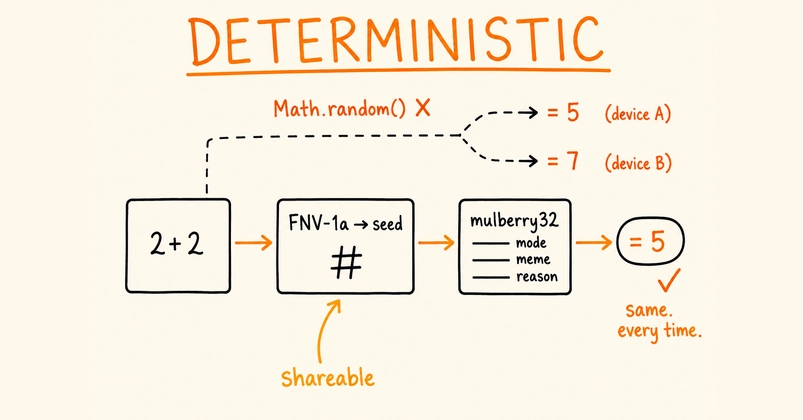
Pseudorandom generators are deterministic. A PRNG eats a seed, runs it through fixed arithmetic, and spits out numbers that sail through statistical randomness tests while being completely predetermined by that seed. Mersenne Twister is the poster child: excellent distribution, used everywhere by default for years, and from a few hundred observed outputs you can reconstruct its internal state and predict the rest. For a Monte Carlo simulation, who cares! For anything where a human has a financial reason to guess your next number, you just shipped a vulnerability and called it a feature.