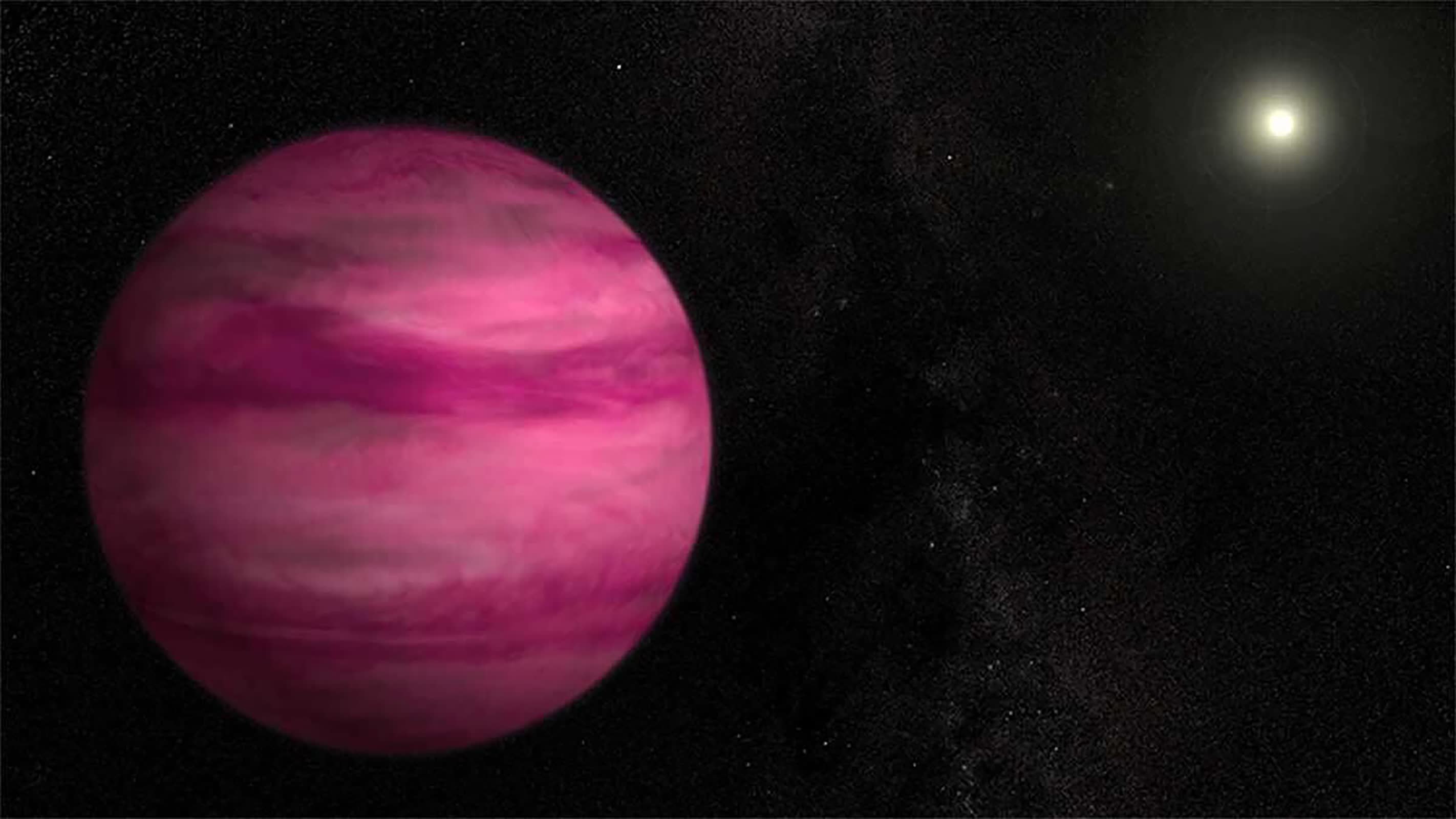
FIRST LOOK: For more than a decade, GJ504b has been something of an oddity – easy to spot, hard to understand. The planet orbits a sun-like star about 57 light-years from Earth and has stood out since its 2013 discovery because of its distinct pink hue. But its appearance didn't reveal much about what was happening there. Despite repeated attempts, ground-based telescopes couldn't extract enough usable data to explain conditions in its atmosphere. That just changed thanks to the James Webb Space Telescope.
Using Webb's ability to isolate faint planetary light from the glare of a nearby star, a team led by Northwestern University captured direct spectroscopic data from GJ504b for the first time. What had taken countless observation attempts from Earth was accomplished in roughly two hours. More importantly, the data was detailed enough to move beyond simple imaging.
When researchers broke the light into its component wavelengths, they found familiar ingredients: water vapor, methane, carbon dioxide, and ammonia. At first glance, that mix did not seem unusual. But when those elements were plugged into atmospheric models, the results didn't hold up. The simulations produced conditions that didn't make physical sense.