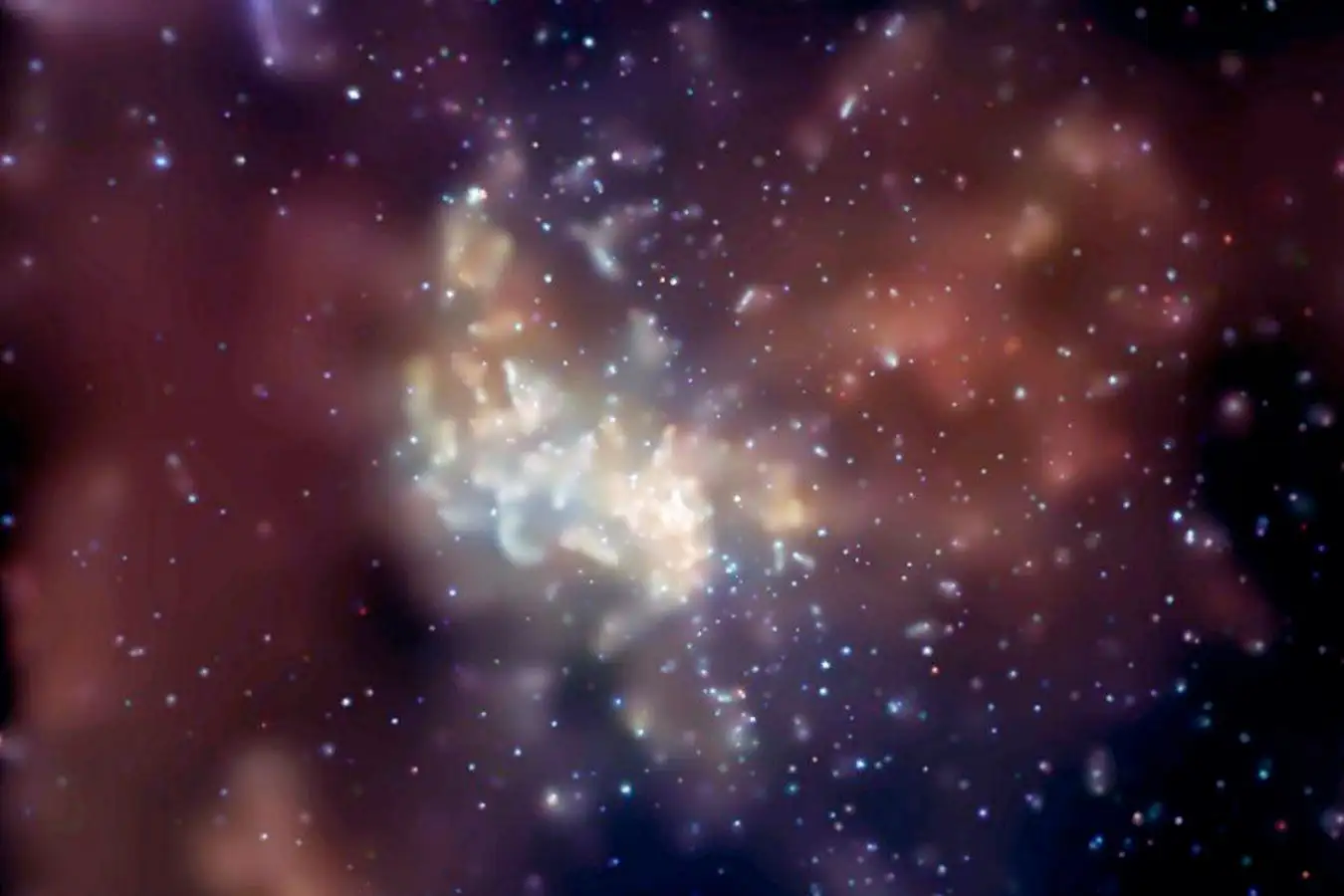
Bright flares are visible near the event horizon of Sagittarius A*Photo by NASA/CXC/MIT/F.K.Baganoff/Getty Images
The centre of our galaxy is a strange and chaotic place, but we may finally have an explanation for the unusual stars that orbit there. Our supermassive black hole, Sagittarius A*, is surrounded by three populations of stars, all strikingly different from one another but with similar ages, and researchers have come up with a relatively simple model that can explain all of them at once.
The closest objects to Sagittarius A* are called S-stars: a spherical swarm of stars, many of which are on elongated orbits that take them dangerously close to the black hole. Their distribution also has a strange, unexplained gap called a zone of avoidance. The next layer contains clockwise disc stars, which are massive stars that sit in a relatively orderly disc outside the orbits of the S-stars. Finally, there are the off-disc stars, which are on more scattered orbits, including some that appear to circle in the opposite direction from the rest.
There have been many explanations proposed for each of these populations, but thus far, none has been able to consistently explain all of them. Xiaochen Zheng at the Beijing Planetarium in China and her colleagues may have a solution.