On April 29, 2026, Nathan Sobo published the Zed 1.0 announcement post on Zed's blog. The post landed on Hacker News at 2,047 points and 663 comments — the highest-engagement HN story in the present cache by a substantial margin. The launch announcement is a milestone marker after five years of development, roughly a million lines of Rust, and a custom GPU-accelerated UI framework called GPUI that the Zed team built from scratch rather than building atop Electron, Chromium, or any other browser engine. The structural argument Zed has been making for the last several years is condensed in one sentence from Sobo's post: "Instead of building Zed like a web page, we built it like a video game, organizing the entire application around feeding data to shaders running on the GPU."
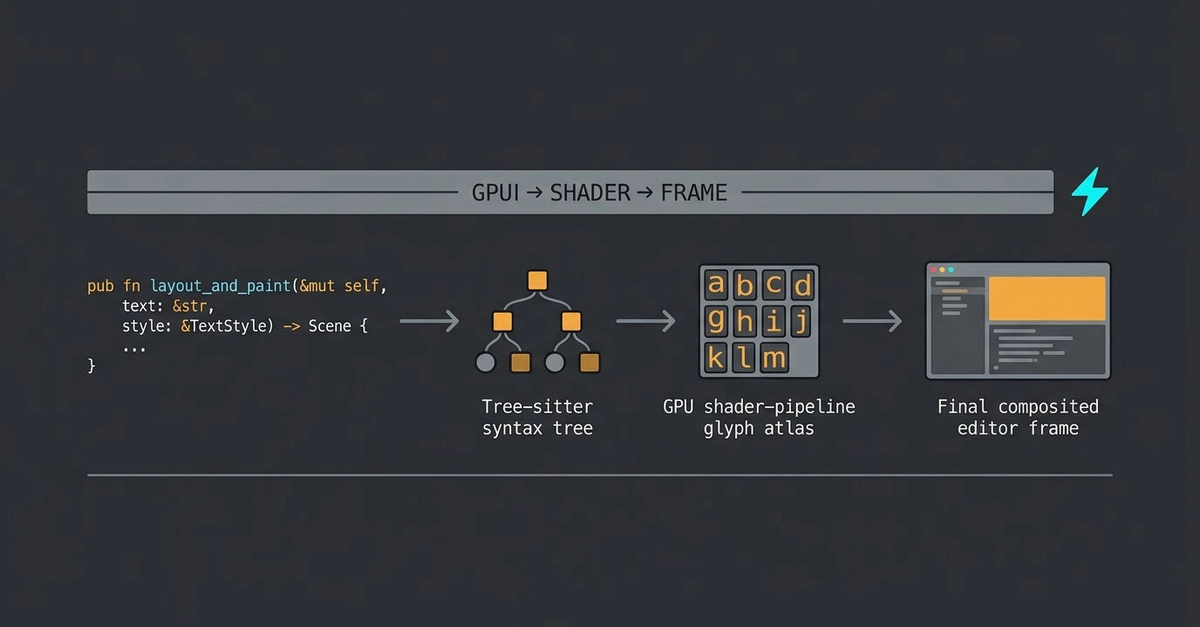
The video-game framing is not metaphorical. Zed's editor surface is composited by feeding glyph atlases, syntax-tree-derived color spans, and pane-layout geometry into GPU shaders the way a video-game engine composites its frames. The reason this matters is the reason the Zed team gave for starting over from the Atom era: Atom was built as a fork of Chromium, and the same team that built Atom is the team that spawned Electron. The Atom-Electron-VSCode lineage is, in the historical-causal sense, Zed's own. Sobo's post is unusually direct about the inherited limitation: "Electron eventually became the foundation of VS Code (which today seems to be forked into a new AI code editor every other week). Web technology offered an easy path to shipping flexible software, but it also imposed a ceiling. No matter how hard we worked, we couldn't make Atom better than the platform it was built on." The 1.0 announcement is, in part, a statement that the rebuild from scratch has finally cleared that ceiling.