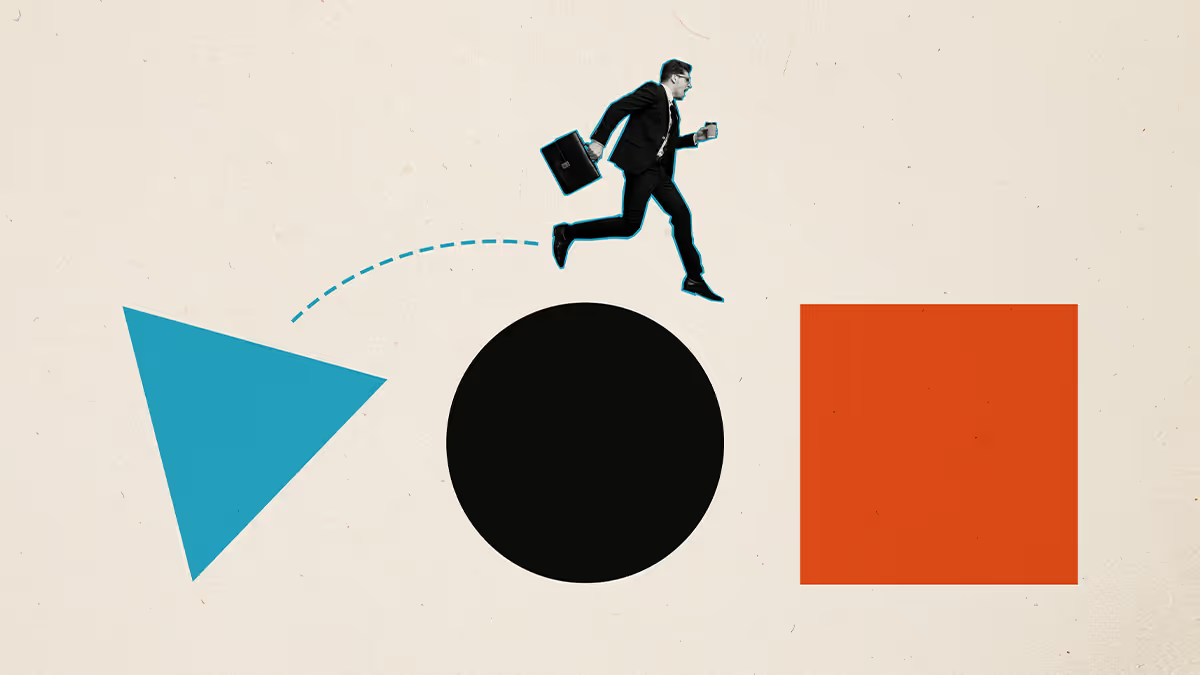
The new career contract will be built on sustainability, adaptability and renewal.gettyFor much of the last century, organizations designed careers around a simple assumption. People were educated when young, worked through adulthood and retired somewhere in their sixties. The model was never as universal as it sounded, but it gave employers a map. Careers had stages. Training had a rhythm. Benefits had boundaries. Retirement had a place in the story.That map is now badly out of date.Pew Research Center, drawing on U.S. Census Bureau projections, estimates that the number of Americans aged 100 and older will more than quadruple from about 101,000 in 2024 to 422,000 by 2054. The Bureau of Labor Statistics says about one in five Americans aged 65 and older participated in the labor force in 2024, with 11.6 million people in that age group either working or looking for work.At the same time, skills are becoming less durable. The World Economic Forum expects 39% of workers’ core skills to change by 2030. People may live longer, work longer and face more frequent reinvention inside the same career.Naeema Pasha, founder of the World of Work Institute at the University of Reading’s Henley Business School (disclosure, where I also work), has been developing a framework for what she calls the 100-Year Career. It is built around three ideas: Last, Adapt and Rise. Longer careers will require people to last physically, mentally and financially. They will require workers to adapt as AI changes the content of jobs. And they will require fairer ways for people to rise again after disruption.The Old Career Map Is BreakingMost employers still treat careers as if they are basically linear. Employees enter, build skills, move upward, plateau and eventually leave. Promotion systems, leadership pipelines and talent reviews often assume that the best careers are the neatest ones.MORE FOR YOULonger working lives will not look like that. They will include breaks, restarts, caregiving periods, illness, redundancy, reskilling, lateral moves and second or third professional identities. A career may have several peaks rather than one.Many firms still punish interruption. A parent returning after a career break may be seen as less current. A worker in their fifties may be treated as less adaptable. A younger employee entering a labor market reshaped by AI may struggle to gain the early experiences that once helped people learn.A 100-year career mindset asks different questions. Not only who is ready for promotion, but who can keep contributing. Not only who has the most recent experience, but who can learn. Not only who fits the role today, but who could grow into the work tomorrow.Longer Lives Need More Sustainable WorkA longer career is not automatically good news. It can mean more opportunity, more income and more purpose. It can also mean more exhaustion.Employers need to be careful not to turn longevity into a justification for endless work. That starts with sustainability. They encourage resilience while leaving workloads, meeting cultures and management practices untouched. They praise stamina while normalizing depletion.If people are expected to work over longer time horizons, employers have to take energy seriously. That means looking at how work is paced, how managers behave and how people recover. It also means recognizing that health, caring responsibilities, menopause, neurodivergence, financial strain and mental health shape whether people can remain in work and keep doing good work.Pasha’s “Last” pillar matters because longevity without sustainability becomes a trap. A workplace that helps people last is not soft. It is better at retaining skill, judgment and institutional memory.AI Makes Adaptability A Shared ResponsibilityArtificial intelligence has made career planning harder because it changes not only what workers do, but what employers think workers are for.Tasks that once gave people early experience can now be automated. Routine analysis can be accelerated. Drafting, summarizing and scheduling can be handled by machines. The result is not the end of human work, but a shift in where human value sits.The risk is that employers treat AI as a productivity strategy while treating adaptation as an individual burden. Employees are expected to learn new systems, protect their relevance and absorb the anxiety of change on their own time. That is not a serious workforce strategy. It is a transfer of risk.Adaptability now has to become part of the employment relationship. Companies cannot simply buy AI tools and hope people will keep up. They need to build learning into the job itself.That means giving workers time to learn, not just access to online modules. It means redesigning roles so people work with AI rather than being quietly compared against it. It means teaching judgment, creativity, ethics, collaboration and sense-making alongside technical fluency.Older workers are especially vulnerable to lazy assumptions here. They are often described as barriers to digital change, when many hold the client knowledge, pattern recognition and institutional memory that make AI more useful.The phrase “human in the loop” is too thin. Remember, humans are not merely inserted into a technological process. They are the reason the process exists.Careers Need Better Ways BackEvery long career will contain disruption. Some of it will be chosen, such as retraining, relocation or a deliberate career change. Some of it will be imposed, such as redundancy, illness, caring responsibilities or technological displacement.The difference between a resilient career and a broken one is often not talent. It is access.Who gets a second chance? Who is allowed to explain a gap? Who is seen as experienced rather than outdated? Who receives sponsorship after a setback? Who is assumed to have potential even when their career has not been tidy?This is where Pasha’s “Rise” pillar becomes most important. Fairness in a 100-year career is not only about entry into work. It is about re-entry, recovery and reinvention.Employers should examine where careers stall. They should look at who receives retraining, who gets internal mobility and who is written off after a non-linear move. They should ask whether career gaps are treated as evidence of lower commitment. They should train managers to recognize transferable capability rather than only recent role similarity.The new career contract will be built on sustainability, adaptability and renewal. Employees will still need to take responsibility for learning and career choices. But employers cannot pretend these are purely individual matters. When organizations design exhausting jobs, limit access to training or treat interruption as a defect, they shape the futures people are able to have.The practical test is simple. Can people last here without being depleted? Can they adapt here without being left behind? Can they rise here after disruption? The employers that can answer yes will be better prepared for the working lives people are actually going to live.
Why The 100-Year Career Will Change How Employers Think About Work
Longer lives, AI disruption and shifting skills mean employers must rethink careers around sustainability, adaptability and renewal.
1,103 words~5 min read