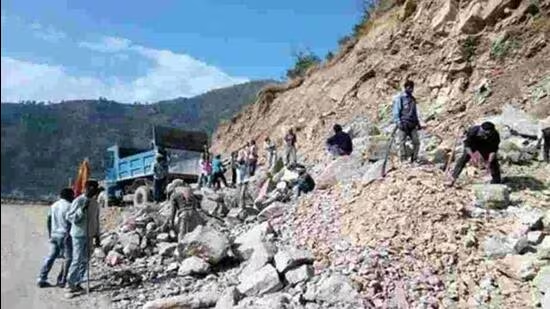
The Centre on Wednesday overhauled norms governing National Highway projects in hilly regions, with the Union Ministry of Road Transport and Highways (MoRTH) scrapping incentives for early project completion, mandating that newly cut slopes withstand at least one monsoon season before final road construction, and enforcing stricter geological investigations and slope-monitoring measures.Centre scraps early completion incentives for hill highway projects, citing landslide risks from aggressive slope cutting and rapid construction.Applicable to future National Highway and centrally sponsored road projects in hilly areas, the amendments to the model Engineering, Procurement and Construction (EPC) contract documents and consultancy framework for Detailed Project Reports (DPRs), issued through a circular, seek to address concerns that aggressive hill cutting and speed-driven construction have contributed to slope instability, erosion and recurring disasters.Under existing EPC contracts, contractors are entitled to a bonus of 0.03% of the contract value for every day a project is completed ahead of schedule. The ministry has removed this provision for projects in hilly terrain, signalling a shift away from speed-driven execution in geologically sensitive areas.Through these changes, the MoRTH has institutionalised the scrapping of financial incentives for early completion of projects in hilly terrain and made it mandatory for newly cut slopes to pass through at least one monsoon season before final road works can proceed.The revised norms come amid growing concerns over the impact of large-scale hill cutting for road widening and expansion projects and the resulting disasters.In the circular issued on Wednesday, the ministry said that rapid expansion of highways through extensive mechanical slope cutting had led to slope destabilisation and erosion in several locations. One of the key changes is the introduction of a staged construction sequence.Contractors will be required to limit the initial phase of work to formation cutting and slope profiling. Pavement works and other permanent structures can be taken up only after the slopes have remained stable through at least one monsoon season. The changes will also alter how contractors are paid. Several payment milestones have been linked to slope protection and stabilisation measures, including the sealing of tension cracks, installation of soil nails, rock bolts and ground anchors, and construction of drainage systems designed to prevent water-induced slope failures.The ministry has also tightened requirements for geological investigations and slope monitoring. Detailed project surveys will now have to use Light Detection and Ranging (LiDAR)-based mapping and drone surveys covering a 300-metre-wide corridor.In addition, projects will be required to deploy Interferometric Synthetic Aperture Radar (InSAR) technology to detect minute ground movements that could indicate developing slope instability.Permanent observation pedestals will also have to be installed on vulnerable slopes to monitor movement during construction. For deep-cut sections exceeding six metres, borehole investigations must now extend at least five metres into competent bedrock before designs are finalised. Any proposal by a contractor to modify approved slope protection measures during execution will require scrutiny by independent institutions such as the Geological Survey of India or Tehri Hydro Development Corporation Limited, according to the circular.The ministry has directed implementing agencies, including the National Highways Authority of India (NHAI), National Highways and Infrastructure Development Corporation Ltd (NHIDCL) and the Border Roads Organisation (BRO), to incorporate the revised provisions into tender documents before inviting bids for new projects.The ministry said that although some of these changes had been proposed earlier through circulars, they were not being implemented.Separately, the National Highways Authority of India (NHAI) on Wednesday said efforts to remove unauthorised parking and encroachments along National Highway corridors have been stepped up following an April Supreme Court order.For this, NHAI is coordinating with state governments and local authorities to take enforcement action at 595 high-priority locations. NHAI said field offices have been directed to audit Advanced Traffic Management System (ATMS) installations and ensure that traffic monitoring cameras, incident detection systems, variable message signboards and emergency call boxes are functional.Enhanced highway patrolling, deployment of ambulances and recovery vehicles, and closer coordination with enforcement agencies are also being prioritised.
Centre removes early completion incentives to ensure hill road safety
MoRTH mandates monsoon stability checks, stricter slope monitoring and geological surveys for National Highway projects in hilly areas. | India News
654 words~3 min read