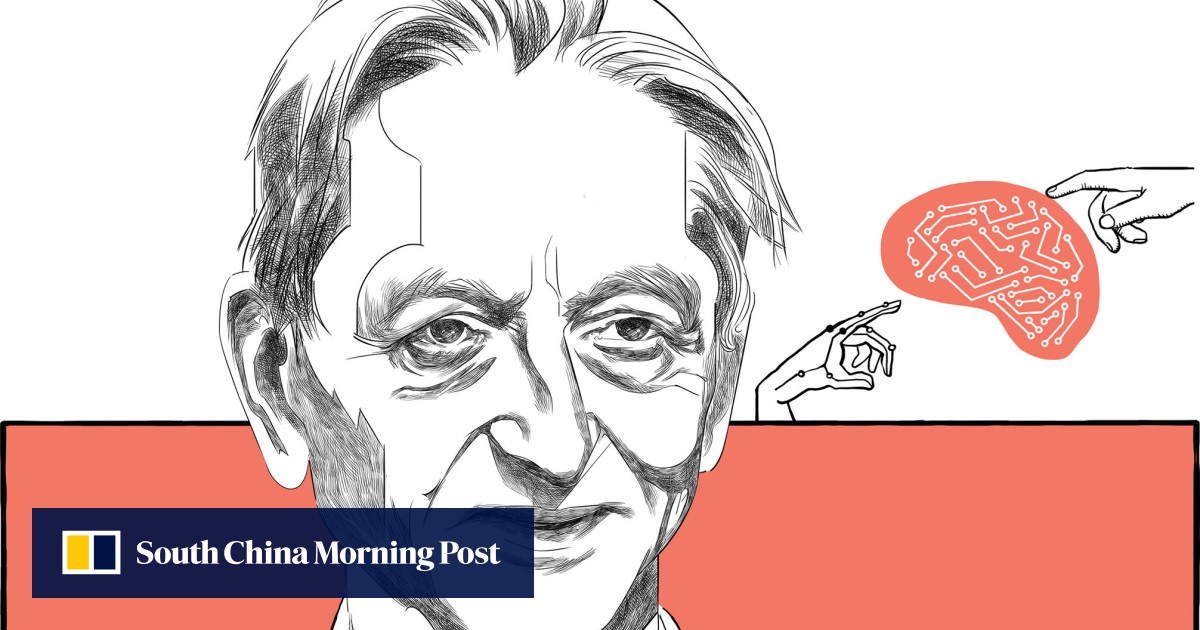
In 1983, while researching an article about artificial intelligence that I was writing for an obscure journal called The Wilson Quarterly, I interviewed an obscure computer scientist named Geoffrey Hinton. Hinton advocated an approach to artificial intelligence that was outside the mainstream but that, as I put it in the article, “some tout as the new wave in AI.”
In those days the mainstream approach to AI— what I called the “top-down” approach — tried to give machines the power to reason by manipulating sequences of symbols, much as a mathematician translates a real-world problem into formal notation and works toward a solution. Hinton believed that true artificial intelligence would come from building neural networks: machines modeled loosely on the human brain, with vast numbers of nodes — “neurons” — connected to one another. The strength of neural networks would lie not in the formal manipulation of symbols but in the patterns of neural interconnection activated for various cognitive purposes. Because the nodes could work simultaneously, the approach was sometimes called massive parallelism. I still remember Hinton uttering that term energetically in his British accent.
I wrote the article up, and it appeared in the quarterly’s Winter 1984 edition, and that was that. In the ensuing years, I’d occasionally encounter Hinton’s name in articles about AI — a reminder, at the edges of my attention, that the field was still moving.