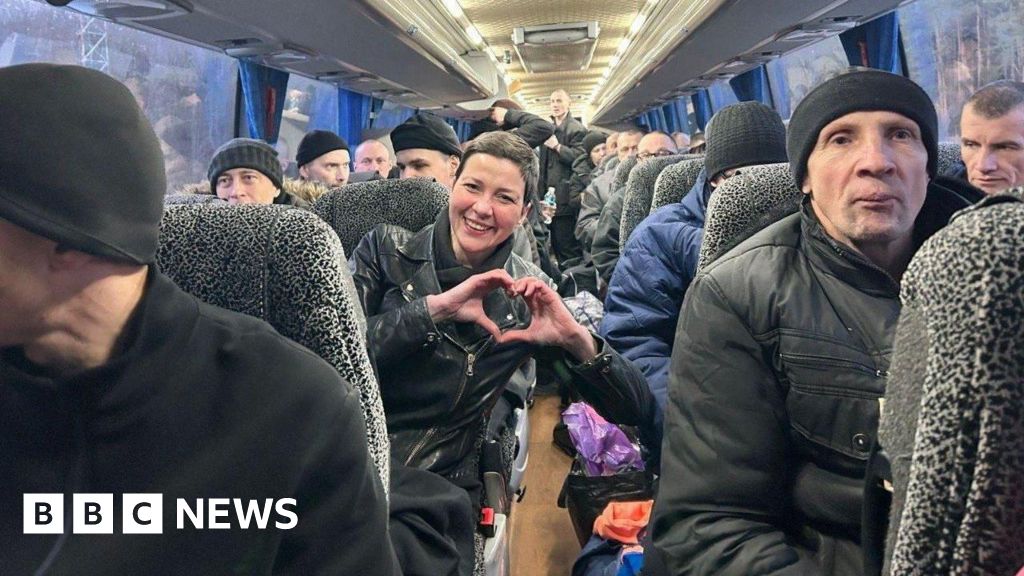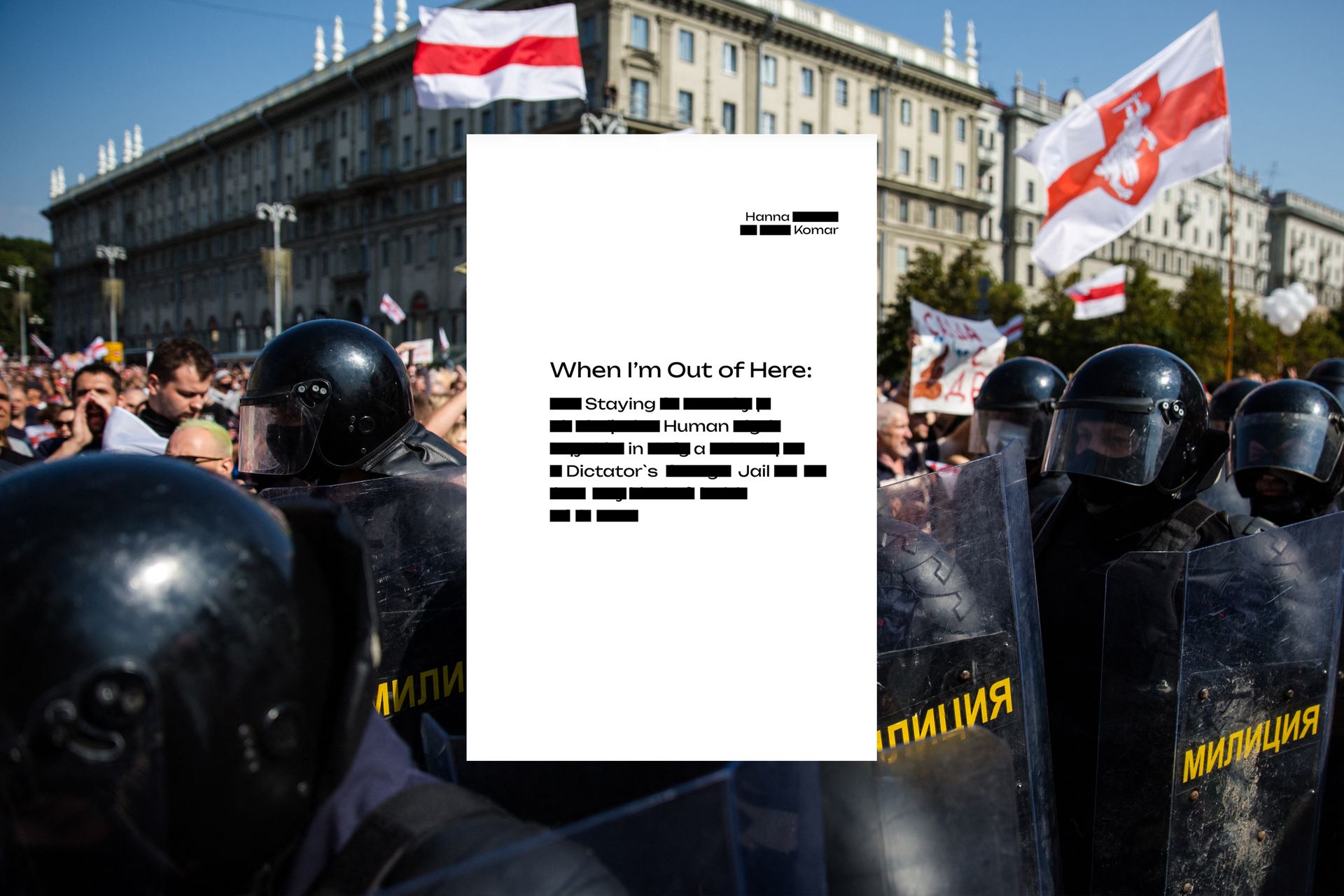
In a Belarusian prison, it's a simple note — "We are with you" — hidden inside a chocolate bar from a volunteer aid package that can move political prisoners to tears. In their tightly monitored environment, where isolation itself is a form of punishment, such gestures take on an almost sacred significance.Hanna Komar's memoir "When I'm Out Of Here: Staying Human in a Dictator's Jail" details how these fleeting acts of solidarity become a means of holding on when living in an authoritarian regime. In some respects, they serve as reminders that the regime has not succeeded in its most fundamental aim: to sever the imprisoned from the society for which they risked their freedom.Part prison diary, part political testimony, "When I'm Out Of Here" is less concerned with brutality than with the fragile, stubborn forms of humanity that persist alongside it. Komar recounts not only her own arrest and imprisonment, but the experiences of countless others swept up in the mass detentions that followed Belarus's 2020 uprising against Alexander Lukashenko. "When I'm Out of Here" situates these personal struggles endured in prison within a wider national trauma, turning individual memory into a collective record of resistance.After the presidential election of August 2020, hundreds of thousands of Belarusians poured into the streets when Lukashenko claimed yet another implausible landslide victory. Independent observers and much of the international community regarded his main challenger, Sviatlana Tsikhanouskaya, as the rightful new leader of the country.For weeks, Belarus witnessed the largest demonstrations in its post-Soviet history: an extraordinary, if brief, eruption of civic defiance in a country long thought politically inert. Though the movement was eventually crushed by mass arrests, torture, and exile, it brought Lukashenko's regime closer to collapse than at any previous moment in his three-decade rule.Komar herself was arrested in September 2020 while marching in support of Maria Kalesnikava, one of the leading figures of the anti-government movement, who had just been detained after thwarting the authorities' attempt to force her into exile. Kalesnikava's dramatic refusal — tearing up her passport at the border to prevent her deportation — quickly became emblematic of the opposition's refusal to yield.Law enforcement officers detain women during a rally protesting the presidential election results in Minsk, Belarus, on Sept. 12, 2020. (TUT.BY / AFP via Getty Images)Hundreds of relatives of detained protesters stand outside a pre-trial detention center in Minsk, Belarus, on Aug. 12, 2020. (Misha Friedman / Getty Images)For Komar, the consequences of showing her solidarity with Kalesnikava were immediate. Her "crime," as she says, was little more than the public expression of hope for a democratic future. For this, Komar was detained and sentenced to nine days of administrative detention, on the strength of a police report alone, a procedural fiction that had by then become routine in Belarusian courts.The brevity of her sentence is, in some ways, what makes the memoir so revealing. Komar writes from the threshold of the prison system rather than its depths, capturing the arbitrary machinery of Lukashenko's system of repression at the moment it first closes around ordinary citizens. Reading it, there is an implicit understanding that far worse is yet to come for those who are less lucky to get out sooner.In the years following the failed revolution, thousands of Belarusians have faced arrest, imprisonment, or exile. Hundreds have spent years behind bars, with some having died in detention. Though recent months have seen the U.S.-facilitated release of some political prisoners, Lukashenko's apparatus of terror remains firmly intact, a reminder that the political crisis of 2020 was never resolved so much as systematized.As a poet, Komar writes that she understood almost immediately that her experience of arrest and detention would need to be transformed into literature. Yet, as she explains in her introduction, she was wary of producing a narrowly autobiographical account, one that would reduce a collective political rupture to the confines of a single voice. The challenge, then, was not only to remember but to arrange memory in a way that could carry more than personal testimony.For this purpose, she turns explicitly to the stylistic model mastered by Belarusian journalist Svetlana Alexievich, whose works — such as "Voices from Chornobyl" — assemble fragments of speech, recollection, and witness testimony from a number of people into a collective narrative form. By adopting this approach, Komar situates her book within a distinctly Belarusian tradition of documentary literature, one that treats individual voices not as isolated case studies but as refracted parts of a shared historical experience.The testimonies in Komar’s book are so vivid and sensory that reading about life in prison can at times feel physically nauseating. What comes through is a world felt in the body’s most basic discomforts: the foul taste of food that barely passes for nourishment, bruises not just from guards but from trying to sleep on thin, unforgiving mattresses over metal bunks, and the relentless "attacks" of cockroaches.The air itself becomes a compromise: the cold draft from an open window is at once intolerable and necessary, preferable to the suffocating lack of ventilation and useful, too, in masking the stench of the shared toilets. Life in prison is shaped not just by the absurd routines of cruelty masquerading as discipline, but by this steady erosion of physical comfort, where countless small sensory irritations pile up into a constant, grinding pressure meant to break prisoners.
'My first impression was it's hell' — Belarusian prison memoir brings attention back to Lukashenko's repressions
In a Belarusian prison, it's a simple note — "We are with you" — hidden inside a chocolate bar from a volunteer aid package that can move political prisoners to tears. In their tightly monitored environment, where isolation itself is a form of punishment, such gestures take on an almost sacred significance. Hanna Komar's memoir "When I'm Out Of Here: Staying Human in a Dictator's Jail" details how these fleeting acts of solidarity become a means of holding on when living in an authoritarian reg
1,627 words~7 min read