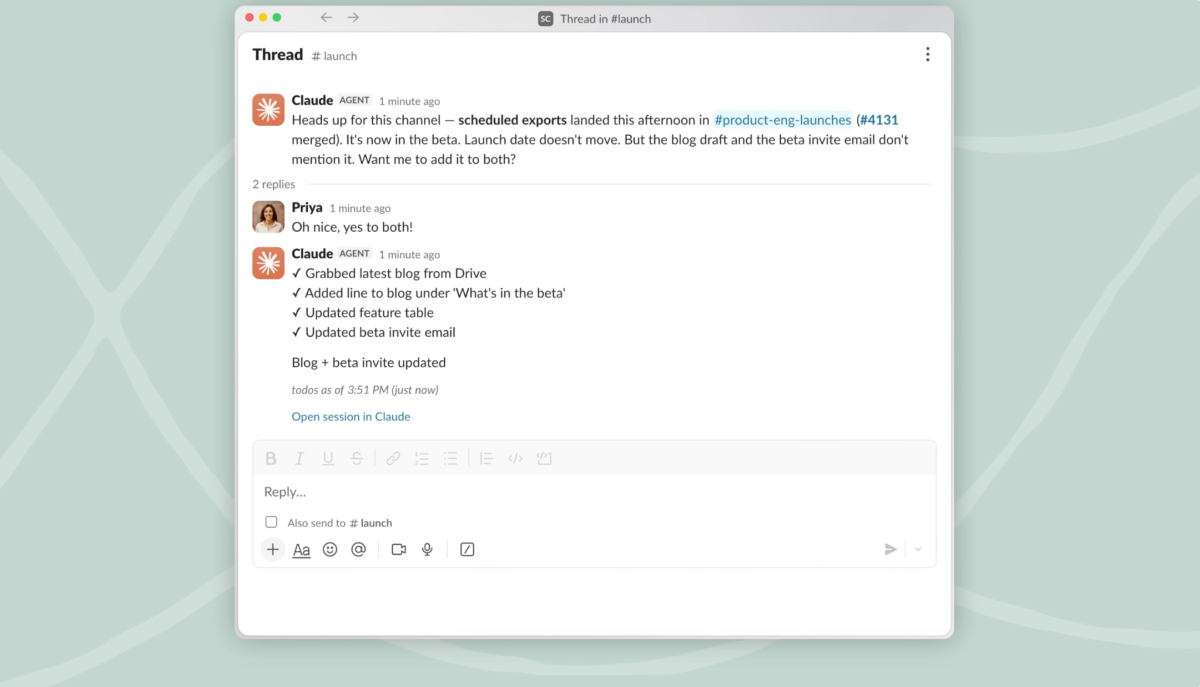
Anthropic has introduced a new feature called Claude Tag, expanding its vision for AI beyond one-on-one chatbot conversations and into team collaboration. The company says the new system allows employees to tag Claude directly inside Slack channels, enabling the AI assistant to work alongside teams, access approved tools and data, and complete tasks asynchronously while building context over time.The launch marks Anthropic's latest effort to make AI a more active participant in workplace operations. Instead of opening a separate chat window to interact with an AI model, users can now bring Claude directly into ongoing team discussions, assign tasks, and allow it to work across connected tools and workflows.Key TakeawaysAnthropic has launched Claude Tag, a new AI collaboration feature for teams.The tool is currently available in beta for Claude Enterprise and Team customers.Claude Tag works inside Slack and can be invited into channels like a team member.The AI can access approved tools, datasets and codebases to complete tasks.Claude can remember channel context and continue conversations over time.Anthropic says 65% of its product team's code is now generated by its internal version of Claude Tag.The company plans to expand Claude Tag beyond Slack in the future.Anthropic is pushing AI beyond traditional chatbot interactionsIntroducing Claude Tag, a new way for teams to work with Claude.In Slack, Claude joins as a team member with access to the channels and tools you choose. Tag Claude in and delegate tasks to it while you focus on other work. pic.twitter.com/R2C6A5Kcye— Claude (@claudeai) June 23, 2026 Most AI assistants today operate through individual conversations where users ask questions and receive answers. Anthropic believes workplace AI can become far more useful if it participates directly in team environments instead of remaining confined to standalone chats.Claude Tag reflects that thinking. Once added to a Slack channel, the AI can be tagged just like a colleague. Users can assign work using simple language, and Claude will break the request into multiple stages before carrying out the task using the tools and information to which it has been granted access.According to Anthropic, the system has already become a central part of internal workflows. The company says tagging Claude is now one of the primary ways teams get work done, with its internal version contributing to activities ranging from software development and support tickets to product analytics and bug investigations.The launch also represents what Anthropic describes as the next evolution of Claude Code, making the AI more proactive and capable of supporting entire teams rather than individual users.Claude learns from team conversations and shared contextOne of the biggest differences between Claude Tag and traditional AI assistants is their ability to accumulate context over time.Anthropic says there is only one Claude operating within a specific Slack channel, meaning every team member interacts with the same AI instance. As a result, Claude can follow ongoing discussions, remember previous interactions and understand the context behind projects without requiring users to repeatedly explain the same information.The company says Claude can also learn from other approved Slack channels and connected data sources if administrators grant access. This enables the AI to develop what Anthropic describes as the tacit knowledge necessary to provide more useful responses and assistance.Importantly, the company notes that Claude does not automatically report information from private channels and remains restricted to the permissions granted by administrators.The AI can work independently and proactivelyAnother feature Anthropic is emphasising is Claude's ability to work asynchronously.Instead of requiring constant supervision, users can assign a task and move on to other priorities while Claude continues working. The AI can schedule tasks for itself, revisit projects later, and even pursue long-running assignments over the course of hours or days.Anthropic says this approach has significantly changed how its own teams operate. Employees can delegate work to multiple Claude instances simultaneously while focusing on higher-priority responsibilities.Claude Tag can also take initiative when its "ambient" behaviour setting is enabled. In this mode, the AI proactively surfaces information it believes may be relevant, follows up on unresolved discussions, and highlights updates from connected tools and channels.The company argues that these capabilities move AI closer to functioning as a genuine collaborator rather than a reactive assistant.Security controls are central to the rolloutBecause Claude Tag is designed for organisations rather than individual consumers, Anthropic has placed significant emphasis on access management and data controls.System administrators determine exactly which channels, tools and information sources Claude can access. The company describes this as creating separate Claude identities for different business functions.For example, a Claude instance configured for sales activities would not share memories or information with another instance handling engineering work. Likewise, employees would only have access to the tools and datasets assigned to their specific environment.Administrators can also set spending limits, monitor token usage, and review logs showing what Claude has done and who requested each task. Anthropic says these controls are intended to help organisations adopt AI while maintaining oversight of sensitive information and operational costs.Available now for Enterprise and Team customersClaude Tag is launching in beta for Claude Enterprise and Team customers and currently operates through Slack integration.Getting started requires organisations to connect Claude Tag to their Slack workspace, configure access permissions, connect relevant tools, establish spending limits, and test the system before wider deployment.Anthropic says Claude Tag replaces the existing Claude in the Slack app. Organisations currently using that application will have a 30-day migration period and will receive introductory credits to help teams experiment with the new feature.The system runs on Claude Opus 4.8, Anthropic's latest model, and the company says it plans to expand Claude Tag to additional workplace platforms beyond Slack over time.Frequently Asked Questions1. What is Claude Tag?Claude Tag is a new Anthropic feature that allows teams to interact with Claude directly inside Slack channels and assign tasks using simple @Claude mentions.2. How is Claude Tag different from a normal AI chatbot?Unlike a traditional chatbot that works in isolated conversations, Claude Tag operates within team channels, remembers context and collaborates with multiple users.3. Can Claude Tag work without constant supervision?Yes. Anthropic says the AI can complete tasks asynchronously, schedule future work and continue projects over hours or days.4. How does Anthropic prevent data from being shared across teams?Administrators create separate Claude environments with controlled permissions, ensuring that information from one department does not automatically flow into another.5. Who can use Claude Tag right now?The feature is currently available in beta for Claude Enterprise and Claude Team customers through Slack.end of article
Why Anthropic Wants Claude to Work Like a Teammate, Not Just Another AI Chatbot
Anthropic has introduced a new feature called Claude Tag, expanding its vision for AI beyond one-on-one chatbot conversations and into team collaboration. The company says the new system allows employees to tag Claude directly inside Slack channels, enabling the AI assistant to work alongside teams, access approved tools and data, and complete tasks asynchronously while building context over time.The launch marks Anthropic's latest effort to make AI a more active participant in workplace operations.
1,071 words~5 min read