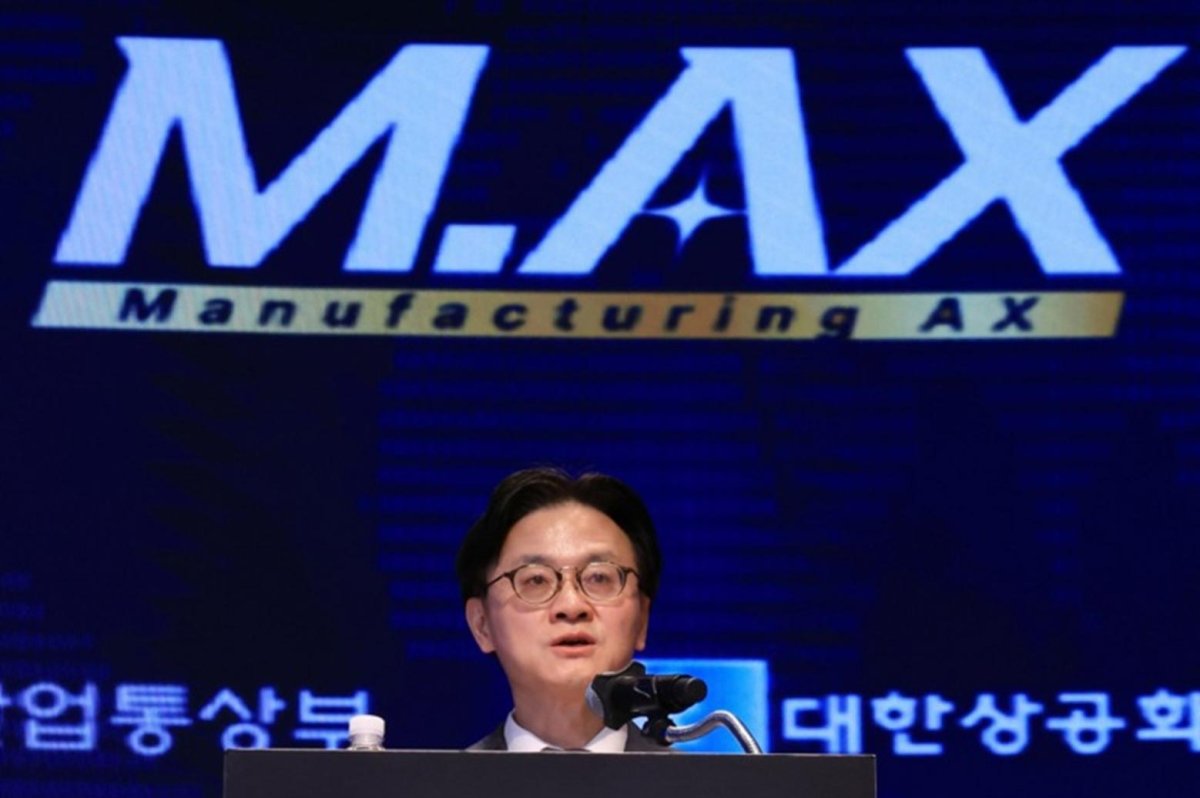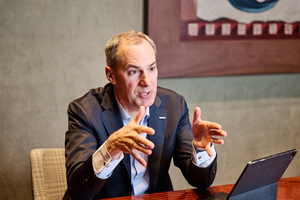
Industrial AI will transform factories, but humans will remain in charge, says Digital Industries CEO Cedrik Neike Cedrik Neike, member of the managing board at Siemens and CEO of Digital Industries, speaks during an interview with The Korea Herald in Seoul on Tuesday. (Siemens Korea) South Korea is uniquely positioned in shaping the future of artificial intelligence, owing to its robust manufacturing sectors and the vast amounts of data generated by its factories, according to a top executive at Siemens.“The treasure we are sitting on as industrial countries is industrial data,” Cedrik Neike, member of the managing board at Siemens and CEO of Digital Industries, said in an interview with The Korea Herald on Tuesday in Seoul, referring to manufacturing powerhouses such as Korea and Germany.Neike was in Seoul as the German tech giant looked to deepen its longstanding presence in Korea, adding a fresh partnership with Naver Cloud to bring localized industrial AI and software tools to Korean manufacturers.He said that while consumer AI is increasingly dominated by the US and China, countries like Korea and Germany have a chance to lead in industrial AI by using factory data to train specialized models to improve manufacturing processes.Korea faces challenges similar to Germany’s, he added. “It is an aging society, and it is a society which needs to find its place in this AI age."“We need to upscale because it’s a huge chance. But it’s also a huge risk,” Neike said. “If you miss industrial AI, your industrial base could be disappearing very quickly."As manufacturing standards evolve toward industrial AI — using data-driven insights to manage complex and flexible production lines — Neike emphasized that Korea is particularly well positioned to lead, thanks to its strength in key industries.“Korea is extremely industrialized with a very high adoption of robotics,” he said. “It is very well placed in key industrial segments such as semiconductors, pharmaceuticals, machine tools, batteries and cars.”Future factoryRising geopolitical pressures, supply chain instability and shifting trade policies are fundamentally changing the nature of manufacturing. Rather than relying on large-scale, export-driven production centers, companies are building smaller, more localized facilities closer to end markets, Neike said, adding that Siemens is also moving in that direction."I believe that we will build way more smaller factories, instead of building one big factory and exporting for the rest," he said.He added that future factories will be much more flexible, producing a more diverse range of products to meet shorter product cycles and local demand.AI is expected to speed up this transition by enabling factories to automate a wider range of tasks and adapt more quickly to changing customer needs, a process Neike described as “automating the automation.”“I think that AI will enable you to talk to your factory,” he said, where AI will provide real-time updates on productivity, bottlenecks, production flows, supply chains and possible layout changes to optimize operations.Humans, however, will remain responsible for evaluating and approving major decisions, Neike stressed, dismissing concerns that AI-driven factories and humanoid robots will reduce human workforces.The jobs will change, though, he said."I think the same amount of people will work, but they will just do less repetitive and more creative jobs in the industrial environment."Workers are expected to move away from manual tasks to do more intellectual jobs, such as supervising AI systems, interpreting production data and industrial models. While AI will increasingly optimize factory operations, humans will remain the ultimate decision-makers.“There will always be a human in the loop,” Neike said, stressing Siemens' vision is not a “dark factory," but an environment where AI serves as a powerful copilot for workers.“Adopting AI will make a country more competitive and have more jobs than countries not adopting AI,” Neike said.“If you don’t adopt AI, you are less competitive on a worldwide basis, and therefore you cannot have your own products and the jobs will disappear.”Deepening Korea pushNeike noted that as industrial AI continues to mature, collaboration between Korea and Germany will grow ever more critical."Germany has to work with Korea," he said, adding that Korea's leadership in semiconductors and advanced manufacturing, combined with Germany’s industrial software and engineering capabilities, could create a powerful partnership.Neike said his visit to Seoul also reflected Siemens’ push to deepen its engagement with Korea’s major industrial sectors, ranging from defense and semiconductors to pharmaceuticals, data centers and construction.The company is currently working with local partners such as shipbuilder HD Hyundai, integrating Siemens digital twin and industrial software technology to digitalize production process and improve efficiency in shipbuilding.On Tuesday, Siemens signed a partnership with Naver Cloud to jointly develop industrial AI and digital transformation solutions for Korean manufacturers. The partnership will combine Siemens' automation, digital twin, industrial AI and IT/OT convergence technologies with Naver Cloud's infrastructure, including its hyperscale and modular data centers and cloud services. The two companies also plan to jointly identify customers and expand the market as well.
Korea's AI treasure is its factory data: Siemens top executive
South Korea is uniquely positioned in shaping the future of artificial intelligence, owing to its robust manufacturing sectors and the vast amounts of data gene
812 words~4 min read