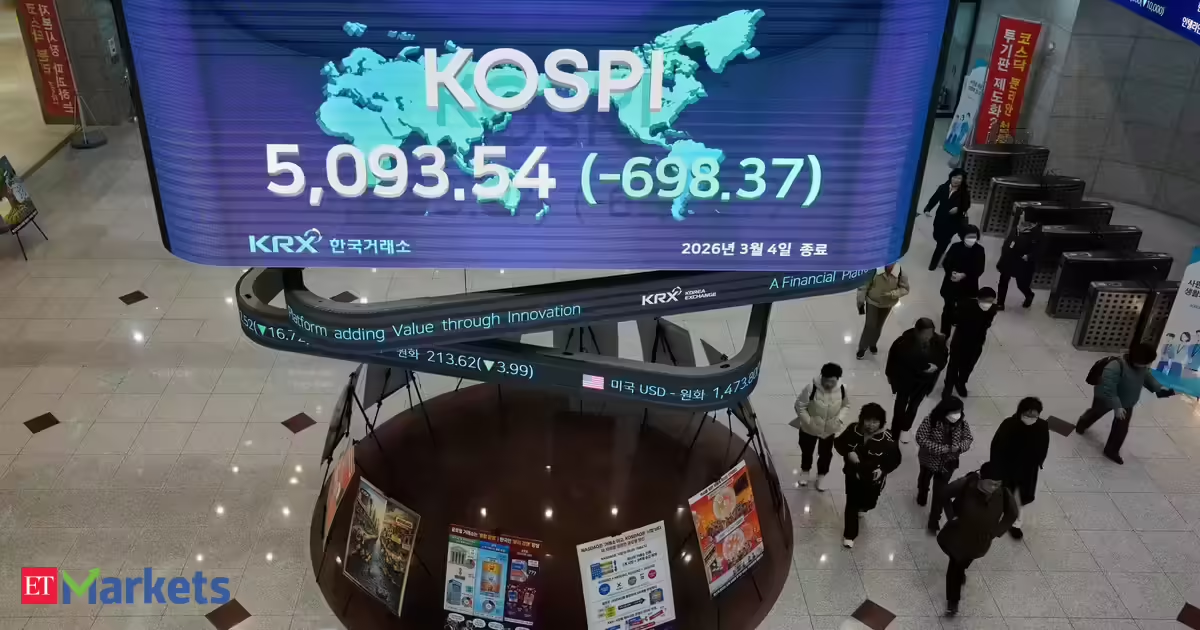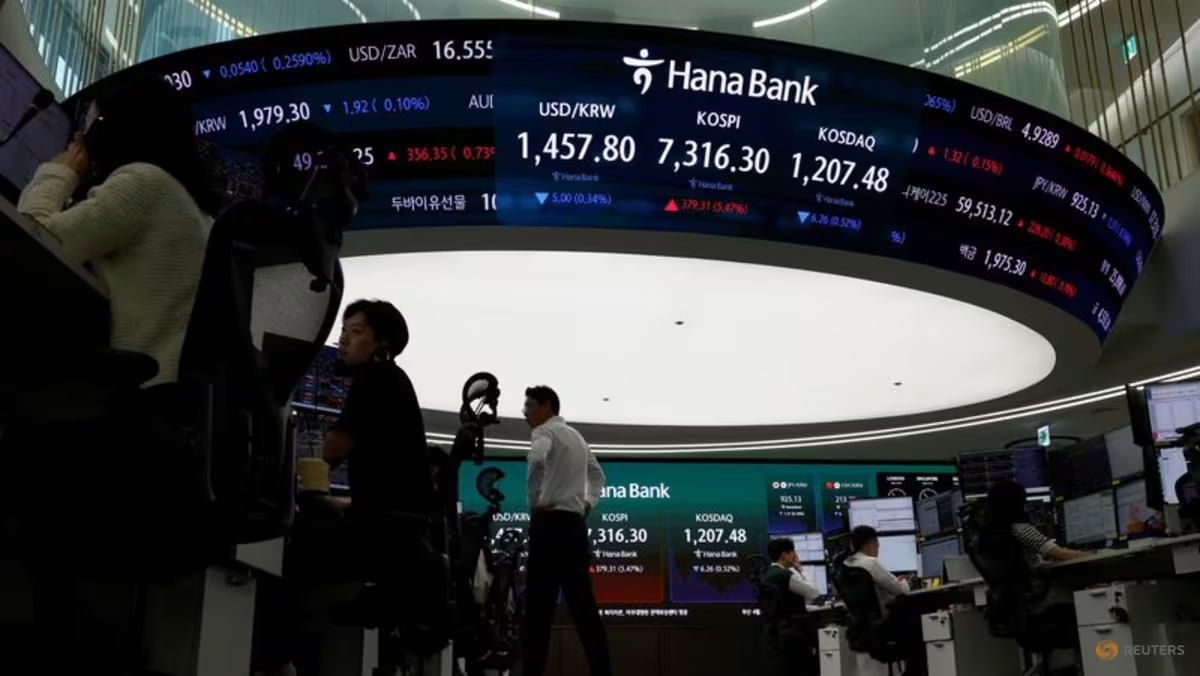
Foreign exchange access remains key hurdle despite Seoul's push to align market infrastructure with developed market standards (Getty Images) South Korea has again failed to make MSCI's developed market watchlist, delaying Seoul's long-running campaign to move beyond emerging market status. The decision comes despite a sweeping reform drive aimed at improving foreign investor access.MSCI, in its annual market classification review released early Wednesday Korea time, kept Korea in its emerging market category and left the country off the watchlist for a potential upgrade to developed market status. The decision pushes back Korea's upgrade timeline, as MSCI requires a market to be on the watchlist before any formal reclassification.The index provider acknowledged Korea's reform efforts, but made clear that the measures had yet to resolve the core accessibility issues."In Korea, authorities have continued implementing the reform agenda introduced in prior years, with additional measures announced across several areas," MSCI said in its global market accessibility review. "However, underlying accessibility issues remain unresolved."Key sticking point: FX accessIts strongest criticism centered on the foreign exchange market, particularly the fact that the Korean won is still not deliverable offshore and that liquidity in the onshore FX market during extended trading hours remains insufficient by developed market standards.According to MSCI, onshore liquidity during extended FX trading hours remains too thin to support tight execution standards comparable to those seen in developed markets. The issue, it said, is "constraining FX operational flexibility for index replicators and others."The Korean government, in a joint response from the Finance Ministry and financial authorities, said some reforms are still under way and others need more time to take hold, while vowing to continue pursuing foreign exchange and capital market reforms on Korea's own timeline.Reforms await market testThe setback highlights the gap between Korea's reform agenda and the level of operational convenience MSCI expects from developed markets. For MSCI, the key question was not whether Korea had announced enough policy measures, but whether global investors could trade, hedge, settle and transfer Korean assets with the same ease they expect in developed markets.Seoul has tried to address the FX concern by expanding access for registered foreign financial institutions, extending FX trading hours and testing third-party FX transactions with overseas investors.The government also plans to open the onshore FX market around the clock in July, before introducing a new offshore won settlement framework that would allow authorized foreign financial institutions to hold and transact Korean won through accounts opened in Korea.But MSCI's latest assessment suggests those steps remain either incomplete or insufficiently tested. In its report, the index provider said market participants need "ample time" to evaluate the sustained effectiveness of reforms before any reclassification consultations can begin.Beyond FX, Korea has also abolished the decades-old foreign investor registration requirement, moved toward the use of Legal Entity Identifiers, expanded English-language disclosures, allowed broader use of omnibus accounts and resumed short selling after a prolonged ban.Offshore won gapA veteran capital markets researcher at the Korea Capital Market Institute said Korea may need to go further in order to address MSCI's core concern over offshore won accessibility."What foreign investors want is for the won and the dollar to be exchanged in New York or London," the researcher said, speaking on condition of anonymity. "But Korea is saying it will keep the Seoul market open for 24 hours and have them trade through Seoul. That is different from opening an offshore spot won market."The planned offshore won settlement framework may improve settlement access, but it is not the same as allowing offshore spot trading of the won, the researcher added.Korea could still be placed on the watchlist next year if MSCI recognizes Seoul's reform efforts, but that would not mean the underlying issues had been resolved, the researcher said."Watchlist inclusion is not the same as actual inclusion," the researcher said, adding that the process would still require at least another year of review and additional time for actual index rebalancing after any upgrade decision. "Even from now, it would take three to four years at the fastest."Korea was placed on MSCI's developed market watchlist in 2008 but removed in 2014 after insufficient progress on market accessibility, the same issue that continues to weigh on its upgrade bid.Investor cautionEven if Korea eventually clears MSCI's hurdles, some global investors remain cautious about what developed market status would mean for the broader market.At a Seoul forum on Tuesday, Alexander Redman, CLSA's chief equity strategist, said Korea has a strong case for developed market status on economic grounds, but warned that an upgrade may not guarantee broad-based foreign demand."From a merit-based approach, yes, Korea should be a developed market," Redman said. "The question is whether that is actually a good thing in the short term."He said an upgrade would trigger forced selling by emerging market funds, while global funds may focus on Korea's largest semiconductor names rather than the broader market.If upgraded, Korea would move from being "the archetype of a big fish in a little pond to a very small fish in a very large pond," Redman said, warning of a potential vacuum in mid- and small-cap shares."Are they going to buy the rest of the market? That's a big question that remains unresolved."
Why Korea missed MSCI watchlist again
South Korea has again failed to make MSCI's developed market watchlist, delaying Seoul's long-running campaign to move beyond emerging market status. The decisi
865 words~4 min read