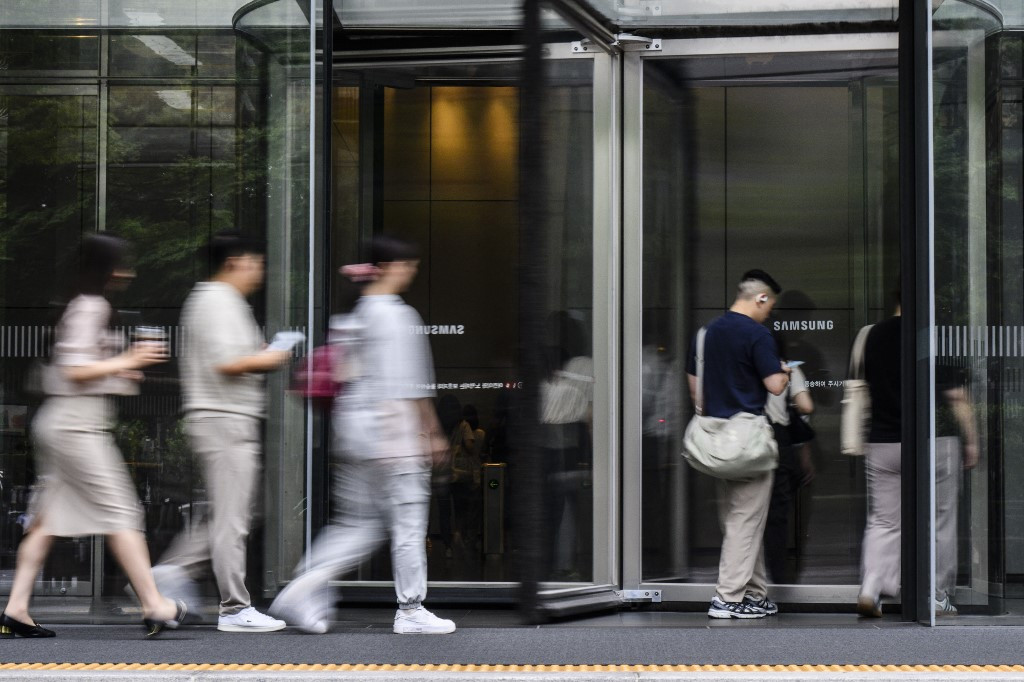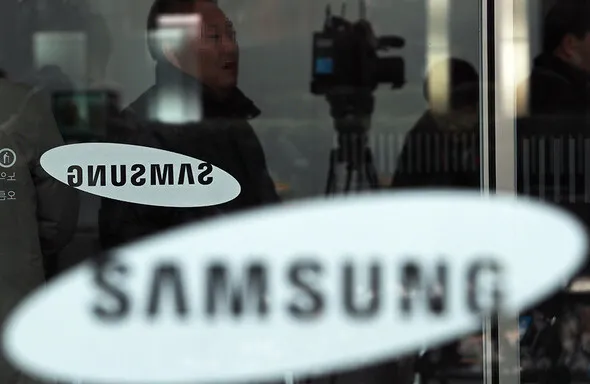
Reporters wait in the lobby of Samsung Electronics headquarters in Seoul’s Seocho district on Nov. 23
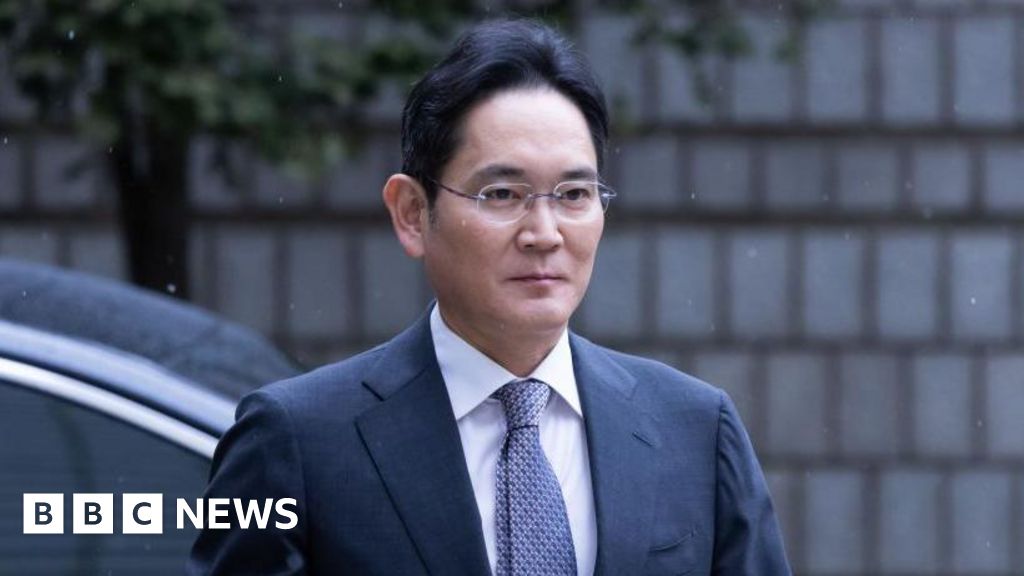
Eight years after the Samsung special prosecutor’s investigation, the group control tower of the Future Strategy Office is once again facing the threat of closure.The office faced an outpouring of denunciations during a National Assembly hearing on Dec. 6 amid accusations that it played a chief role in support to Choi Sun-sil and daughter Jung Yu-ra and lobbying for a merger between Samsung C&T and Cheil Industries, prompting Samsung Electronics vice chairperson Lee Jae-yong to pledge that he would “dismantle” it. As the officer in charge of external relations, office president (deputy head) Chang Choon-ki was quested by prosecutors on charges of directing over 30 billion won (US$25.8 million) in support from Samsung to Choi. President Kim Jong-joong (first strategy team head) is being accused of lobbying for National Pension approval as the official in charge of the Samsung C&T/Cheil Industries merger, which has drawn heavy criticisms for unfairness in its percentages.“There had already been predictions of changes like a downscaling of the Future Strategy Office in connection with the third-generation transfer of power [among Samsung’s ruling Lee family], and they may also have felt the need to give the appearance of taking some kind of responsibility for the support to Choi and her daughter,” said a Samsung Group source, strongly suggesting the control tower dismantlement pledge may have been discussed ahead of time.Samsung’s first control power came with its chairman’s secretariat, established in 1959 under founder Lee Byung-chull. But its legacy has proved a mixture of glory and disgrace, prompting three name changes since the mid-1990s, when Samsung first began making strides as a global company.During the foreign exchange crisis in 1998, it changed names to the “restructuring headquarters”; in 2006, it was reorganized into the Strategy and Planning Office as part of a public apology for the Agency for National Security Planning “X-file case.” After revelations of illegalities in a 2008 special prosecutor’s investigation of the Samsung slush fund scandal - including trillions of won in funds in borrowed-name accounts - led to the indictment of chairman Lee Kun-hee and others, the office’s abolition was announced as part of the group’s management reform measures.But even after losing its name, the office continued working behind the curtain. In 2010, it re-emerged under the name Future Strategy Office. Today, it has over 250 people working on six teams: strategy, management diagnostics, personnel, communications, planning, and law-abiding management. Amid the three name changes, the position of senior officer - often referred to as the group’s second-in-command - changed hands among vice chairpersons from Lee Hak-su to Kim Sun-taek and on to Choi Ji-sung.Assessments of the Samsung control tower have been nothing if not polarized. Samsung has named its planning capabilities alongside Lee Kun-hee‘s leadership and the capabilities of professional affiliate managers as one of the three main pillars of its success story. Other critics have accused it of being an organization without any legal identity that plays a guiding role in illegal or ambiguously legal actions.“It wields immense authority yet bears no responsibility, and as a result it has done things that are ill-considered and even illegal,” said Solidarity for Economic Reform director Kim Sang-jo. “Since there’s so little contact with society at large, it has remained insensitive to social change and the public’s demands, choosing to rely on past methods instead.”With most of the office’s chief figures, including Choi, being subordinate to Lee Kun-hee, many have also questioned their ability to spearhead the changes and innovations needed by Lee Jae-yong, the chief presence among the Lee family’s third generation.Predictions on the Samsung control tower’s fate are divided. Some argue that after Lee Jae-yong’s announcement to the public, the new dismantlement won’t be a transparent ploy like the 2008 declaration. When grilled by lawmakers at the hearing on whether his promise to dismantle the control tower wasn’t “just words,” Lee answered, “The public is watching. Wait and see.” At the same time, he could keep the office’s functions going in some different form, on the grounds that he would need some control tower unless he gives up managing the group.The most likely scenario in this case would be for the office to become part of the internal organization at Samsung Electronics, the group’s core company. In the Hyundai Group’s case, a control tower organization led by vice chairperson Kim Yong-hwan is located within that group’s core company, Hyundai Motor. If Samsung decides to shift over to a holding company system in the long term, that company could end up naturally assuming control tower functions. Samsung Electronics recently said it is considering plans to spin off holding and business companies. If the Samsung Electronics holding company merges with Samsung C&T, it would mean the completion of the group’s holding company system. SK and LG, South Korea‘s third- and fourth-ranked groups, already have holding companies performing a control tower function.A potential drawback of moving the group’s control tower inside Samsung Electronics is that it would leave open to criticisms of failing to keep the dismantlement promise. Shifting over to a holding company system would also take some time.“More than any reshuffling of the control tower’s organization or renaming, the important thing is to address the gap between power and responsibility and to implement fundamental reforms that put an end to misguided practices of engaging in illegal actions for the chaebol chairman’s interests or serving as a shield,” said Hongik University professor Jun Sung-in.By Kwack Jung-soo, business correspondent Please direct questions or comments to [english@hani.co.kr]