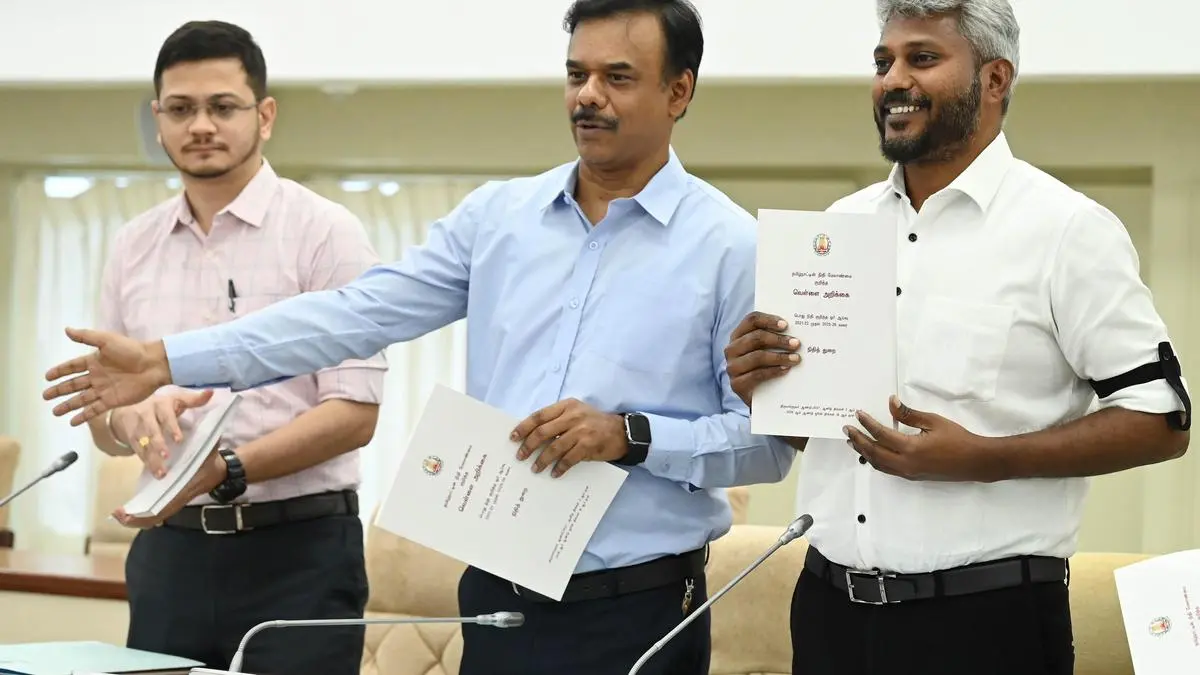
TN Finance Minister N Marie Wilson (right) and MA Siddique (centre), Additional Chief Secretary, Finance Department, Govt of Tamil Nadu releasing a White Paper on the Fiscal Management of Tamil Nadu, in Chennai, on June 16, 2026
| Photo Credit:
The White Paper on the public finances of Tamil Nadu for the period between FY22 and FY26 released by the new TVK-led government paints a picture of total disregard for fiscal prudence by the previous DMK government. Heavy spending and leakages in revenue collections have led to a consistently elevated revenue deficit and ballooning debt in the last five years.The White Paper indicates that salvaging the fiscal situation would require a sharp focus on increasing tax compliance, expanding the tax net by plugging corruption and reining in wasteful expenditure. It is remarkable that India’s premier industrial State with a strong services presence should slip up in revenue collections. While Maharashtra and Karnataka have managed to bring revenue deficit below 1 per cent of GSDP in FY26 and Gujarat recorded a revenue surplus, Tamil Nadu has consistently recorded revenue deficit over 2 per cent of GSDP in the last five fiscal years. The post-Covid correction has clearly not happened. This is largely due to the State’s total revenue receipts declining from 10 per cent of GSDP in FY22 to 8.32 per cent in FY26. Committed expenditure such as salaries, pensions and interest along with other statutory obligations account for almost 87 per cent of revenue receipts, leaving little room for productive investment. Capital expenditure as a percentage of GSDP has therefore been declining from 1.79 per cent in FY22 to 1.44 per cent in FY26. With the State borrowing to meet its annual expenditure, outstanding debt stock has doubled over the last five years to ₹10 lakh crore. The interest on these loans is resulting in crowding out other productive spending. The ratio of interest payments to capital expenditure in FY26 stood at 1.32:1 in FY26.While the new government has done well to acknowledge the magnitude of the problem, it must now make an honest attempt to set things right. It can start by assessing the fiscal impact of its numerous poll promises, such as ₹2,500 per month grant for female heads of families along with six free LPG cylinders and eight grams of gold, silk saree for brides, gold ring for newborns, grants for unemployed youth, farm loan waivers and interest free higher education loans. It should drop those that are unproductive. There must be a conscious effort to reduce annual borrowing. Revenue reform holds the key. All heads of Tamil Nadu’s own tax revenue including SGST, excise duty on fuel and excise and VAT on liquor have registered a decline as percentage of GSDP over the last five years.The tax net must be expanded to include all companies in the manufacturing and services sector, including those under-reporting revenue. Leakage of tax revenue in liquor sales must be addressed too. While taxes on liquor in Tamil Nadu mopped up ₹11,836 crore in FY26, the collections in Maharashtra and Karnataka were several multiples higher. Stamp duty collections do not correspond with transaction value, pointing to corruption. Hopefully, the new government will read the writing on the wall and more importantly set a saner financial course for the State.Published on June 23, 2026