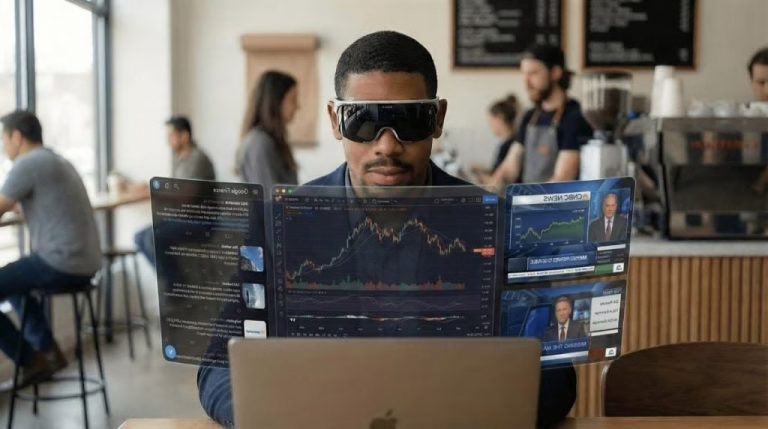
For most of Luminvera’s short life, the pitch came with an AR wearable. The company, incorporated in March 2026 and run out of Silicon Valley, started as a bet that the right device could pull an industrial engineer out of what its founder, Lu Yang, likes to call the “2D Stone Age.” A flat monitor renders a machine as lines on a plane. The machine is not a plane. The wearable was supposed to close that gap, letting an engineer see the thing in three dimensions, hands free, on the factory floor. Yang would demo it like a Tony Stark from Iron Man: here is the flat drawing, here is the same part standing in the air in front of you.
Recently, she dropped it.
“Following the pivot, we will focus exclusively on software for B2B customers in the robotics industry,” Yang says. The sentence is flat. The decision behind it runs back through most of a decade, to a problem she has been describing the whole time.
Yang built her career in the automotive industry, at Bosch, the German industrial and electronics conglomerate, and Mercedes-Benz. Trained as an IT project manager, she was responsible at Bosch for digital transformation across engineering and quality management. The job, stripped down, was watching expensive engineers do work that did not need their expertise.