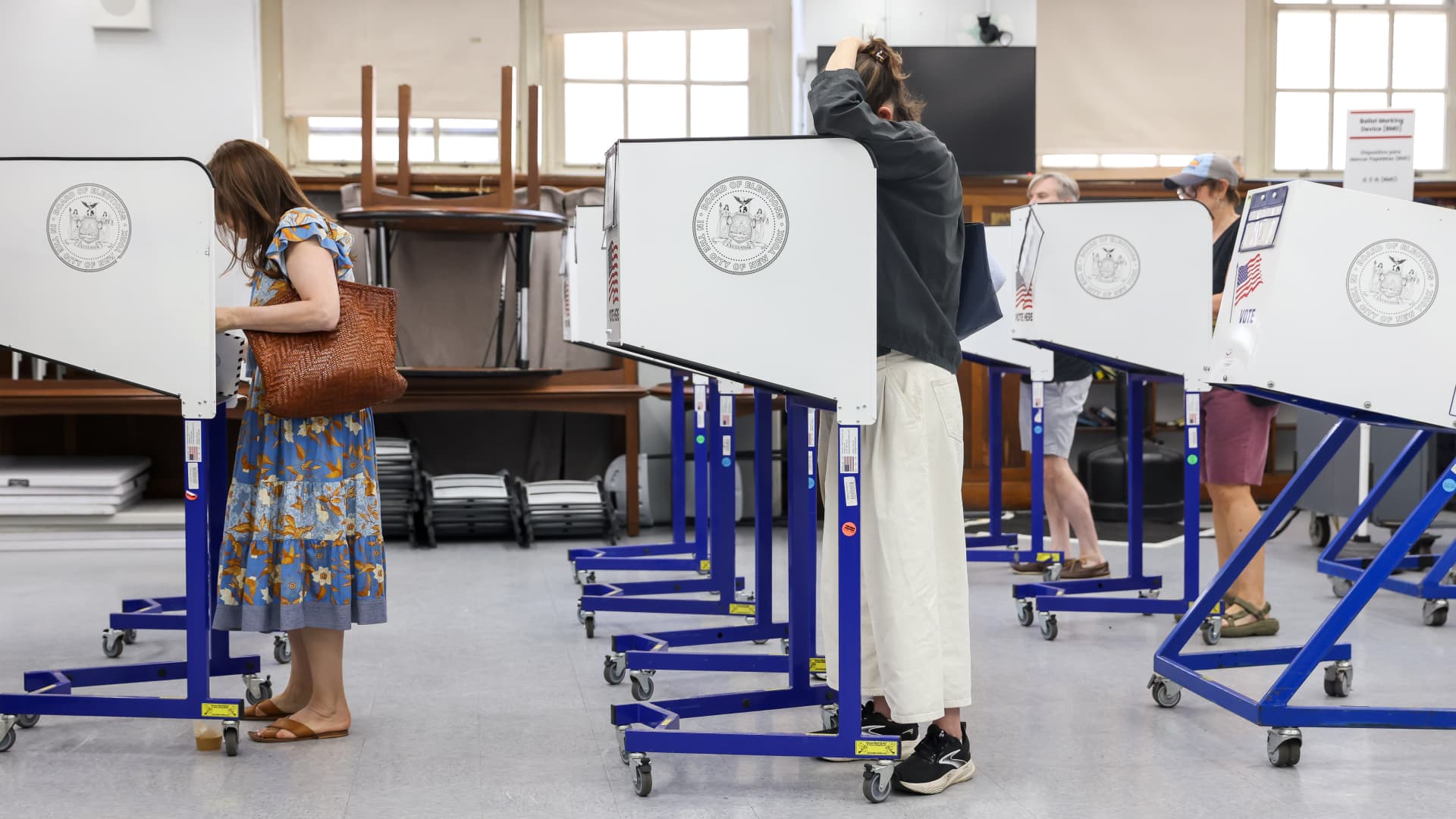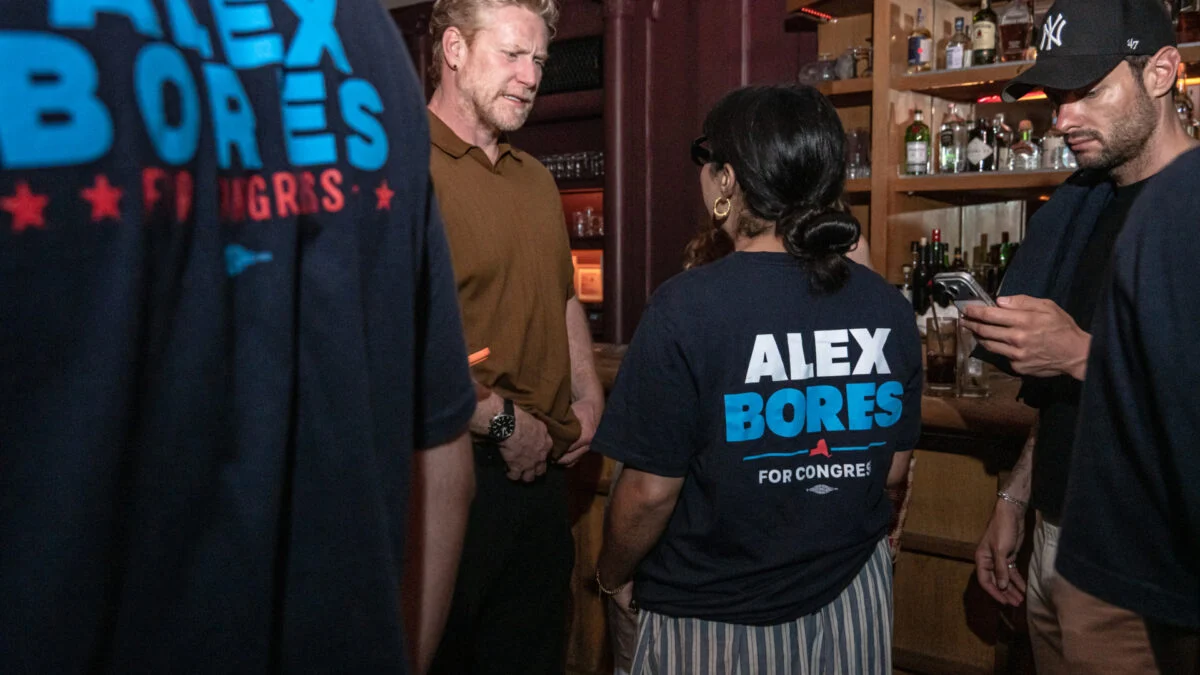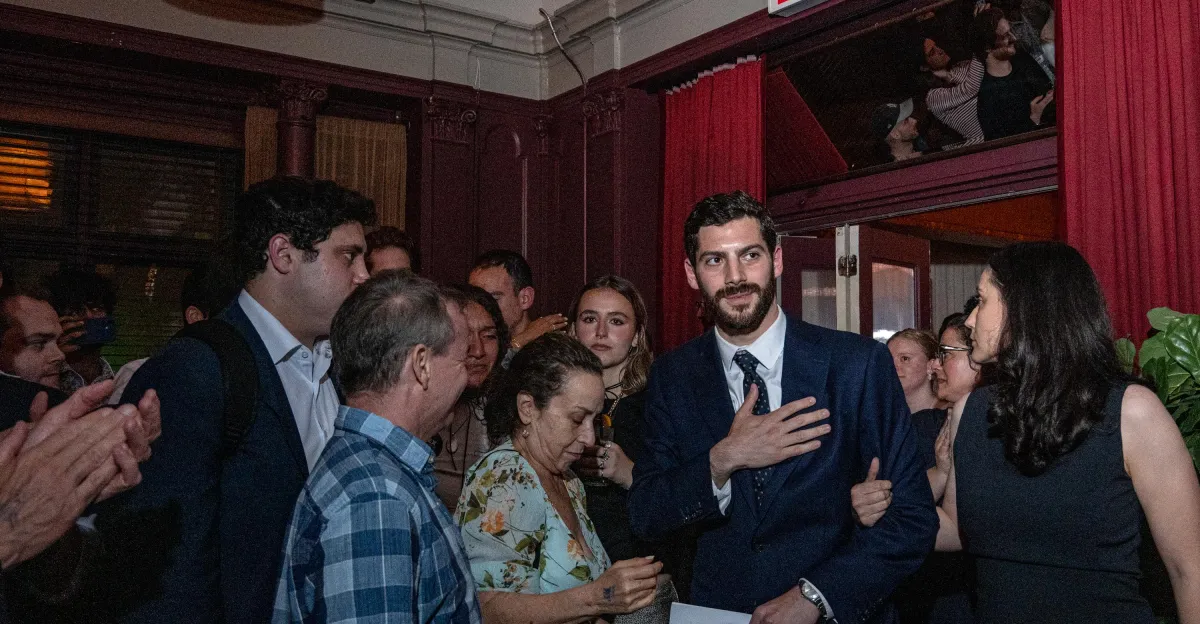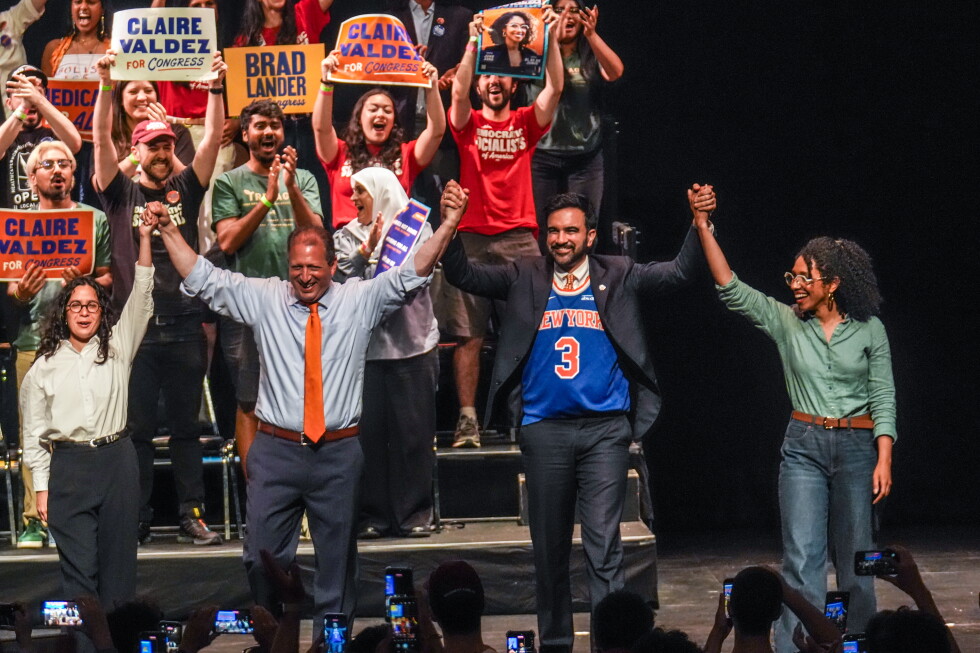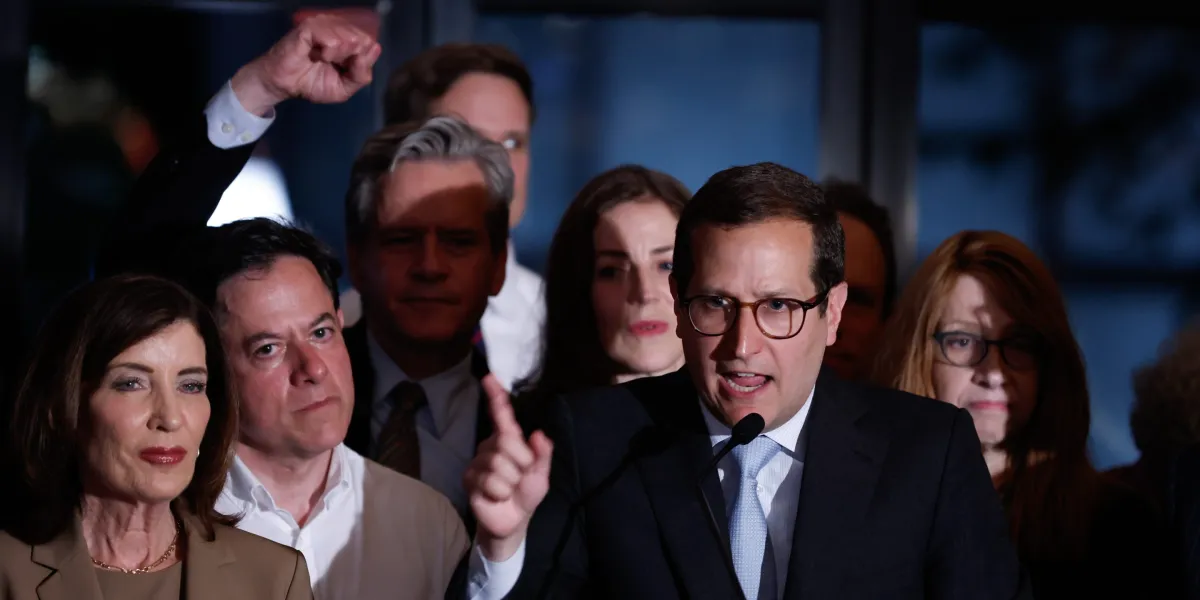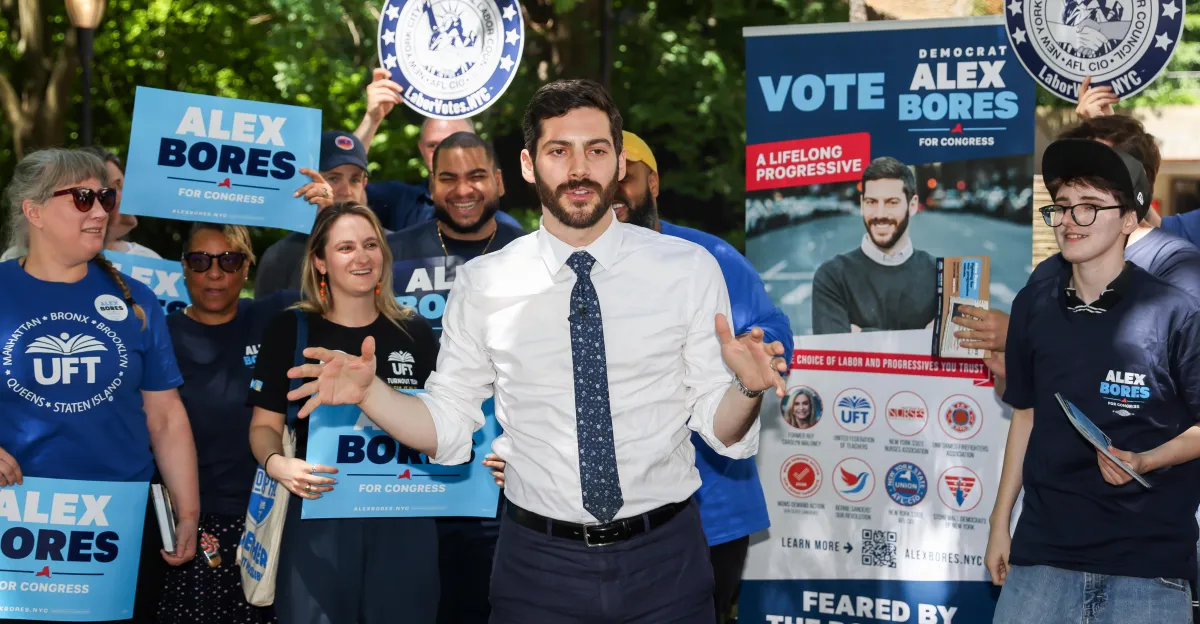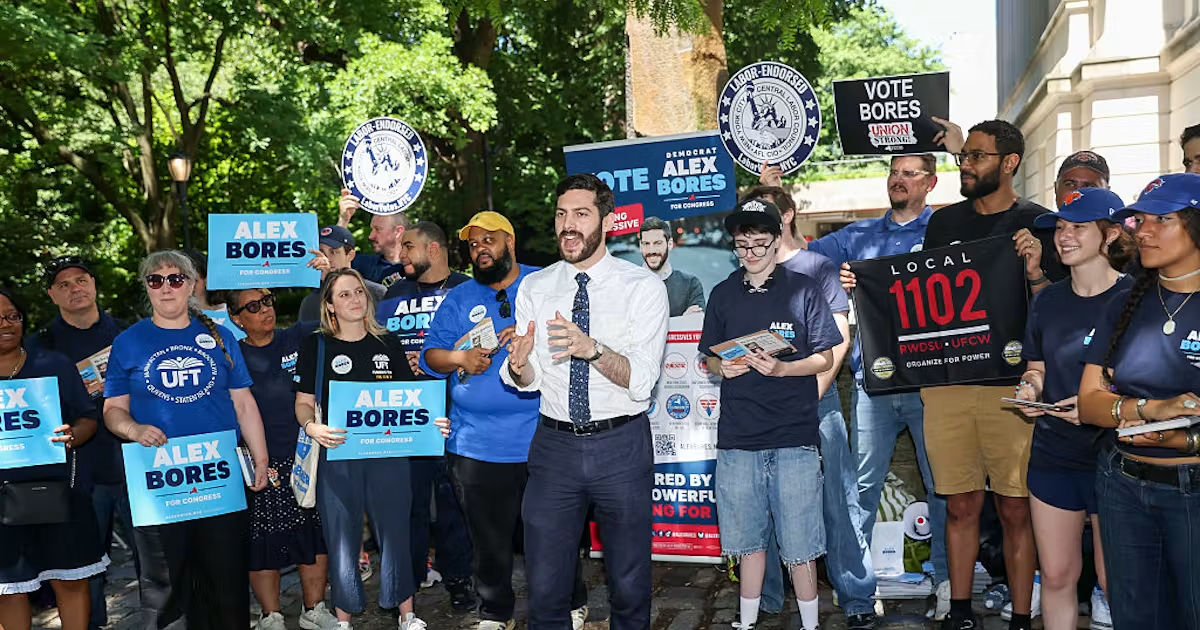
As New Yorkers head to the polls on Tuesday, a crowded Democratic primary in the state’s 12th congressional district could serve as a referendum on tech money in politics. But why this race has drawn quite so much money is a little mysterious. To some, it’s an intra-industry disagreement about the best approach to regulation—or, more cynically, a fight about which companies will get to influence future law. To others, it’s a sign that certain pro-AI interests want to make an early and brutal example of anyone who stands against them.AI industry political action committees have flooded this race with cash since it started. Leading the Future, a PAC funded in part by tech giants like Andreessen Horowitz and the co-founders of OpenAI and Palantir, has spent over $7 million against one particular candidate: two-term New York Assemblymember Alex Bores. Other PACs then jumped in on Bores’s behalf, including Public First Action PAC, which is supported in part by Anthropic and spent $10 million in Bores’s race. Bores, a former Palantir employee himself, might seem like an oddly small-fish target for one of the country’s richest, most powerful industries. His troubles with the PACs started with the Responsible AI Safety and Education, or RAISE, Act, an AI regulation bill he co-sponsored last year in the state legislature.The act, Bores’s own team acknowledges, is merely a “first step” toward robust AI regulation. Yet it’s also one of the strongest AI oversight laws currently on the books in the U.S. The bill, which New York Governor Kathy Hochul signed into law in December 2025, is somewhat aligned with California’s Transparency in Frontier Artificial Intelligence Act, signed into law earlier that year. Both laws only apply to the largest AI companies, like OpenAI, Anthropic, and Meta. New York’s RAISE Act requires these large frontier developers to write and publish a yearly framework that explains how the company will assess risk, mitigate any safety threats, and comply with national and international standards. The law also requires these companies to disclose serious safety incidents within 72 hours of learning about them, and introduces an enforcement mechanism, empowering New York’s attorney general to bring civil actions against companies that fail to submit the required reporting or make false statements. Bores and State Senator Andrew Gounardes—the bill’s other champion—originally wanted the penalty for the first violation to be $10 million, with up to $30 million in fines for subsequent violations, but the lawmakers brought those fines down to $1 million and $3 million to better align with California’s law.The bill was wildly popular with New Yorkers—84 percent of respondents supported it in a June 2025 poll—and it passed handily in both the state Senate and Assembly. But it quickly received pushback from the AI industry; Leading the Future announced its plans to target Bores in November 2025, before the bill had even been signed.“They want to send a message to any member of Congress that the cost of trying to regulate the AI oligarchs is complete political destruction,” said Alyssa Cass, a communications strategist working with the Bores campaign.The Trump administration also attempted to get out in front of the law, publishing an executive order on AI regulation just eight days before Hochul signed the RAISE Act. The executive order directed the Department of Justice to challenge “onerous” state AI laws that it believes conflict with a “minimally burdensome” national AI policy. In the order, the administration specifically said that state AI regulation hampers the country’s ability to “win” its “race with adversaries for supremacy” and called state laws “cumbersome.”Asked about the PAC’s heavy spending against Bores, a Leading the Future spokesperson provided a statement arguing that “Anthropic and its allies” started the spending war: “Their network of outside groups has spent $21 million across 5 dark-money super PACs to prop up Alex Bores’s campaign. Leading the Future is proud to stand against that unprecedented effort and for a transparent, national AI framework that serves workers, families, and the country.” The statement added that “any claim that we oppose regulation is flat wrong.”Public First Action explicitly markets itself as a pro-regulation PAC. One of its main principles is to support federal AI regulation, but ensure that it would not preempt state laws until the federal guidelines are robust enough to stand on their own. Anthropic, which has positioned itself as the safety-first tech company, gave $20 million to the PAC this February. The PAC’s other funders are less clear.Asked about Public First’s involvement in Bores’s race, a spokesperson for Jobs and Democracy, a subsidiary of Public First Action, wrote that opposing PACs were trying to “end [Bores’s] political career” in retaliation for the RAISE Act. “We’re in this race because candidates who champion AI guardrails shouldn’t have to stand alone against Big Tech. The fact that this race has gone from a crowded primary to a two-way race between the author of the RAISE Act and a cosponsor is proof that Leading the Future’s plan has backfired.”While Bores is betting that his strong stance on AI and public battle against AI PACs will win him the election, his opponents are focusing on other issues. Bores has three main competitors—State Assemblymember Micah Lasher, Jack Schlossberg of the Kennedy family, and the formerly Republican, anti-Trump crusader George Conway (once-husband of Trump 1.0 adviser Kellyanne Conway).Lasher—who also supported the RAISE Act—has been described in the media as a “nerd” or “wonk,” and is running a strong if somewhat bland campaign. He was in the lead in one mid-May poll. Schlossberg’s campaign has reportedly been disorganized, and the candidate seems to be banking on his family legacy to overcome his relative lack of political experience. Conway has framed his campaign as an effort to impeach Trump.If Bores loses, it may simply be because voters were drawn to the allure of a Kennedy or inclined to vote for a policy wonk. Then, too, some voters may remain put off by Bores’s former work for Palantir—a company whose AI software has reportedly been used to identify military targets. To his supporters, though, a Bores loss would show that the AI industry has a powerful grip on our elections, and can push out any candidate it doesn’t like. And if that message gets around, Cass said, it will be that much harder to get politicians to stand up to the industry.“Members of Congress are rarely known for their acts of political bravery,” Cass said. “And there is a really limited window, given how fast this technology is moving, for regulation.”
The AI Industry Is Spending an Insane Amount to Tank This NY Democrat
An OpenAI-affiliated PAC has spent over $7 million to defeat Alex Bores. An Anthropic-affiliated PAC has spent $10 million to boost Bores. What is going on?
1,086 words~5 min read