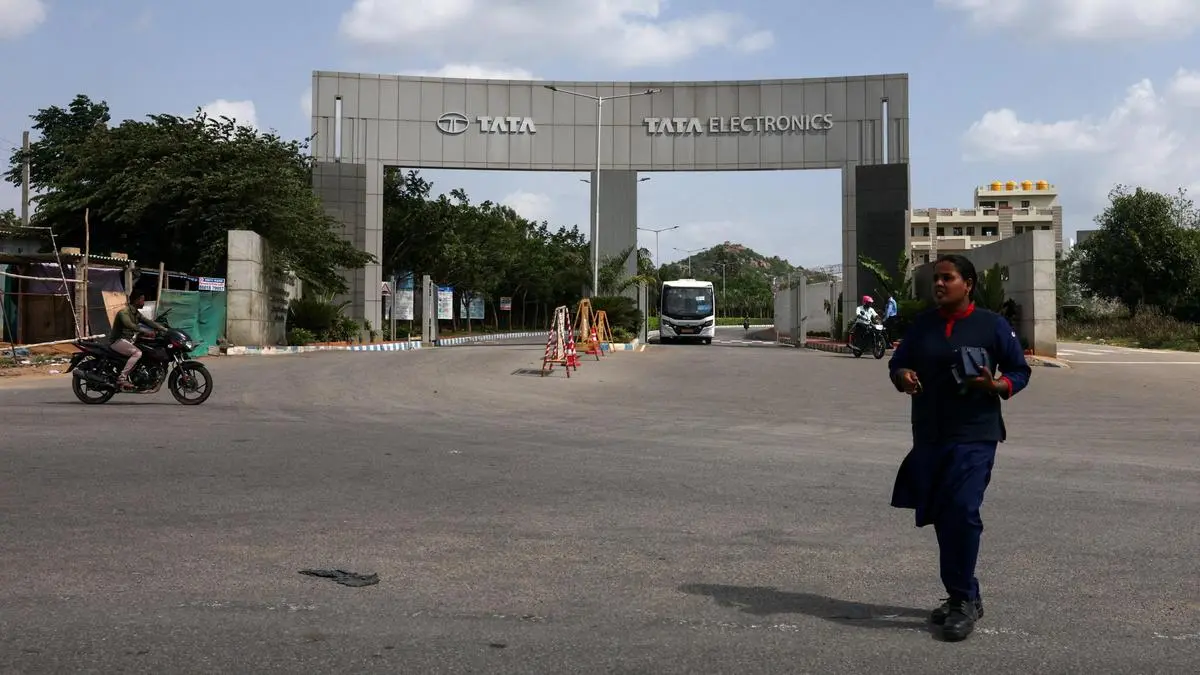
The entrance to Tata Electronics’ components factory for Apple in Hosur
The cybersecurity breach suffered by Tata Electronics on Monday highlights the need for an avant-garde approach to safeguarding enterprise information, according to experts who spoke with businessline.A Tata Electronics spokesperson confirmed the security breach after ransomeware group World Leaks posted company details related to Apple and Tesla“A few weeks ago, Tata Electronics identified a cybersecurity incident on some of our systems. Our response protocols were deployed immediately, and the incident has had no impact on our operations across businesses, which remain unaffected,” said the spokesperson.Reports indicate that hackers were able to access purported component design and specification document related to Apple and Tesla, both customers of the Indian group.Such supply chain breaches are among the most damaging in cybersecurity, considering the blast radius that reached beyond the breached entity, according to Srinivas L, Joint MD & Joint CEO, 63SATS Cybertech.“When a manufacturer’s network is compromised, the attacker inherits trust relationships, customer schematics and proprietary specifications belonging to clients. A single intrusion can expose multiple global corporations simultaneously, converting one vendor’s weakness into systemic risk across the ecosystem,” he said. He also warned that the exfiltration of design and inspection documents exposes trade secrets, contractual confidentiality and downstream client liabilities all at once.breach by defaultFor this reason, PrivaSapien argues that the future of cybersecurity must adopt a ‘breach by default’’ mindset, particularly in the face of growing AI-generated attacks. The company noted that as data moves across increasingly interconnected ecosystems with rising AI adoption, enterprises must embrace a new model of resilience — one that protects data even while it is in use.“The game moves to proactive anti-dote for attacks. Even in case of a breach, the need is that compromised data is protected beyond breach. That is where the industry must evolve next,” said Abilash Soundararajan , Founder & CEO, PrivaSapien.He added that privacy-enhancing technologies, such as differential privacy, consent-based access control, pseudonymous inference, zero knowledge proof system, homomorphic encryption, synthetic data, secure multi party compute and advanced anonymisation techniques, can significantly reduce the amount of sensitive information that needs to be shared, reducing the attack surface of sensitive data while still enabling business value creation.Published on June 23, 2026