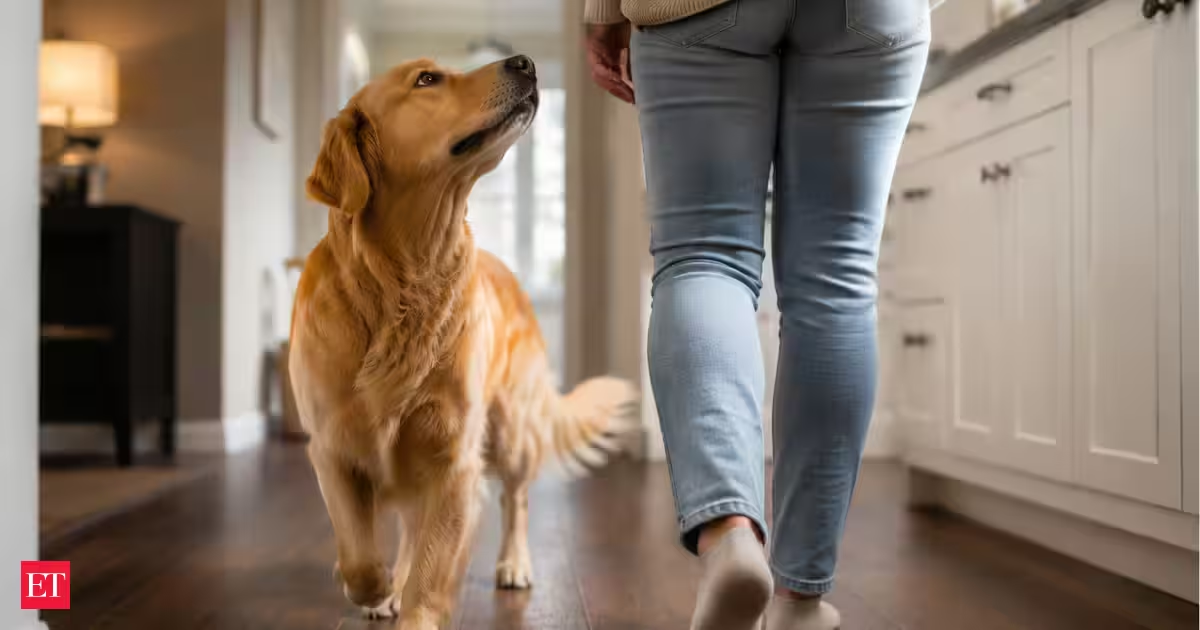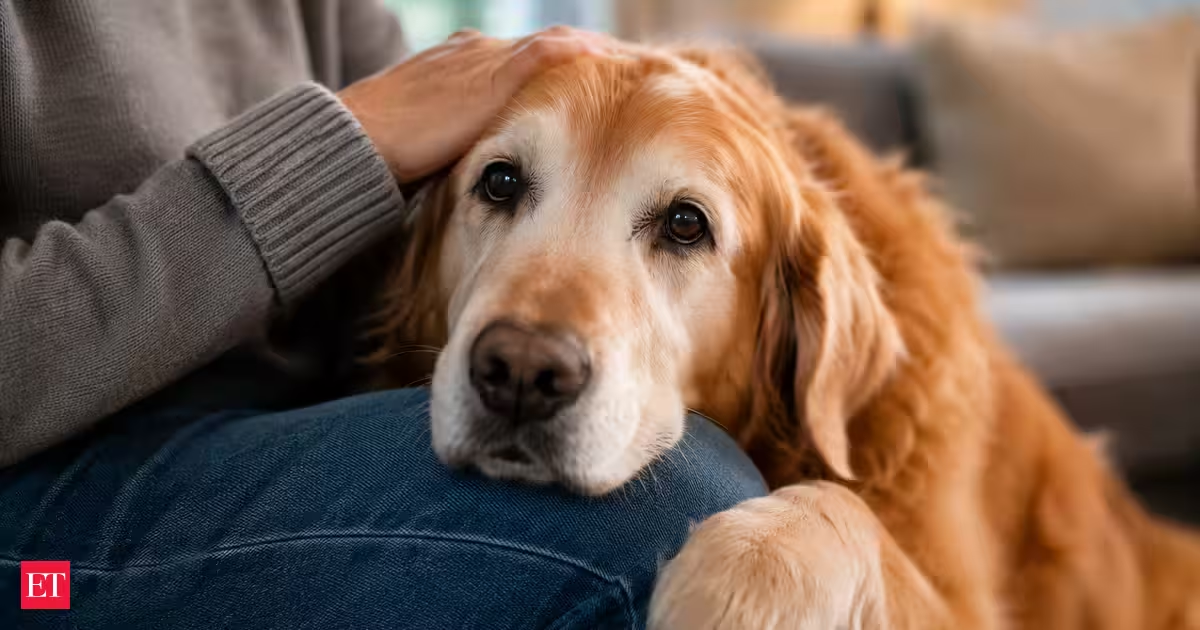
Here’s why dogs evolved a sensitivity to human eye contact, pointing gestures and emotional tone that even wolves raised alongside people never develop.gettyMost dog owners assume their dog’s “velcro behavior” is about affection. Their dog follows them from room to room, waits outside closed doors, appears underfoot the moment they settle somewhere new — and the easy interpretation is that the animal simply likes them. That explanation isn’t wrong, exactly, but it stops far too soon. What looks like fondness at the household level is, at the biological level, the expression of a social architecture that predates dogs entirely. It took shape in pack-hunting wolves long before domestication existed as a concept, and it was never selection-pressured out of the animals that eventually became our companions. Understanding what that architecture is, and why it persists, requires going back to the predator the domestic dog descends from.Dogs Inherited The ‘Wolf Pack’ ObligationWolves are what biologists call obligate social hunters, that is, animals whose survival depends not just on being with others, but on coordinating with them. Unlike solitary hunters such as leopards or tigers, wolves pursue prey that often outweighs them considerably, which means a lone wolf is, in practical terms, an ineffective one. Over thousands of generations, the individuals that stayed close to the group survived. Those who wandered alone did not. That selective pressure wired proximity-seeking into the canid brain at a foundational level: not just as a preference, but as a default operating mode.Dogs carry that wiring intact. Domestication, which genomic studies place somewhere between 15,000 and 40,000 years ago, depending on the methods used to estimate it, didn’t dismantle the social architecture of the wolf. Instead, it simply redirected it. Where a wolf orients toward its pack, a dog orients toward its human household. The composition of the group changed; the drive to track it and remain inside it did not.MORE FOR YOUWhat ‘Velcro Dog’ Behavior Actually IsBehavioral biologists studying attachment in domestic dogs have identified something that closely parallels the attachment system documented in human infants. The phenomenon is called the secure base effect, and a 2013 paper published in PLOS ONE put it on firm experimental footing: in an unfamiliar environment, a dog explores more readily and settles more quickly when its owner is present, and becomes measurably more distressed when separated. Crucially, the presence of an unfamiliar person provided no such buffer. This means that the effect was specific to the attachment figure, not to human company in general. The parallel with infant-caregiver bonding is not incidental. Both reflect the same underlying evolutionary logic, which dictates keeping a socially dependent individual close to a trusted protector.The implication is that the human, in the dog’s social cognition, is not primarily a food source. The human is the anchor of the group. Following from room to room might be, neurologically, the same behavior as a wolf pup remaining within range of its mother. Proximity is not an expression of neediness; it is the baseline state the animal is organized around.Domestic dogs and wolves also diverge in one particularly telling way. Wolves, including those socialized extensively around humans, maintain a degree of behavioral independence that most domestic dogs do not. A 2009 study published in PLOS ONE found that dogs are unusually sensitive to human social signals, like eye contact, pointing gestures and shifts in emotional tone, in ways that wolves raised alongside humans are not, and that this sensitivity appears to be a product of domestication itself rather than simply of exposure to people.The selection logic is straightforward. The animals that thrived in early human settlements were not necessarily the largest or most capable hunters. They were the ones most attuned to human behavior, most tolerant of close quarters, and most motivated to remain near the group. Thousands of generations of that pressure produced an animal whose social intelligence is, at its core, organized around monitoring the people it lives with. The room-following behavior most owners notice is a surface expression of that deeper reorganization.When Is ‘Velcro Dog’ Behavior A Concern“Velcro dog” behavior exists on a spectrum, and the distinction at one end of it matters clinically. A dog that moves through the house alongside its owner, settles nearby and returns to rest when nothing is happening is displaying normal proximity-seeking behavior, which is an everyday expression of the pack bond. A dog that cannot tolerate even brief separation without vocalizing, becoming destructive or showing signs of acute distress is displaying something categorically different: what a 2015 study in PLOS ONE characterized as separation-related disorder, representing a dysregulation of the attachment system, not a normal expression of it.The two can look similar from the outside, but they have different causes and different interventions. Most dogs that follow their owners are simply doing what the species is built to do. On the other hand, a smaller subset of “vecro dogs” is experiencing genuine anxiety that warrants behavioral support and, in some cases, veterinary attention. The reliable distinction is not how closely a dog follows when together, but how it functions when left alone.It is also important to zoom further out when talking about species evolution and behavior alteration. When the behavior of a domesticated species shifts dramatically from its wild ancestor, like when a wolf becomes an animal that monitors a human’s every movement, reads a pointed finger, and waits outside a bathroom door, the temptation is to frame the change as a corruption of something more natural. But evolution doesn't work that way. Behavioral change, however dramatic it looks against the ancestral baseline, is not inherently a sign that something has gone wrong. It can also be a sign that something worked. The velcro dog padding after you down the hallway is, in a real sense, exactly what thousands of years of selection pressure built, and from a biological standpoint, that is a more interesting observation than it first appears.Your dog tracks your every move, but how connected are you really to them? Find out with this science-backed test: Pet Owner Connectedness Scale
Why Does Your Dog Follow You Everywhere? A Biologist Explains ‘Velcro Dog’ Behavior
Why dogs follow their owners everywhere isn’t just affection, it’s an ancient wolf survival drive that domestication redirected but never erased.
1,007 words~5 min read