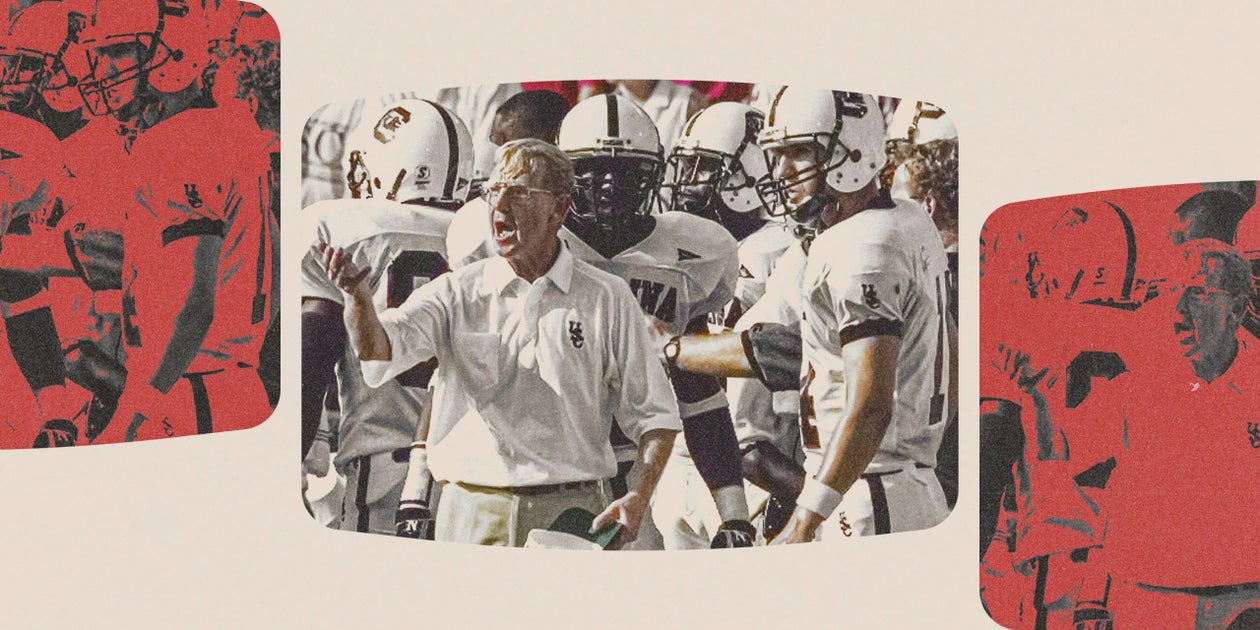
Editor’s note: As the World Cup continues in the United States for the first time since 1994, The Athletic is looking back at college sports in the 1990s and how much has changed since then. Join us for a couple of weeks of offseason football and basketball nostalgia.Erik Kimrey remembers taking off his team gear before going downtown, so South Carolina fans didn’t know he played for their football team. And he remembers the end of that season, when Clemson fans threw Zero brand candy bars on their field.“You had to take it,” said Kimrey, a backup quarterback at the time. “We didn’t win any games.”Skip Holtz remembers his dad, Lou Holtz, coming out of retirement to take the Gamecocks job because he liked rebuilding programs. The Holtzes just didn’t realize how much of a rebuild the 1999 South Carolina team would be.Alan Piercy remembers the pain of watching it all as a fan, his beloved school being attacked as not worthy of SEC membership. As the 20th century ended, South Carolina had, by record, the worst SEC football team ever, and the longest SEC losing streak of all time.But South Carolina’s 0-11 season became a story not just about losses but redemption — and, weirdly, one of the program’s proudest moments. Years later, as Piercy, a 1995 graduate of the school, now writes a book about that era, he can’t help but look at it in the context of the world.“There are no smartphones. There is no social media. It’s pre-9/11. Those years, that time were sort of the last moments before the world got really complicated,” Piercy said. “Despite all the losing, it was a pretty good time — a good time to be alive.”South Carolina joined the SEC in 1992, ending two decades in the football wilderness of independence. It was lucky to be in the conference, as Piercy put it: Florida State passing on the SEC opened the door. But it was tough going for the Gamecocks for most of the ’90s. Sparky Woods was fired after the 1993 season. Brad Scott came in and led South Carolina to the first bowl win in program history in 1994, but couldn’t sustain it, and things bottomed out in 1998.Really bottomed out.“We won our opener in ’98, and were thinking how great this was — not knowing we were going to lose 21 in a row,” said Kimrey, a freshman quarterback when the streak started. “There wasn’t a lot of pride in the program.”Some of the results of South Carolina’s 1-10 season in 1998 were excusable. Even a home loss to Marshall was to a 12-1 team quarterbacked by Chad Pennington. That was one of four losses by 5 points or less, and only two losses were by more than 20 points.Still, it was bad. When the Gamecocks lost 38-0 at home to Mississippi State, falling to 1-3, Scott told the media: “There’s nowhere to go but up.”They did not go up. Scott was let go, but did not go far. Clemson hired a new coach, Tommy Bowden, who hired Scott as an assistant.South Carolina, meanwhile, was ready for a big name.Lou Holtz was a national celebrity, not just the national championship-winning coach at Notre Dame but a guest on Johnny Carson, where he did magic tricks, and a CBS television analyst after retiring from South Bend in 1996. But Holtz, who died this past March, had the coaching itch again — or at least the itch to rebuild, as he’d done at Arkansas, Minnesota and even Notre Dame.“When ball coach is in your blood, it’s in your blood. It’s about the challenge,” Skip Holtz said in a recent interview. “If they had just gone 11-1, I don’t think he would have taken it. I would say Dad was a builder, and he was really good at it.”South Carolina was Lou Holtz’s sixth college head-coaching job, after previous stops at Notre Dame, Minnesota, Arkansas, NC State and William & Mary. (Scott Halleran / Getty Images)Then-South Carolina athletic director Mike McGee “didn’t like to be told no,” as his sports information director Kerry Tharp put it. (McGee would later hire Steve Spurrier to replace Holtz.) When he hired Holtz, the Gamecock fans were in awe; the headline in Columbia’s newspaper, The State, saying it all: “USC fans rejoice after Holtz hiring.”“After a 1-10 season, you have to take drastic measures,” law student Rick Campbell told the newspaper. “That’s why you need Lou Holtz.”Tharp, who got there in 1985, said the lead-up to the ’99 season was the most national exposure the program had gotten during his tenure, “and not even close.” Outlets like HBO and CBS came to do stories on Holtz.It was exciting.Then the season started.The opener at No. 24 NC State — one of Holtz’s previous stops — was an omen. The game was played in a driving rain, the outer remnants of Hurricane Dennis, and the Gamecocks fumbled eight times and turned it over on the first four possessions. Final score: NC State 10, South Carolina 0.And so it began: A 15-point loss at No. 12 Georgia, a home loss to East Carolina, four straight SEC losses … then an 11-10 loss to Vanderbilt, which dropped Holtz’s team to 0-8 and extended the losing streak to 18.“I read the Bible more now than ever before,” Holtz told the media after the Vanderbilt loss. “That’s where I get my strength. I spend a lot of time in Job. You wonder how in the world everything can be going wrong.”With a trip to No. 4 Tennessee next, Holtz offered his trademark poor-mouthing: “We need an open date more than we need a game against Tennessee. You feel like a fighter staggering on the ropes waiting for the bell.”“He told us to ignore the stuff he put in the media,” Kimrey said. “That was part of his tactics, to poor mouth and downplay. But behind the scenes, he definitely challenged you, but most of the time he was very encouraging.”The results were fairly similar to the previous season: Some blowouts, some competitive games where the other team pulled away. But it felt different in Year 1 of Lou Holtz, like something was still brewing.“We didn’t talk about the streak,” said Skip Holtz, the team’s offensive coordinator. “It wasn’t like, ‘Well, we lost again.’ It was ‘Hey, this is where we got better this week.’”They would turn on ESPN and hear talk about the streak. But locally, fans were fairly positive, given the circumstances, with Skip Holtz estimating 90 percent of fans were still great. The rest wondered why the turnaround wasn’t happening quickly.Skip Holtz had been the head coach at UConn — where he had just made the Division I-AA playoffs and received a Big East invite — but chose to go coach with his dad. From a professional standpoint, it wasn’t a smart move, but it was a chance for his grandkids to grow up around their grandparents. Plus, it was a chance for Holtz to be an SEC offensive coordinator. For the defense, Lou Holtz hired Charlie Strong, who put together one of the league’s better defenses.The offense? Not so much. South Carolina shuttled through quarterbacks (five attempted at least five passes) and had so many injuries on the offensive line that it moved defensive linemen over. The Gamecocks scored eight offensive touchdowns in 11 games.The season finished with losses to No. 4 Tennessee, No. 4 Florida and rival Clemson. The 11th and final game was full of embarrassments: The Clemson fans tossed Zero bars and Clemson players carried Scott off the Williams-Brice Stadium field. The one victory came when South Carolina players formed a circle around the midfield logo and prevented the Tigers from dancing on it.“It is over,” Lou Holtz said afterward. “There is nothing we can do to change this season. We have to live with it. The important thing is what are we going to do about it?”And what they did about it proved to be the takeaway for those within the program and its fans.Attendance remained strong, burnishing the reputation of the fan base. They kept coming even during an 0-11 season. To this day, it remains a talking point around the program.“What jumps out to me, across both seasons, is the passion of our fans,” Kimrey said. “We really felt that.”Things also didn’t feel as miserable within the team as it may have seemed. Skip Holtz acknowledged that if the transfer portal existed in 1999, “everybody might have left.” But whether it was the lack of free agency, player leadership or Lou Holtz’s force of personality, the team held together.When the new century began, the Gamecocks went 8-4, then 9-3, going to two straight Outback Bowls.“I don’t think we would have been as good a team in 2000 and 2001 if we hadn’t suffered through those years,” Kimrey said.The Gamecocks slipped to 5-7 the next two seasons, then 6-5 in Holtz’s final season in 2004. But rather than disappear from the national radar, South Carolina brought Spurrier on board. It reinforced that South Carolina belonged in the SEC, despite the spiteful columns written during the 21-game losing streak.Is Bowden vs. Spurrier the best rivalry ever in college football?Joe Rexrode“There was really insulting media coverage around the conference,” Piercy said. “It definitely stung. But Holtz pulled us through that just by sheer force of personality.”Piercy grew up in Columbia and now works in the insurance business. But his side job is writing. After he published a book on South Carolina athletics in its era as an independent, his co-author, South Carolina historian Evan Faulkenbury, approached him about writing a book about the 1998-99 teams.“My first reaction was why would anyone want to read about that?” Piercy said. “We spent 25 years trying to forget about it.”But the more he studied it, the more he warmed to it. The book, due out in 2028, is titled: “It Could’ve Been Worse: A 21-game losing streak and the battle for the soul of Gamecock football.” Piercy has spoken to people around the program from those days, but it’s a quote from someone else — Chris Jones of Esquire, speaking with Tommy Tomlinson — that resonated with him. Jones was talking about his devotion to Burnley, an English soccer team with a similar history of losing as the Gamecocks:“I never understood people who cheer for front-runners. I’m glad the team I inherited also happens to resemble most of us and our lives: some victories, some defeats, some high periods, some low periods. Sometimes, I see fans of bigger teams and watch how relieved they are when they win, rather than joyful, and how devastated they are when they finish second. I’d rather be a fan of a team that makes winning feel special, finishing in second feel great, and losing feel expected. That’s a much healthier and relatable perspective, at least for me.”
South Carolina lost 21 games in a row to end the 1990s. But there was a silver lining
Lou Holtz's first Gamecocks team went 0-11 and hardly scored. But it laid the groundwork for the better decade that followed.
1,817 words~8 min read