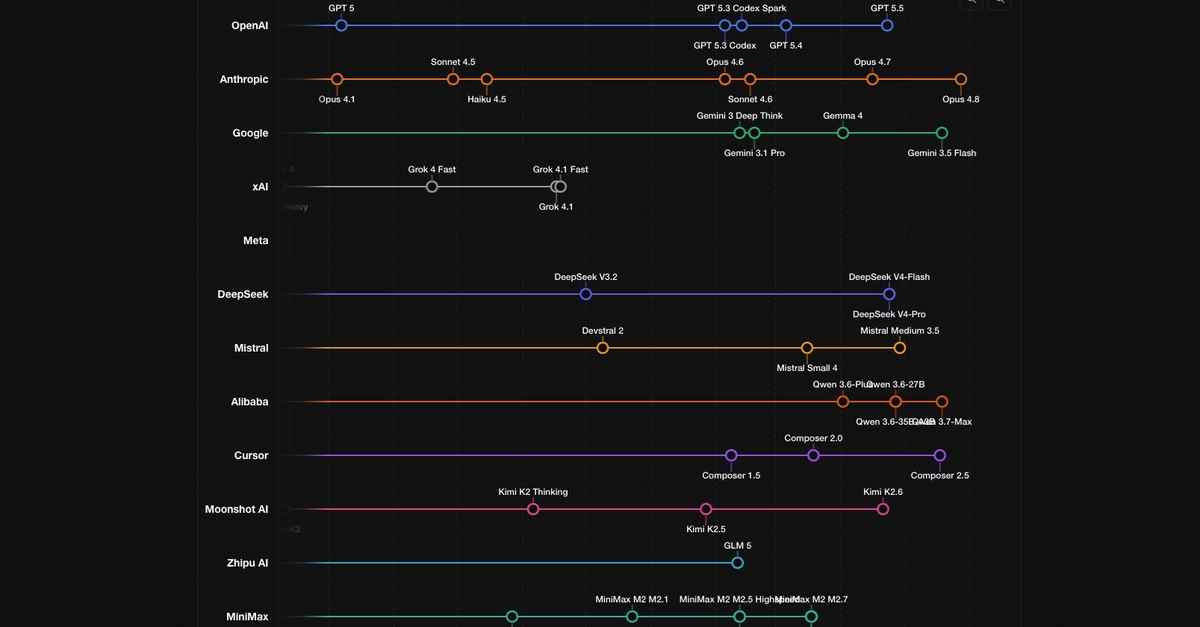
In the twenty-five days between 17 November and 11 December 2025, four separate companies released what each called its most powerful artificial intelligence model ever built. xAI shipped Grok 4.1. Google launched Gemini 3. Anthropic dropped Claude Opus 4.5. OpenAI unveiled GPT-5.2. Before anyone in Brussels, Washington, or London could finish reading the safety documentation for one of these systems, the next had already landed. Then, barely two months later, Anthropic released Claude Sonnet 4.6, its second major model launch in less than a fortnight.
This is not a temporary burst. It is the new normal. OpenAI has surpassed $25 billion in annualised revenue and is reportedly taking early steps towards an IPO. Anthropic is approaching $19 billion. According to BCG's AI Radar 2026, 65 per cent of CEOs say accelerating AI is among their top three priorities for the year. McKinsey reports that 88 per cent of organisations now use AI technology in at least one business function. The competitive pressure is relentless, and it exposes a structural problem that no amount of political will or regulatory ambition has yet solved: the institutions charged with governing artificial intelligence operate on timescales that bear essentially no relationship to the timescales on which the technology itself evolves. The question is no longer whether reactive regulation can keep up. It cannot. The question is what replaces it.