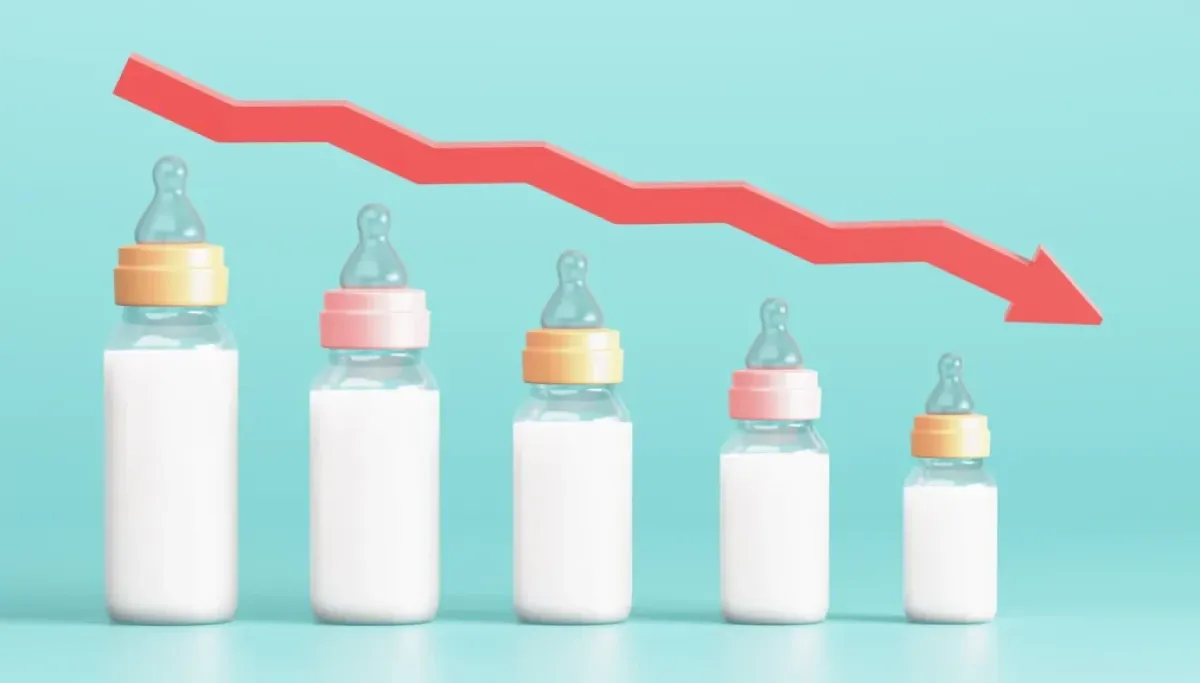
“Big families are like waterbed stores,” comedian and father of five Jim Gaffigan jokes. “They used to be everywhere, and now they’re just weird.”But he might have to update his shtick: Big families are having something of a moment. A small but growing share of U.S. births are occurring in Gaffigan-sized families, and some think supersizing that trend holds the key to solving the problem of declining fertility.Declining U.S. fertility is well documented. According to Tim Carney of the Washington Examiner and the American Enterprise Institute, “Americans had fewer babies last year than in any year since the 1970s. … The result is the lowest birth rate in American history, a collapse of more than 25% since 2007.”
The total fertility rate fell to 1.57 births per woman in 2025, well below the replacement level of 2.1 last seen in 2007. A new working paper by Caitlin Myers and Ezekiel Hooper blames the advent of the iPhone for accelerating U.S. fertility declines since 2007. A decadeslong drop in marriage rates and the recent leveling off of nonmarital childbearing contributed, too.To reverse fertility declines, some see promise among big families. Instead of trying to convince reluctant nonparents to start having children, the thinking goes, a more fruitful approach is to encourage current parents to add to their brood. As pronatalists Daniel Hess and Paul Morland enthusiastically suggest, “People who aren’t ready for kids don’t have to have them. Those who already have kids choose to have more!”Hess and Morland note that in Kazakhstan, the fictional home of Borat, the total fertility rate “went from 1.9 in 1999 to above 3.3 in 2021” entirely due to growth among big families. “Third births doubled, fourth births tripled, and fifth+ births went up more than fivefold,” they add.For explanations, one study credits rebounding economic growth after the demise of the former Soviet Union. But another points to “significant changes in the support of large families,” including “an increase in the allowance for non-working women on the occasion of the birth of a fourth or more child.” Large families, who “make up the main category of poor households” in Kazakhstan, also receive preferential mortgage interest rates. And mothers of “many children” receive the title of “mother heroine,” are paid a monthly allowance for life, and even qualify for free public transportation.Consistent with their view that it’s easier to convince the already family-oriented to have another child, Hess and Morland call for similar “benefits geared toward larger families” in the United States, including tax breaks for “third and higher children.” The U.S. already offers refundable child tax credits paying added benefits for each child, provided parents have at least modest earnings. During the pandemic, Democrats temporarily made larger child tax credits available to all parents, including, for the first time, nonworkers who pay no income taxes. That masked an agenda of increased welfare subsidies under the false guise of providing “tax cuts,” and the temporary expansion expired. Expensive proposed revivals face an uphill climb.A generation ago, conservatives sought effectively the opposite — to mandate a nationwide “family cap” so that welfare checks didn’t automatically increase when parents already dependent on taxpayers for support had an additional child. The landmark 1996 welfare reform law ultimately let states decide, and a recent review indicated nine states and Guam had some sort of family cap policy in 2023.If offered, would bigger subsidies for large families even make a difference? The iPhone study suggests more subsidies are unlikely to increase fertility, which is driven by “the formation of relationships and the time and inclination for partnered intimacy, not the cost of raising children.” As the authors note, “the policy instruments to which governments have committed the largest sums — cash transfers, tax credits, subsidized childcare, extended parental leave — do not, on their own, address the behavioral shift our estimates suggest is at work.”MY FATHER AND THE SYSTEM THAT REPLACED HIMOthers share those doubts. Catherine Pakaluk, mother of eight and author of Hannah’s Children: The Women Quietly Defying the Birth Dearth, argues that “the idea that we could influence a couple with $1,000 more of a tax break or a baby bonus is almost offensive. … I think this is a really sacred and private decision.”Burgeoning federal deficits compound doubts that greater subsidies for large families are around the corner. Yet even in their absence, and despite being fodder for comedians, a small but growing share of American parents are opting for bigger families. Cultural leaders and policymakers should consider the reasons why and encourage others to follow their example.Matt Weidinger is a senior fellow and Rowe scholar in opportunity and mobility studies at the American Enterprise Institute.