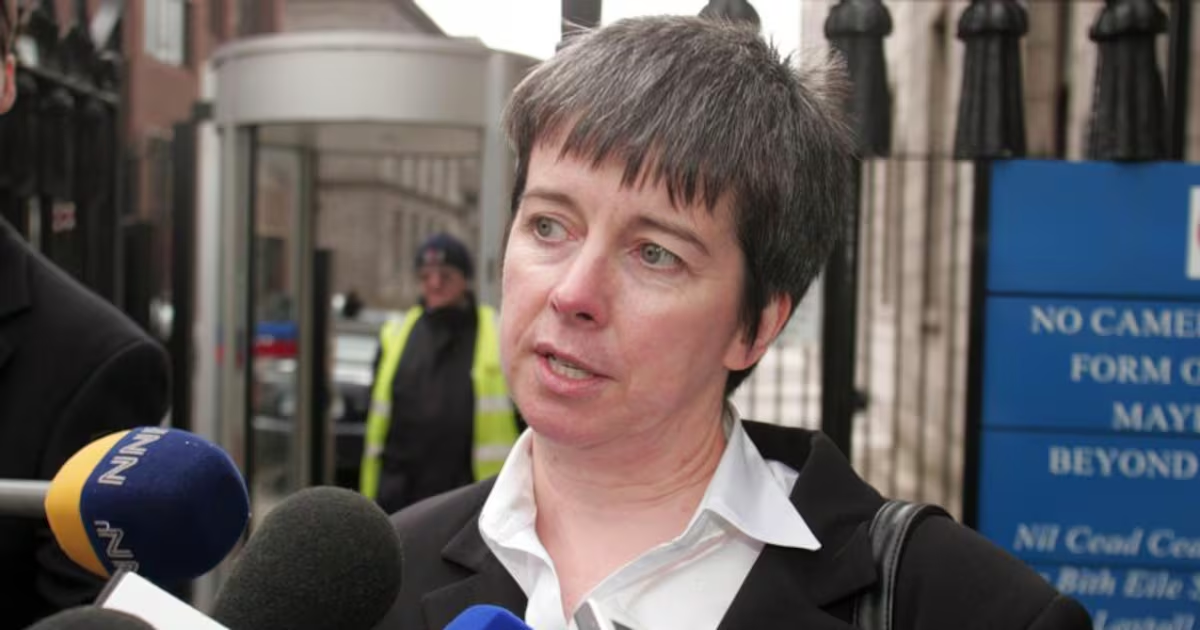
The Government will engage with survivors of abuse in a Co Cork national school who are planning to take legal action against the State, Taoiseach Micheál Martin has said.His remarks come as 19 women said they are planning to take legal action against the State over its failure to pay them redress for the abuse they suffered at Dunderrow National School in west Co Cork.In 1998 Leo Hickey, the former principal of the school, was sentenced to three years’ imprisonment having pleaded guilty to 21 sample counts from 387 charges of sexually abusing 21 young girls between 1964 and 1973.In 2017 Hickey was jailed again for sexually abusing a nine-year-old boy in a different school in the 1990s.One of Hickey’s victims, Louise O’Keeffe, received compensation in 2014 after a long-running legal battle against the State culminated in a victory.O’Keeffe brought a case for damages through the Irish courts, but the Supreme Court ruled that the Department of Education was not liable because the school was under the management of the Catholic Church, even though the State paid Hickey’s salary.In 2014 O’Keeffe was vindicated when the European Court of Human Rights ruled that Ireland had failed to protect her as a child.Following that ruling, O’Keeffe received €84,000 in compensation and the then government set up an ex gratia redress scheme where applicants had to demonstrate that their abuse followed a prior complaint against their abuser.This scheme collapsed in 2019 when a review found that elements of it were incompatible with the Strasbourg ruling.A revised iteration of the scheme operated in 2021-2023. However, many survivors were still ineligible due to a condition that required applicants to have sued the State before July 2021.Speaking to reporters in advance of a Cabinet meeting on Tuesday, the Taoiseach said: “Leo Hickey committed horrific sexual abuse on many, many young children at that time.”He spoke of the possibility of mediation with the victims planning to take legal action and said: “We should engage with the victims here and their representatives and that’s what we will do.”[ ‘You weren’t safe’: Women call for redress over abuse in Co Cork schoolOpens in new window ]Martin added: “There have been ex gratia schemes here but I do fully understand the hurt and the experiences” and that “there have been different legal issues around responsibility”.He said: “It was clear at that time that the necessary guidelines were not in place that we now have in terms of child protection.”Louise O’Keeffe took Ireland to the European Court of Human Rights over its failure to protect her from teacher Leo Hickey when she was a pupil at Dunderrow National School in Co Cork in the 1970s, and won the case. Photograph: Garrett White/Collins Court [ ‘You weren’t safe’: Women call for redress over abuse in Co Cork schoolOpens in new window ]Tánaiste Simon Harris was also asked about the issue on his way into Cabinet. “The Government is extraordinarily eager to work on a process here that enables people to get a degree of closure and support and that’s why we’ve done two things,” he said. Harris said the first measure was a scoping inquiry on abuse at schools that has brought about a commission of investigation into the handling of historical child sexual abuse in schools. He said the second thing the Government has done is to “set up an interdepartmental group to look at some of the recommendations around redress”.This group is due to deliver a report next year “on how best to progress”, Harris said.“I want people to know they are heard, they will be listened to and both the commission and the interdepartmental [group] I think are the ways to go forward.”Harris also said he wanted to make a broader point saying: “While I don’t in any way step away from the responsibility of the State in various issues I would also not like to see a situation where religious orders are allowed walk away from their responsibilities either.”He said: “I think it’s important that all of that is considered by the interdepartmental group too and what levers could be pursued by the State in relation to making sure that religious orders also make a contribution.”
Taoiseach promises engagement with victims of abuse in Co Cork school
Nineteen women are planning to legal action against State over its failure to pay them redress for abuse suffered
698 words~3 min read