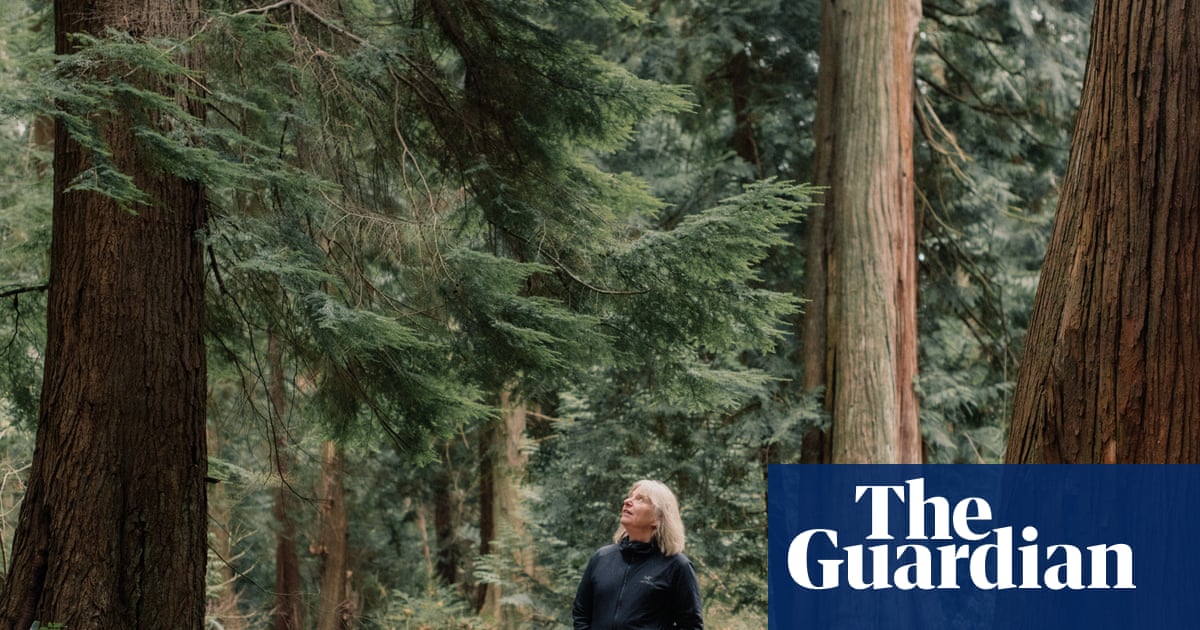
Near the summit of Volcan Mountain, Janice Bina-Smith sits with a group of us in a circle on crunching oak leaves. The red ants don’t seem to be in a biting mood. Patches of sky above are clear. Gusts of wind move the trees, wagging their tips.Article continues after advertisement
“The forest is the therapist,” she says, “not me. I’m the guide. Your guide only opens the door.” What we will experience is nothing like hiking, she adds. “When people are hiking, they’re usually eager to reach a destination. They don’t fully experience what they see. Forest bathing is a way to slow down, step out of our bodies. Stopping to notice everything.”
Janice picks up a piece of bark, rolls it in her fingers, and smiles. “It does help to remember what you noticed as a child.” A musician and nature educator, Janice (who told the tale of the mountain lion on her roof) is in her final stage of becoming a forest therapy guide. In a few weeks, she will be accredited by the Association of Nature and Forest Therapy Guides and Programs. She hopes to make nature therapy her semiretirement vocation.
Forest bathing, also known as shinrin-yoku, originated in 1982 when Japan’s Ministry of Agriculture, Forestry, and Fisheries observed that office workers felt better when they were outdoors in a natural environment. Consequently, the department started recommending nature immersion to its employees. Researchers found that after employees spent time in forests, their blood pressure decreased; their number of killer cells, a type of white blood cell that attacks tumors or cells infected with a virus, increased; and their immune system became stronger.