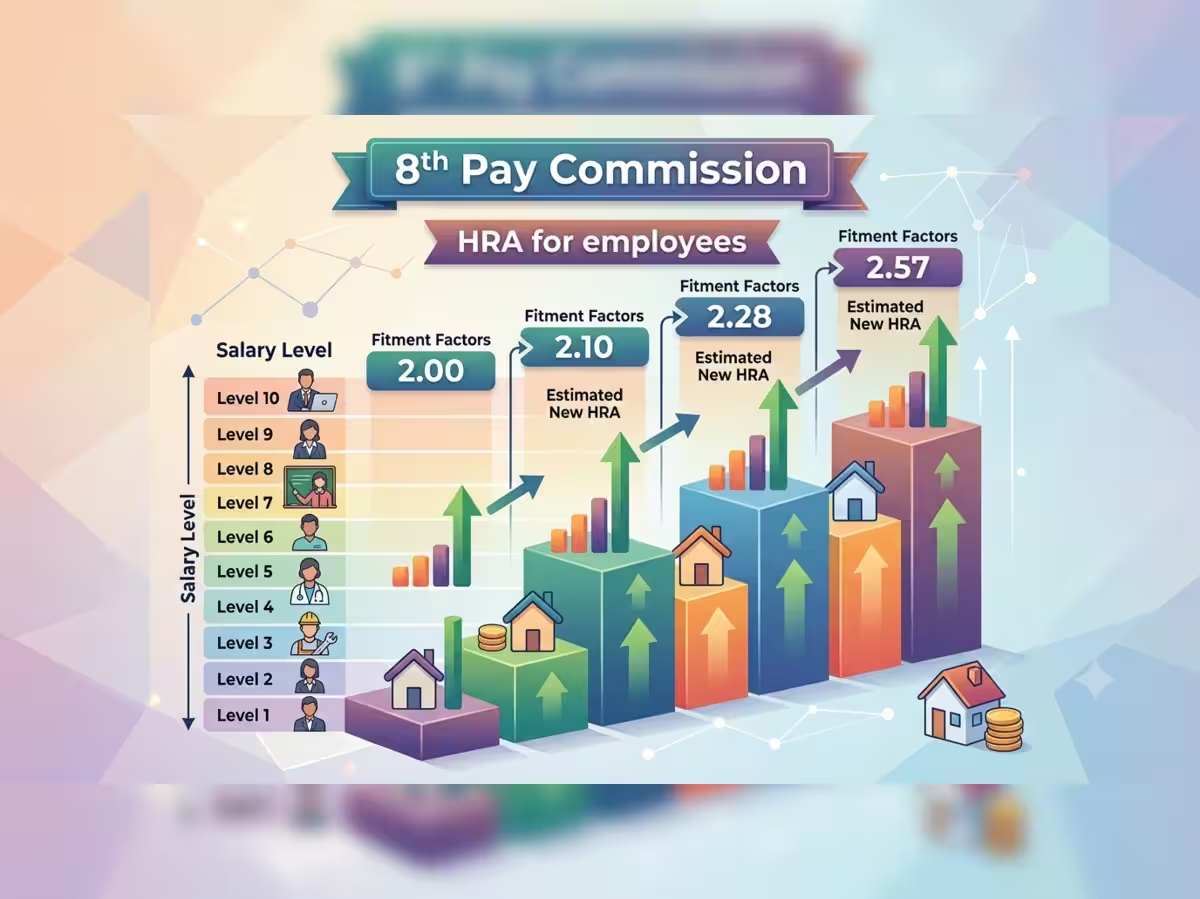
The 8th Pay Commission (8th CPC) is holding meetings with employee, pension bodies and other stakeholders in Lucknow today (June 23, 2026). The pay commission is scheduled to have as many as 30 interactions with these today. Among all interactions of 8th CPC members with different stakeholders, a key demand is to increase the rates of house rent allowance (HRA) from the current rates of 10%, 20% and 30%. Different employee and pensioner bodies have suggested varying rates for HRA. But almost all of them want a significant hike, suggesting a hike would help a large number of employees’ payouts to keep pace with rising rents. Manjeet Singh Patel, national President of All India NPS Employees Federation (AINSPEF), told ET Wealth Online employee bodies are concerned as in big cities like Delhi and Mumbai, rents are high and it becomes difficult for employees at lower levels to afford exorbitant rents. “A Level-1 employee in a city like Delhi receives only Rs 5,400, which is calculated as 30% HRA. However, renting even a small 2BHK flat in Delhi generally costs at least Rs 12,000 per month. To address this issue, we have demanded a minimum HRA of 36% for X-category cities. If this demand is accepted, the HRA could increase to at least Rs 13,600 after the implementation of the 8th Central Pay Commission (8th CPC),” says Patel. House rent allowance (HRA) in 7th Pay Commission The 7th Pay Commission decides on three HRA rates at the time of implementing its report. The rates were 8%, 16% and 24% for Z, Y and X categories, respectively. When DA reached at 50% in January 2024, the Finance Ministry increased the rates to 10%, 20% and 30%, respectively. Here we take you through HRA recommendations five major employee bodies have kept before the 8th Pay Commission. HRA demands by NC-JCM National Council – Joint Consultative Machinery (staff side), (NC-JCM), which is the umbrella body of all central government employees, in its memorandum submitted to the 8th Pay Commission has recommended 40% (X cities), 35% (Y cities) and 30% (Z cities) HRA rates. The employee body has suggested increasing HRA with a rise in DA. HRA demands by IRTSA Indian Railways Technical Supervisors’ Association (IRTSA), which represents technical employees in Indian Railways, has recommended that the current three-tier HRA classification should be made into four as per the rates given below- A class cities (40%+DA): Population 50 lakh and above. B class cities (30%+DA): Population 20 Lakh to 50 lakh C class cities (20%+DA): Population 5 Lakh to 20 lakh D class cities (10%+DA): Population below 5 lakh IRTSA has also suggested HRA be linked to the Consumer Price Index or DA. The rates shall automatically increase by 25% whenever DA goes up by 25%, says IRTSA in its memorandum. HRA demands by AIDEF All India Defence Employees’ Federation (AIDEF), which represents a large number of defence civilian employees, has recommended 40% (X cities), 35% (Y cities) and 30% (Z cities) HRA rates to the 8th Pay Commission. HRA demands by FNPO Federation of National Postal Organizations (FNPO), the key body of postal employees in India, has recommended HRA rates to be 30%, 35% and 40% for Z, X and Y cities. FNPO says that HRA should be linked to DA and should also be extended to pensioners. HRA demands by AINSPEF AINSPEF in its memorandum has suggested three rates for HRA. For X, Y and Z cities, its proposed HRA rates are 36%, 24% and 12%, respectively. The employee body has recommended DA to be merged with basic salary when it crosses 25% and the remaining DA to be provided on new basic salary.
8th Pay Commission HRA changes: 5 employee bodies recommend house rent allowance up to 40%; check details - The Economic Times
8th pay commission proposals: Central government employees are urging the 8th Pay Commission to significantly hike House Rent Allowance (HRA) rates, citing soaring urban rents. Employee bodies are proposing increases to 36%, 40%, and even higher for different city categories, with some suggesting HRA be linked to Dearness Allowance (DA) and extended to pensioners. These demands aim to better align payouts with the cost of living, particularly for lower-level staff in major metropolitan areas.
611 words~3 min read