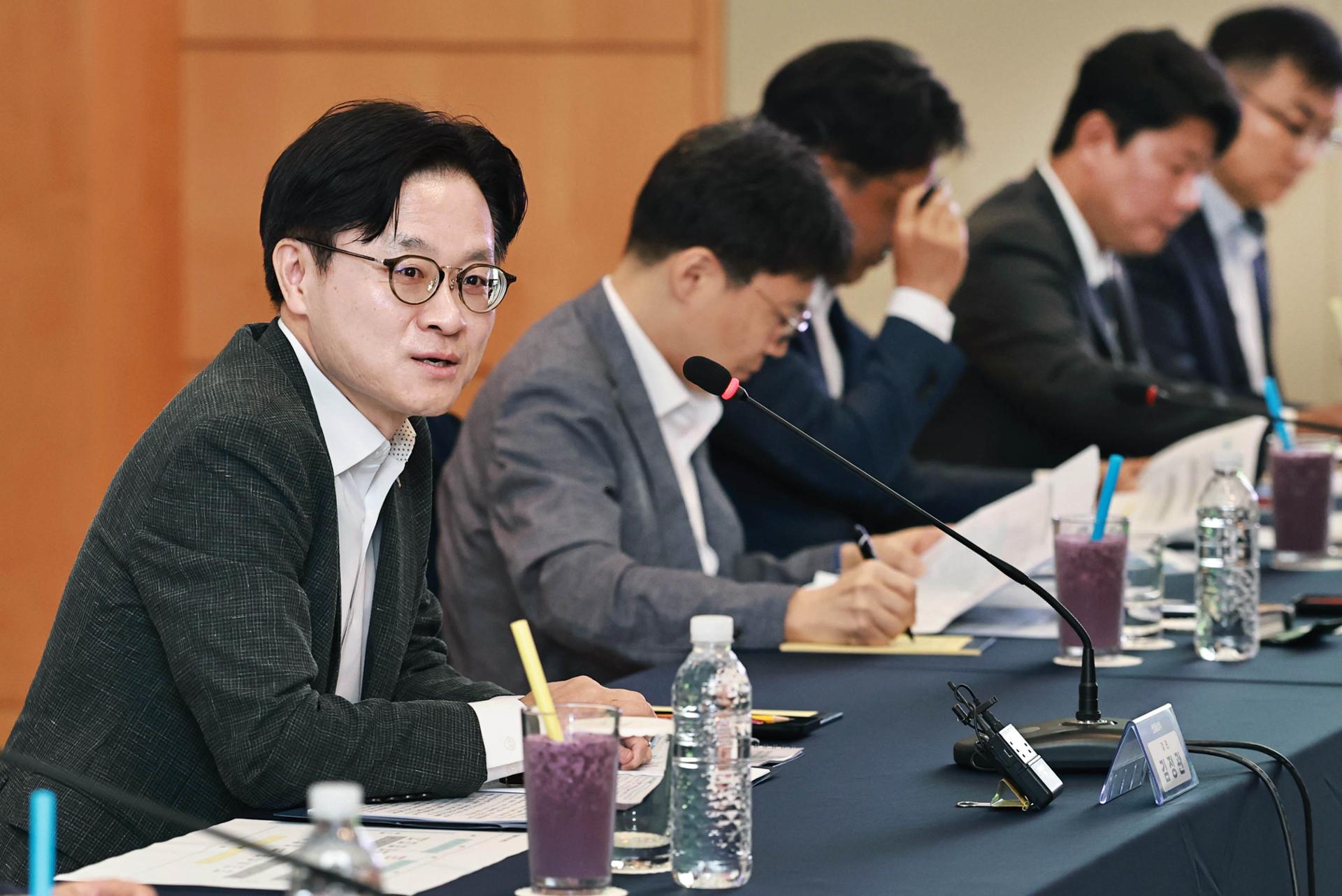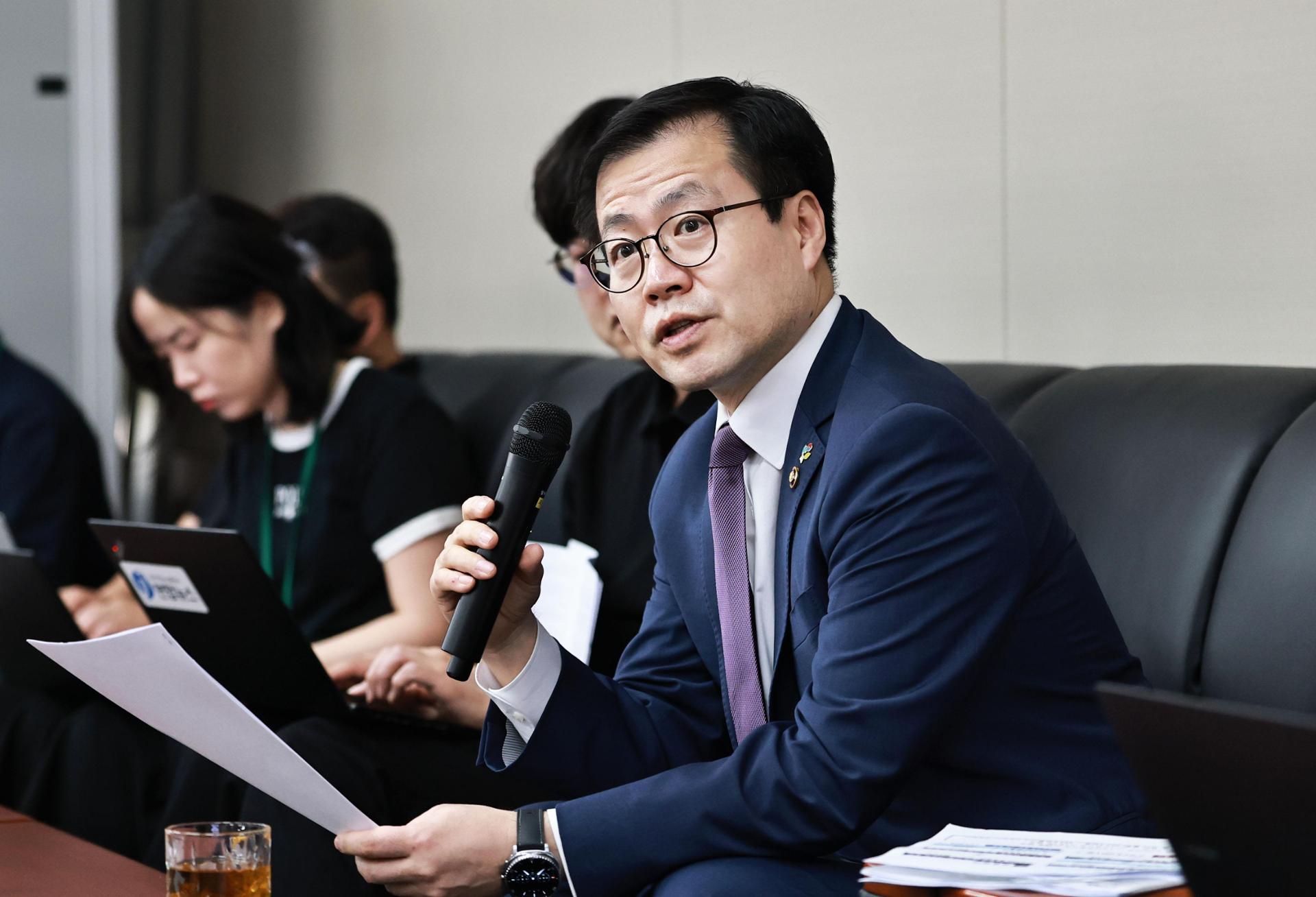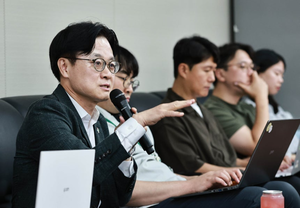
Kim Jung-kwan says Seoul has reached a broad agreement with Brussels, while calling for new approaches to chip investment, tax revenue and corporate profit-sharing South Korea's Industry Minister Kim Jung-kwan speaks to reporters at Sejong Government Complex on Monday. (Ministry of Trade, Industry and Resources) South Korea has made progress in talks with the European Union over steel tariff-rate quotas, Industry Minister Kim Jung-kwan said, raising hopes that Korean exporters may face a smaller cut than the bloc's planned overall reduction.In a wide-ranging briefing in Sejong on Monday, Kim also discussed corporate bonus dispute, chip-related tax revenue, Canada's submarine tender and possible new semiconductor production sites.Kim said the biggest outcome of his recent trip to Kazakhstan, Europe and the Middle East was a "broad agreement" with the EU on steel TRQs."Korea's current quota stands at about 2.58 million metric tons, and we have reached a consensus that Korea's allocation would not be reduced by the full 46 percent even if the EU lowers its overall import ceiling," Kim said. He declined to give a specific figure.The EU plans to cut its duty-free steel import quota by about 46 percent, from 33.82 million tons to 18.35 million tons, from July 1 as part of efforts to protect its steel industry. Tariffs on imports above the quota will double from 25 percent to 50 percent.Kim said Seoul had not offered any special concessions to the EU in return, noting how its measure violates the free trade agreement.Trade Minister Yeo Han-koo and senior trade officials have led negotiations with Brussels to secure the largest possible quota for Korean steelmakers. The government plans to announce support measures for the steel industry around the time the EU finalizes its quota decision in late June or early July.The EU is Korea's second-largest steel export market, accounting for 3.24 million tons of Korea's 28.25 million tons in steel exports in 2025.On Seoul's talks with Washington over the first project under their strategic investment framework, Kim struck a cautious note, saying the necessary procedures are still underway.Turning to overseas opportunities, Kim said Korean companies in the Middle East were willing to join reconstruction projects if opportunities arise, but added that Seoul remains cautious on Iran because financial sanctions, EU restrictions and stalled talks with the US still pose risks.Regarding Canada's next-generation submarine procurement, in which Korean shipbuilders are competing against Germany, Kim said Seoul was waiting for the outcome with "hopeful expectations.""In terms of the competitiveness of the submarine itself and the broader industrial package, I believe we are ahead," he said. "But we could face a disadvantage if Canada prioritizes close cooperation with NATO."Kim said Seoul was aware of speculation that Canada could split the order between Germany and Korea or delay the decision to July, but had not received any official notice.At home, Kim said Korea needs to update its policy framework for the wider fallout from the semiconductor boom, from corporate bonuses and tax revenue to future chip sites.On corporate profit-sharing, he pushed back against efforts to treat bonuses as a labor dispute issue, saying shareholders and investors are being left out of the debate.“I do not think it is right to say that bonuses should become a subject of labor disputes,” Kim said.“When it comes to operating profit, the participants are not only management and labor unions. There are also investors,” he said. “Investors come in knowing they may take losses, while workers enter under the basic premise that wages are guaranteed. The level of risk is completely different.”Noting that domestic and foreign investors and shareholders have “no room” to participate in such discussions, Kim said an “institutional supplement” is needed.Asked how the government should use excess tax revenue from the chip profit boom, Kim declined to give specifics but called for long-term tools to strengthen resource security.“One of our chronic problems is that fiscal and budget decisions are made on a short-term clock,” he said. “We need to prepare long-term measures to strengthen resource security, whether through excess tax revenue, a fund or a special account.”Kim also said Korea may need additional chip production sites as global demand expands. He declined to comment on speculation that Gwangju and South Jeolla Province are being considered for new facilities.“Existing investment projects should be carried out as quickly as possible,” Kim said. “There are also views that those projects alone may not be enough, and I think a new site may be necessary.”
Korea secures softer EU steel quota cut, minister says
South Korea has made progress in talks with the European Union over steel tariff-rate quotas, Industry Minister Kim Jung-kwan said, raising hopes that Korean ex
738 words~3 min read