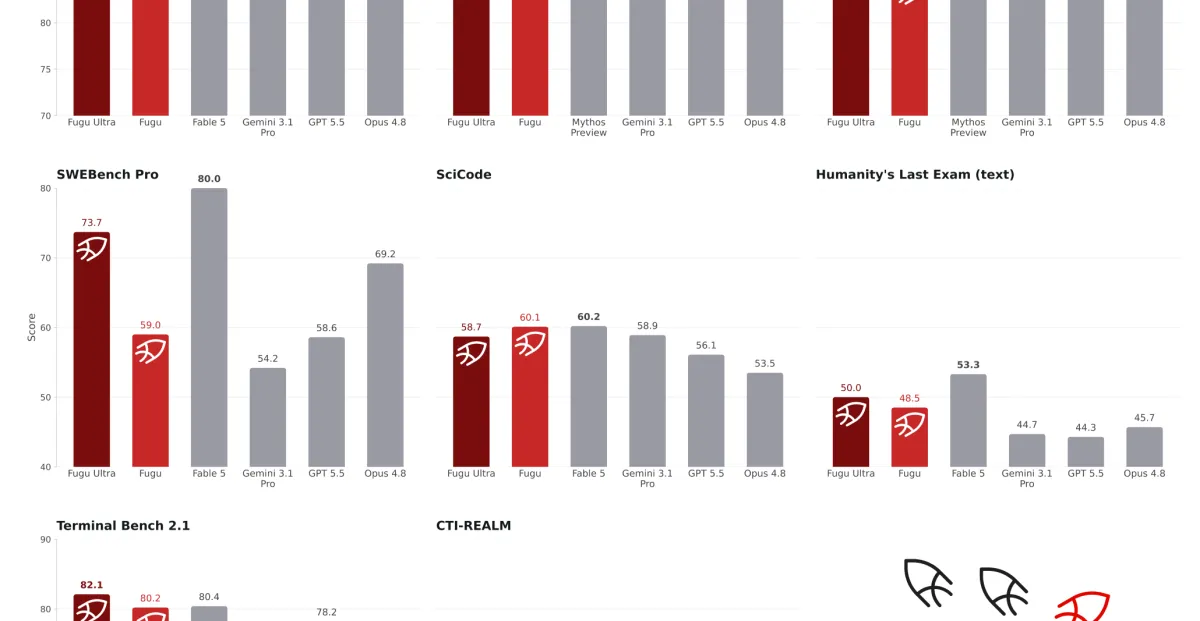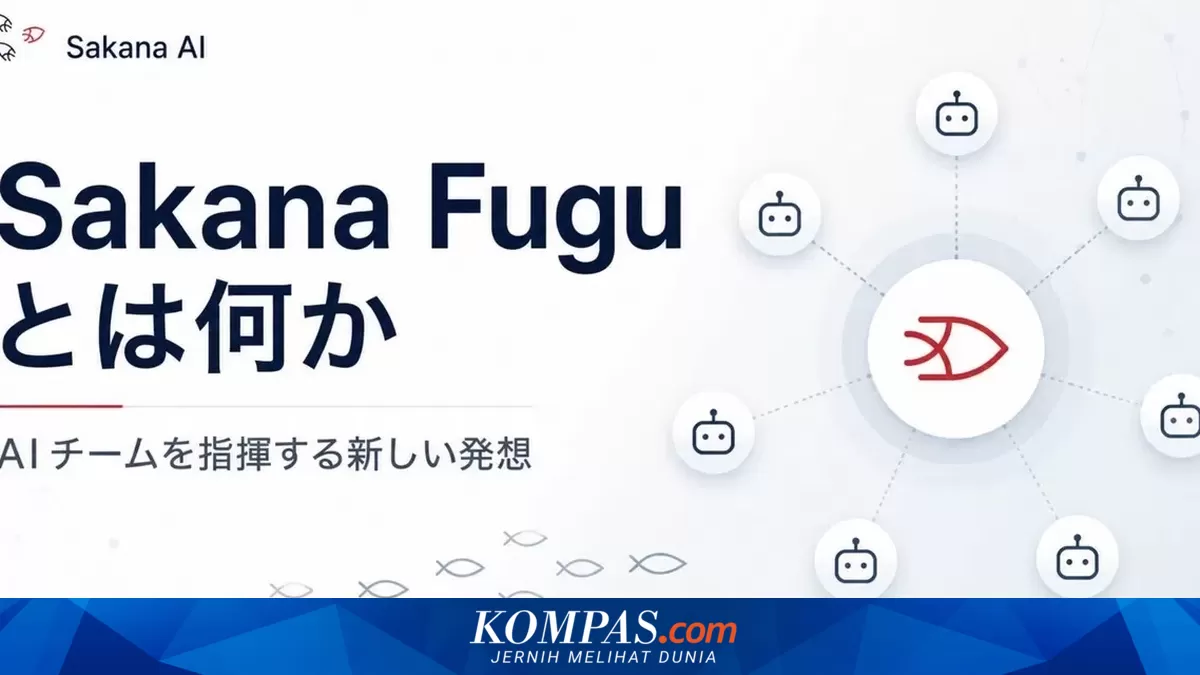
Just ten days after the US government forced Anthropic to pull Fable 5 and Mythos offline globally, a Japanese AI lab launched what may be the most interesting response yet. Tokyo-based Sakana AI has unveiled Fugu and Fugu Ultra, two new AI systems that make a fairly bold claim: frontier-level capabilities without depending on a single frontier model.The timing is not accidental. For years, the AI race has largely been defined by who could build the biggest and most capable model. The events of June 12 introduced a different question altogether: what happens when the model your company relies on suddenly becomes unavailable?Sakana's answer is that perhaps the future isn't one model at all.What Fugu Actually IsUnlike GPT, Claude, Gemini, or most frontier systems, Fugu isn't a monolithic model. Instead, it's an orchestration layer trained to coordinate multiple AI models behind a single API. From a developer's perspective, it behaves like one model. Behind the scenes, however, it distributes work across a pool of specialist models, assigning different roles such as reasoning, execution, verification, and synthesis before combining the results into a final response.The distinction matters. AI orchestration isn't new. Plenty of companies route prompts between models. What Sakana is arguing is that Fugu isn't a rules-based router wrapped in clever prompting. Rather, the orchestration itself has been trained as a model, learning when to delegate, which specialists to use, and how to merge outputs effectively.That approach builds on Sakana's earlier research efforts, including Trinity and Conductor, two orchestration-focused papers presented at ICLR 2026. In simple terms, Fugu's innovation isn't necessarily a bigger brain. It's a better manager.Why People Are Paying AttentionThe most compelling part of Fugu isn't the benchmark table. It's what Sakana chose to demonstrate. One showcase involved playing four consecutive games of blindfold chess, forcing the system to maintain an accurate internal representation of the board state throughout extended interactions. Another involved designing a mechanical iris mechanism in CAD, where multiple moving components must work together with precise physical constraints.Neither task is particularly flashy.What they test instead is something AI systems often struggle with: maintaining coherence over long, multi-step workflows without gradually drifting off course.That's increasingly becoming the real challenge in the age of AI agents. Generating a good answer is one thing. Remaining reliable through dozens or hundreds of interconnected decisions is another.Early user reports seem to point in the same direction.Developers have described deeper code reviews, while security practitioners have highlighted the system's ability to stay within defined assessment boundaries instead of wandering into unrelated tasks. Those anecdotes should be treated cautiously, but they align with the broader story Sakana is trying to tell.This is less about raw intelligence and more about sustained execution.The Benchmark Story Is More Nuanced Than The HeadlinesThe benchmark results are strong. Fugu Ultra performs competitively against some of the most capable systems available and leads several coding and reasoning evaluations. Sakana's published numbers place it among the strongest models on tests such as LiveCodeBench, TerminalBench, and SWE-Bench Pro.But this is where it's worth resisting the temptation to oversimplify.Fable 5 still outperforms Fugu on certain software engineering benchmarks. GPT-5.5 remains ahead in some long-context evaluations. Other frontier models continue to hold advantages in specialized areas, including cybersecurity.In fact, there are even instances where standard Fugu scores higher than Fugu Ultra. The takeaway isn't that Fugu has overtaken everything else. It's that Sakana has managed to build a system that belongs in the same conversation as the frontier models many developers have spent the last year benchmarking against.That's an achievement on its own.The Bigger Story Isn't PerformanceThe real significance of Fugu may have very little to do with benchmark rankings. The launch arrives at a moment when AI access itself is becoming a geopolitical issue.The removal of Fable 5 and Mythos demonstrated a reality many organizations hadn't fully confronted: a model can disappear overnight because of regulatory decisions entirely outside a company's control.Sakana appears to have built Fugu around that exact problem.Because the system operates as an orchestrator across multiple models, the disappearance of one provider doesn't necessarily break the product. Models can be swapped, replaced, or rerouted while maintaining continuity for users.Whether that makes Fugu truly resilient remains an open question. But it does represent a different philosophy. Instead of asking which model is best, Sakana is asking what happens when your best model becomes unavailable. That's a question the AI industry may have to answer far more often in the years ahead.The CatchThere are some important caveats. Fugu is not open source. The orchestration layer is proprietary, and Sakana has not disclosed the full composition of the model pool operating underneath it. That raises a reasonable question: how much of Fugu's performance comes from Sakana's orchestration technology versus the frontier models it coordinates?At the moment, outside observers don't have enough visibility to answer that definitively. Cost is another consideration.For particularly demanding workloads, Fugu Ultra can reportedly reach roughly $10 per message. That may be acceptable for research or specialized enterprise workflows, but it quickly becomes expensive at scale.And then there's the central marketing claim.Fugu is being positioned as a response to the vulnerability exposed by recent export controls. Yet if a significant portion of its model pool relies on providers ultimately subject to those same controls, then its resilience has practical limits.The architecture may be more flexible. Whether it is genuinely "unbannable" is something that remains unproven.The Bottom LineSakana AI's latest launch feels important not because it introduces another frontier model, but because it challenges the assumption that frontier AI must come from a single model in the first place. Fugu's central idea is that intelligence can emerge from coordination rather than scale alone.Whether that vision ultimately wins remains to be seen. But the timing is hard to ignore. A month ago, the AI conversation was largely about who had the smartest model.Today, a growing part of the discussion is about who can keep their AI running when the smartest model suddenly isn't available anymore. Fugu may be one of the first serious attempts to build for that reality.
Ten days after Fable 5 shutdown, Sakana AI makes its move
A Japanese AI lab, Sakana AI, has launched Fugu and Fugu Ultra, innovative AI systems that claim frontier-level capabilities without relying on a single large model. This development follows US government actions against Anthropic, highlighting concerns about AI model availability.
TL;DRAI
Sakana AI unveiled Fugu: orchestration of specialist models instead of a single frontier model, responding to Fable 5's ban. Tech strategy shifts to geopolitically resilient orchestration, avoiding vendor lock-in as regulatory controls reshape AI access globally.
1,009 words~5 min read