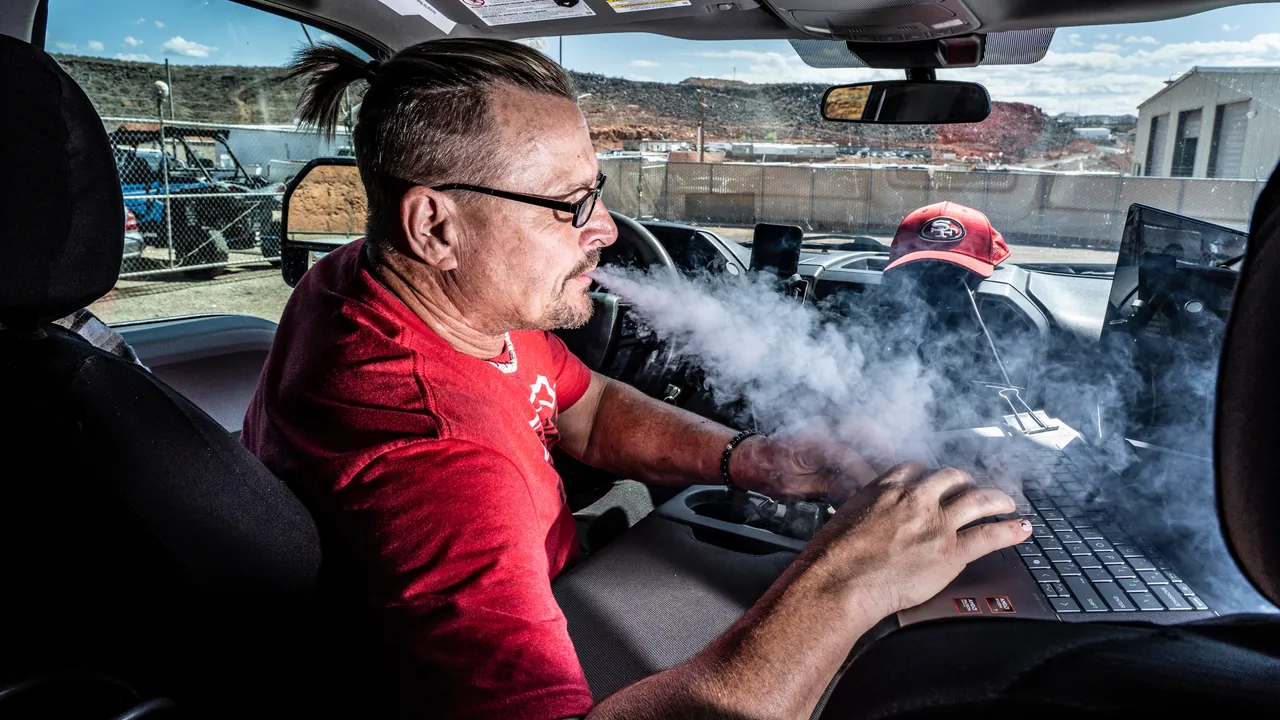
Owning a car is a fundamental part of life in the U.S. Americans rely on their private vehicles to get to work, to shepherd their kids around, and just to survive in areas of the country where public transportation isn’t readily accessible. We’re attached to our cars, and it shows. Collectively, Americans owe more than a trillion in auto debt, and, last year, 1.7 million vehicles were repossessed.In this week’s issue, the staff writer Paige Williams goes inside the booming repo industry, riding along with Matthew Pitman, a longtime repo man whose popular YouTube channel, RepoNut, chronicles the daily grind of repoing. The result is a piece that shows just how fraught, shadowy, and dangerous that work can be. (In 2023, at least seven repossessors were killed—the highest number on record.) I spoke with Williams about how Pitman’s story illuminates the industry, and what has led to the staggering number of repossessions in recent years.The conversation that follows has been edited and condensed.How did you come across Matthew Pitman, a.k.a. RepoNut?When my editor, Micah Hauser, asked me to write about the repossession industry, I started reading (and watching, and listening) widely on the topic. Pitman had been interviewed about his work on a podcast hosted by a former air-traffic controller. That appearance led me to his YouTube channel, RepoNut, which contains more than eight hundred videos of repossessions he has carried out, dating back to 2008.As Micah so nicely puts it, there’s a narrative magnetism to Pitman’s repo encounters, many of which play out as micro-dramas of people in crisis confronting an embodied messenger of the great, unfeeling, deeply unfair American financial system. These moments of friction reveal a lot about the country, the economy, the centrality of the car in American life, and the moral compromises we make when performing our jobs.You describe several pretty harrowing and thorny scenes of repossession. One man literally runs after and jumps onto Pitman’s truck. What makes repoing so dangerous?Fear, mostly, and ignorance. Repossessors operate by stealth. They work quickly and, usually, in the wee hours, when most target vehicles are at home, and debtors are sleeping. That’s when a repo agent is most likely to be mistaken for a thief in the night. Debtors have been known to come out shooting.There were a record number of vehicle repossessions last year. Why is that?Inflation; the escalating price of automobiles; an auto-financing industry that’ll “get you in,” no matter what, as one source put it. There’s a range of interconnected reasons. Pandemic-relief payments took some of the pressure off of consumers, but that pressure is back, and rising.The industry is also underregulated. Why is this?Automobile repossession is predominantly regulated at the state level. This means that the country has patchwork laws: what is legal in Arizona or Alabama may be against the law in Massachusetts or California. The American Recovery Association has been pushing for unity among repo agencies, but the A.R.A. is an industry trade group, not a regulatory agency. Over all, the industry is much more complex and nuanced than I’d imagined it to be, and its central mission is vital to what one source described as the functioning of America’s “ecosystem of cars.” A system without meaningful oversight can’t help but operate in what one source described as “chaos.”Read or listen to the story »This Week’s Issue“Landscape Portrait,” by Tom Gauld.Charlie Kirk’s teen disciplesEliza Griswold on the students carrying the torch of Christian nationalismWhat science knows about griefA personal history by Amanda Petrusich, about navigating the loss of a spouseColson Whitehead’s big scoreJulian Lucas on the novelist and his crime trilogyPlus: Fiction by Ben Lerner; Adam Gopnik on the spectacle of sport; Hua Hsu on the American Dream; and more.Explore the issue »Editor’s PickAlex Bores is one of many candidates in the hotly contested race for New York’s Twelfth Congressional district.Photograph by Michael Nagle / Bloomberg / GettyThe NY-12 Primary Is Awash with Money but Short on BeliefNew York’s Twelfth District is one of the richest, smallest, and most solidly Democratic districts in the country, and the hotly contested Democratic primary race is packed with glitzy candidates, including Alex Bores, who has become the center of an A.I. proxy war; George Conway, a former Republican turned Trump critic; and Jack Schlossberg, the only grandson of President John F. Kennedy. Read Naaman Zhou on the spiky, confusing contest »More Top StoriesKeir Starmer announced his resignation this morning, making him the sixth British Prime Minister to step down since the 2016 Brexit vote. His abdication is further proof, Sam Knight argues, that the position “is like a room in which there is perpetually less air to breathe.”Do Netanyahu’s domestic opponents offer a real alternative? Isaac Chotiner speaks with a member of an alliance challenging the Israeli Prime Minister in the upcoming elections.A new book about sex shows that what biologists have learned about the birds and the bees (not to mention the baboons and the beetles) suggests that sex is far stranger than we could’ve previously imagined.The most-clicked link in yesterday’s newsletter was about why filmmakers have had so much trouble adapting the Odyssey for the big screen.Is a canoe the most reliable mode of transport for getting to the World Cup in New Jersey? Watch our staff writer Zach Helfand find out.
Inside the Fraught World of Vehicle Repossession
From the daily newsletter: Paige Williams discusses her report on the shadowy, dangerous, and booming repo industry.
880 words~4 min read