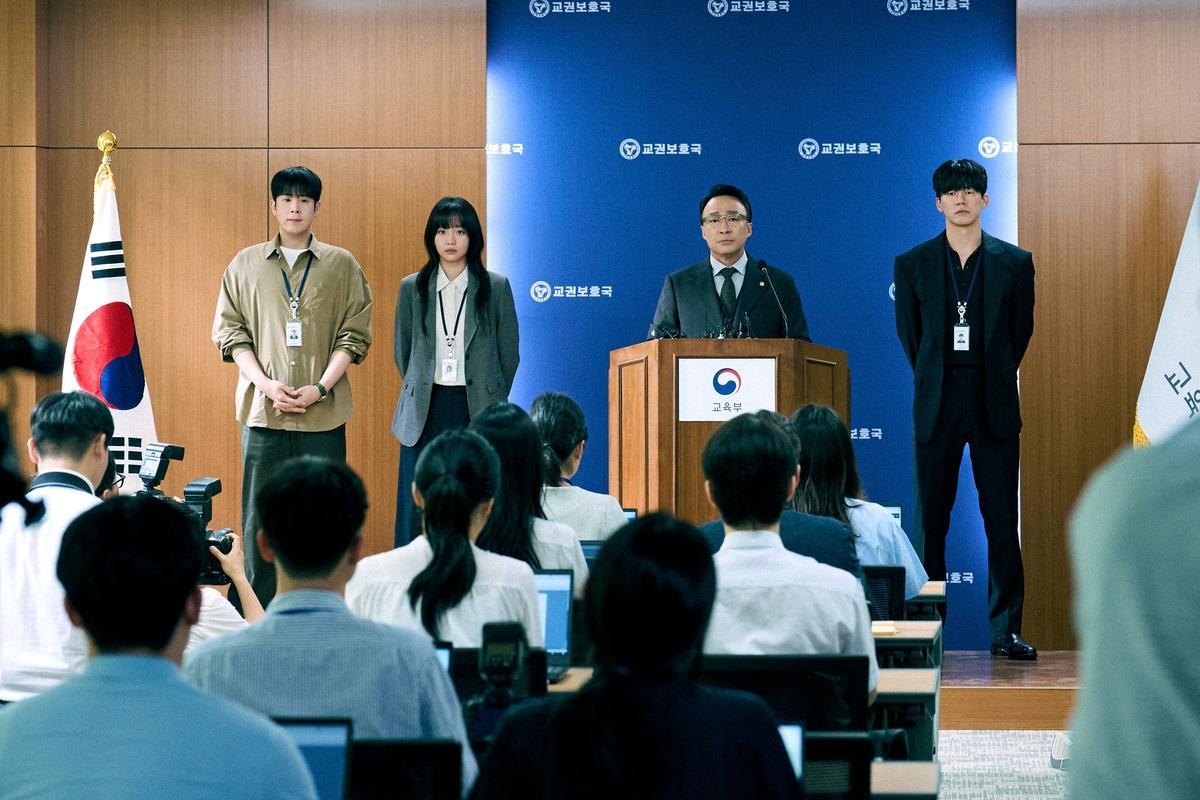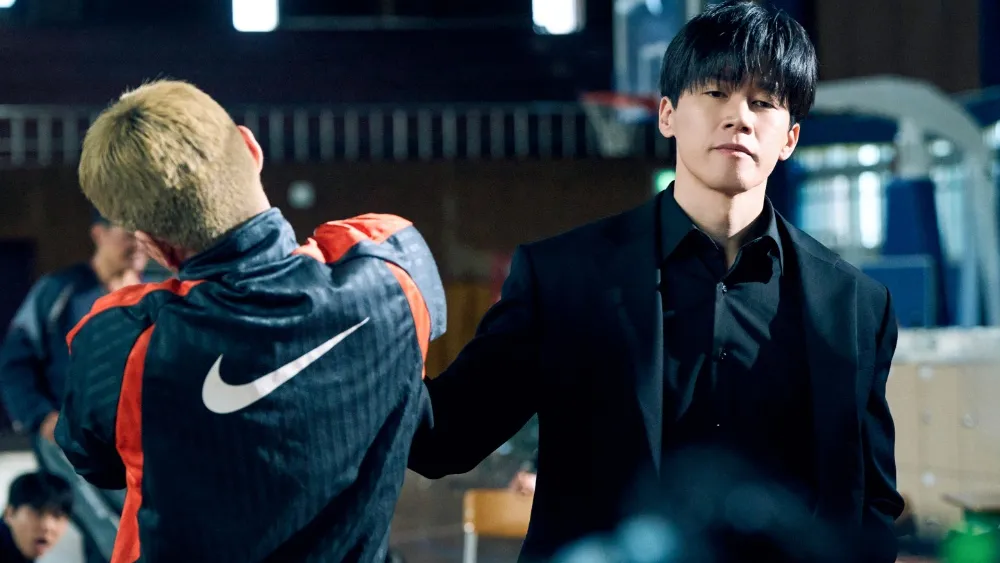
LIM WOONG When Netflix's new K-drama "Teach You a Lesson" started climbing global ratings charts this month, it did what good television is supposed to do: It made a country argue with itself. The show follows a fictional government unit called the Teachers’ Rights Protection Bureau as it descends on bullies and corrupt adults to rescue schools from violence. Forbes hailed it as "one of the smartest, best-written and most addictive" dramas of the year.While critics have praised its emotional acting and moral clarity, Korean viewers (including my spouse and me) have watched it with a wince of recognition and shame. The reason is simple. The series dramatizes a crisis in Korean classrooms that has been building for the better part of two decades.This is a conversation worth having: why a country of 50 million people is so ready to cheer for a special-ops captain and a grief-stricken bureaucrat to ride into a school and fix what grown-ups cannot.To understand why the conversation has reached this pitch, you have to understand how quickly the norms in Korean classrooms have shifted. For most of the postwar era, Korean schools ran on a model in which the institution was carried almost entirely on the backs of individual teachers. Teachers were effectively sovereign inside the schoolhouse. Corporal punishment was tolerated, even praised. Hairstyles, uniforms and after-school hours were policed like a military unit. That model worked for the industrialization era, but it did not survive Korea’s democratization. Corporal punishment was banned outright. Uniform and hairstyle rules were loosened. Students were, for the first time, more explicitly treated as rights holders. By the late 2010s, the pendulum had swung so far that some teachers reported being unable to enforce basic classroom rules without risking a parental complaint or, worse, a child-abuse investigation. The model of "your teacher is always right" is breaking down in an era of smartphones, social media, helicopter parenting and adolescent mental health crises.The result is what you see in the headlines and what "Teach You a Lesson" so vividly dramatizes. School administrators and homeroom teachers have been pushed to the margins by angry, litigious parents, by bullies, and by a legal climate that treats every disciplinary decision as potential child abuse. When a small number of students and parents repeatedly disrupt a class, when verbal abuse and false accusations become routine, the teacher is not the only one who pays the price. There is a quieter casualty: the learning rights of the silent majority, and the school experience they will carry into adulthood.Korea is a democracy, and yet the learning rights of the majority are being eroded while a vocal minority captures the conversation. Why, then, does the silent majority — most students, most parents — look away? Three lines of sociological thought deserve to be brought in.The first is Mancur Olson's logic of collective action. Olson argued that small, intensely organized groups almost always prevail over large, dispersed ones, because the cost of acting is borne individually while the benefit is shared collectively. A malicious parent or a student who knows how to weaponize the child-abuse hotline faces a concentrated incentive. The reasonable parent, by contrast, has nothing comparable to gain from intervening in someone else's dispute. The arithmetic is asymmetric, and over time, the system tilts toward those who cry the loudest.The second is Elisabeth Noelle-Neumann's spiral of silence. Public opinion climates can silence people when speaking appears costly. Once a vocal minority has framed the debate, the majority begins to read the room and stay quiet, and that quiet is mistaken for consent, which in turn further emboldens the minority. In Korean schools, the teacher who speaks up for a colleague under attack risks becoming the next target. The parent who defends a teacher in front of an aggressive family risks becoming the next complaint. Silence, here, is not indifference; it is a rational calculation. Multiplied across thousands of schools, these calculations produce the vacuum that the drama's fictional bureau was invented to break.The third is Hannah Arendt's banality of evil. Arendt did not need malice to explain how ordinary people become complicit in extraordinary harm. Only thoughtlessness, bureaucratic habits and the small corruptions of convenience. The Korean system has been hollowed out by a sequence of small accommodations: a principal who signs off on a baseless complaint to keep the peace; a superintendent who declines to defend a teacher because the case is politically inconvenient; education officials who reframe a structural crisis as a question of teacher professionalism because that is easier to address. None of these decisions is evil in the colloquial sense. Together, they amount to a quiet surrender.These three insights point to the same conclusion. The problem is not a handful of bad actors. It is the silence that allows a handful of bad actors to set the terms of public life, while the rest of us, out of fear or exhaustion, decline to contest them."Teach You a Lesson" is a fine drama. Its real subject, though, is not the bureau it imagines. The fantasy of a special-ops captain storming in to rescue beleaguered teachers is appealing precisely because it absolves the rest of us. It lets us feel concerned without acting concerned. To cheer for the bureau on screen and then look away from the teacher next door is what many decent people in Korea are doing.What the country is choosing to become will not be decided by a Netflix scriptwriter. Where are the parents who recognize that their child's right to learn is inseparable from the rights of every other child? Where are the administrators who treat the protection of teaching not as a political liability but as a foundational public good?The bureau in the drama is a fantasy. The solidarity with good teachers that it dramatizes is not. That is the choice in front of us, and it belongs to no one else.- - -Lim WoongLim Woong is a professor at the Graduate School of Education at Yonsei University in Seoul. The views expressed here are the writer’s own. — Ed.
[Lim Woong] What Korea's school crisis is really about
When Netflix's new K-drama "Teach You a Lesson" started climbing global ratings charts this month, it did what good television is supposed to do: It made a coun
TL;DRAI
South Korea's schools collapse: aggressive parents and bullies marginalize teachers as the silent majority disengages from the system. Organized minorities overcome dispersed majorities through collective action asymmetries and spiral of silence, a pattern in any institution.
1,012 words~5 min read