Overseas Indians can also send their foreign earnings to NRE accounts for investments and family maintenance in India
| Photo Credit:
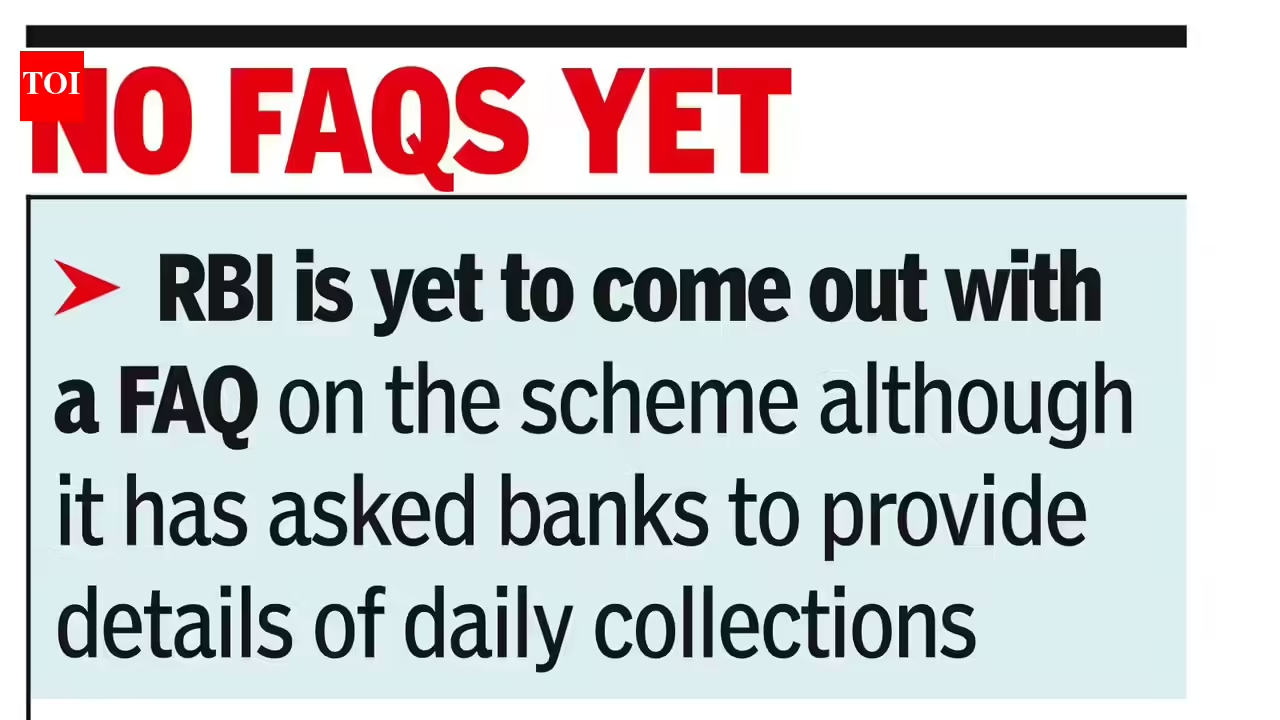
Raising interest rates on the limited period high interest rate FCNR (B) deposit scheme is only half the job for banks in their bid to attract foreign capital. The other half is answering customer queries and bankers’ own anxiety to be on the right side of regulations with regard to such deposits.Hence, bankers’ are expecting the Central bank to issue detailed FAQs (frequently asked questions) to address customer as well as their own concerns regarding mobilising resources under the limited period high interest rate Foreign Currency Non-Resident (Bank)/ FCNR (B) deposit scheme.Non-resident Indian (NRI) customers’ queries relate to whether their balances in a non-resident ordinary (NRO) and non-resident external (NRE) deposit can be routed into FCNR (B) deposits, which are now fetching attractive interest rates of 6-7 per cent thereabouts.NRO deposits help NRIs manage income earned within India. Overseas Indians can also send their foreign earnings to NRE accounts for investments and family maintenance in India. Both deposits are denominated in Rupees.Bankers’ have their own queries in terms of allowing premature closure of NRI deposits in the backdrop of fresh FCNR (B) dollar deposits offering higher interest rates.Offering leverage on a FCNR (B) deposit has emerged as a grey area. For example, a large Indian bank is offering its NRI customers, who are maintaining a FCNR (B) deposit of a minimum of $1 million with it in India, a loan of nine times the deposit amount from its overseas branch. The total amount ($1 million deposit and $9 million loan) is parked as a FCNR (B) deposit with the Bank.Further, small and mid-sized banks, which do not have overseas presence, are extending stand-by letter of credit (SBLC) to their FCNR (B) deposit customers so that they can approach select foreign banks for loans against the SBLC. Such loans, in turn, will be parked with Indian banks as FCNR (B) deposits.Since there is regulatory ambiguity on providing leveraged facilities against FCNR (B) deposits, the Central bank should clearly spell out whether such arrangements are kosher, Bankers said.Senior bank executives fear that if the RBI does not come up with requisite clarifications and banks go ahead and provide leverage facility to FCNR (B) depositors, they may get hauled over the coals during annual inspection if the central bank’s inspection team considers such a facility as not in keeping with the regulations.Bankers’ noted that providing leverage will require changes in banks’ lending policy. “A change in lending policy will require board approval. Provision of a leverage against a FCNR (B) deposit will require sign-off from the risk management committee of the board. This may take some time,” a senior executive with a public sector bank said.In a bid to attract foreign capital, RBI Governor Sanjay Malhotra had announced on June 5th that RBI will be bearing the full hedging cost on fresh 3–5-year FCNR (B) deposits raised by Banks up to 30th September 2026.To ensure that banks go the full nine yards in mobilising NRI deposits by offering higher interest rates, RBI exempted fresh FCNR (B) and NRE deposits from statutory reserve ratios such as cash reserve ratio and statutory liquidity ratio.Published on June 22, 2026