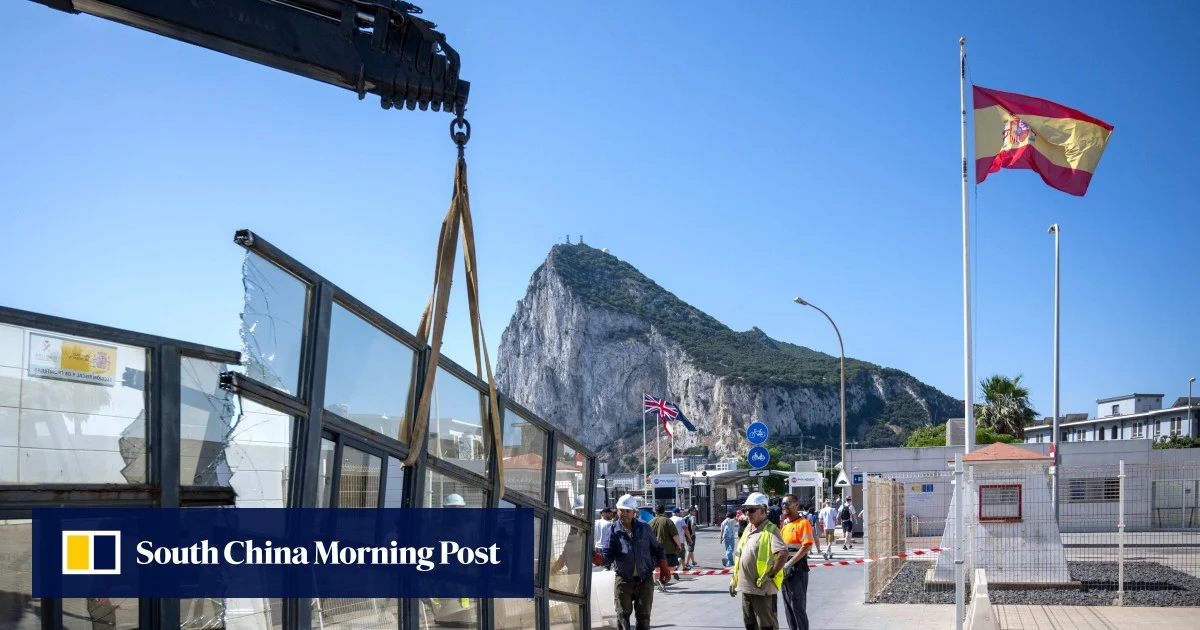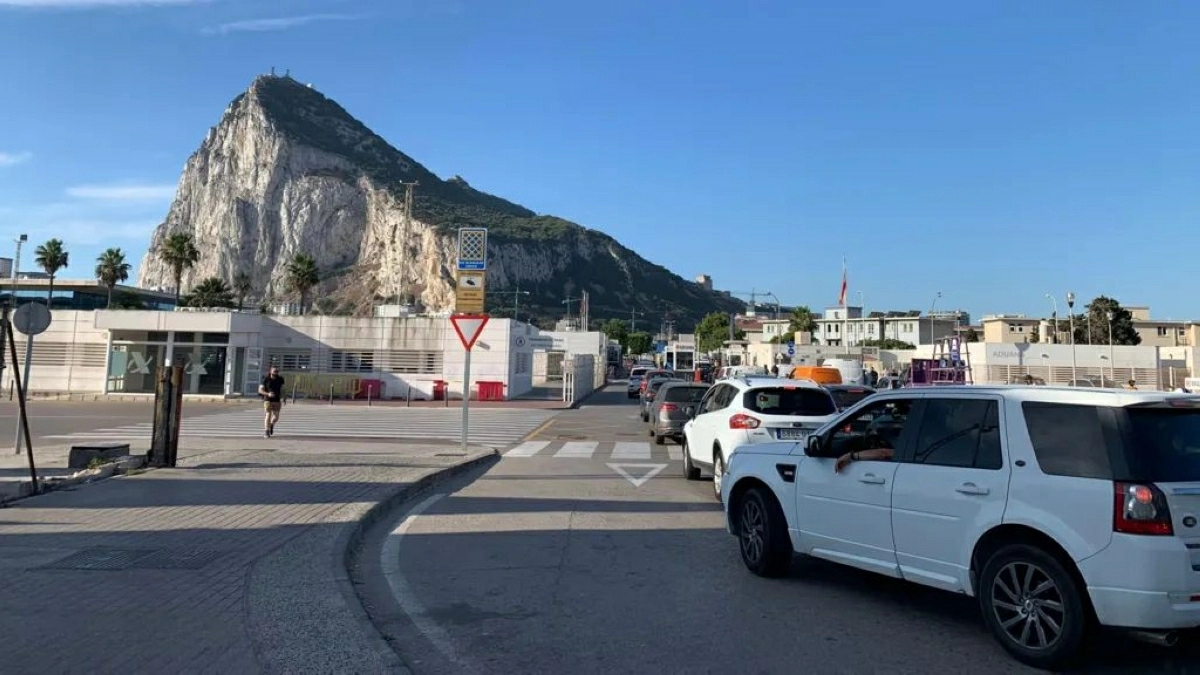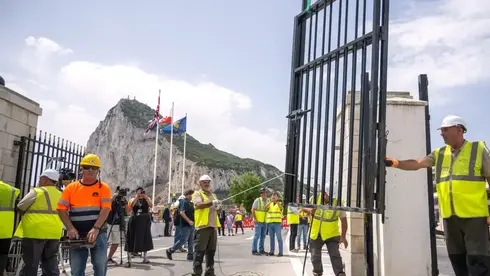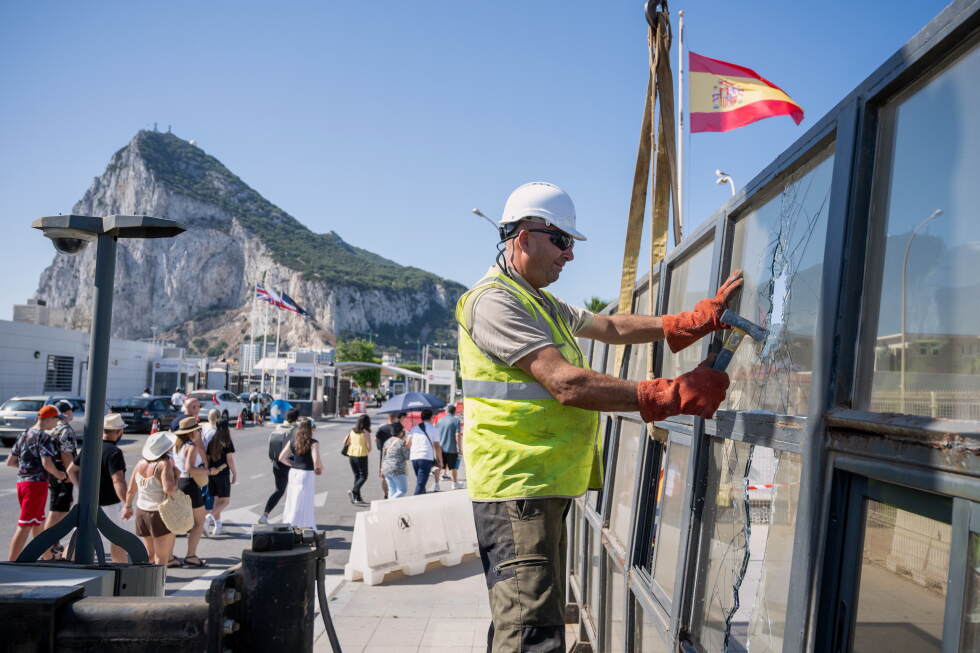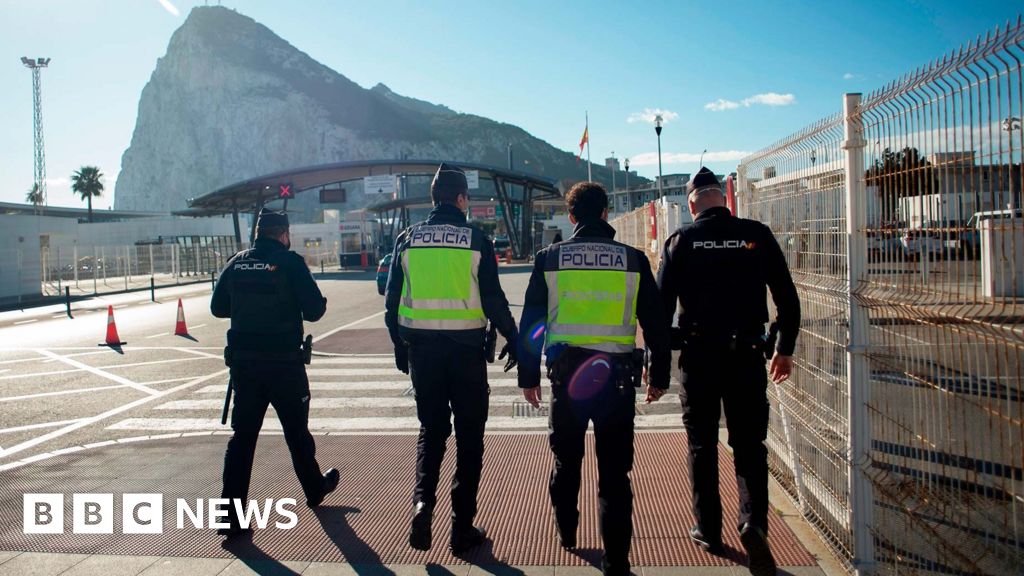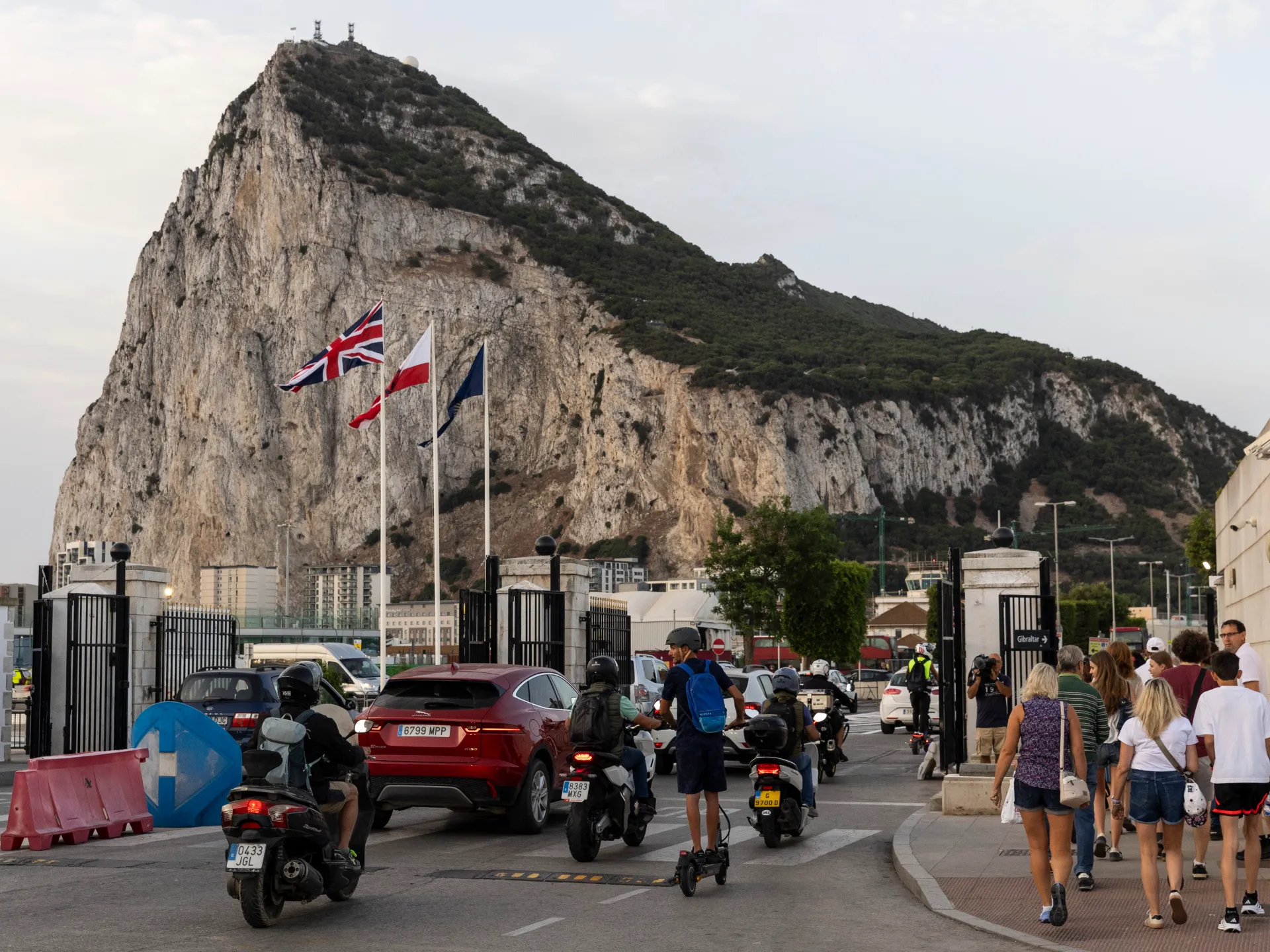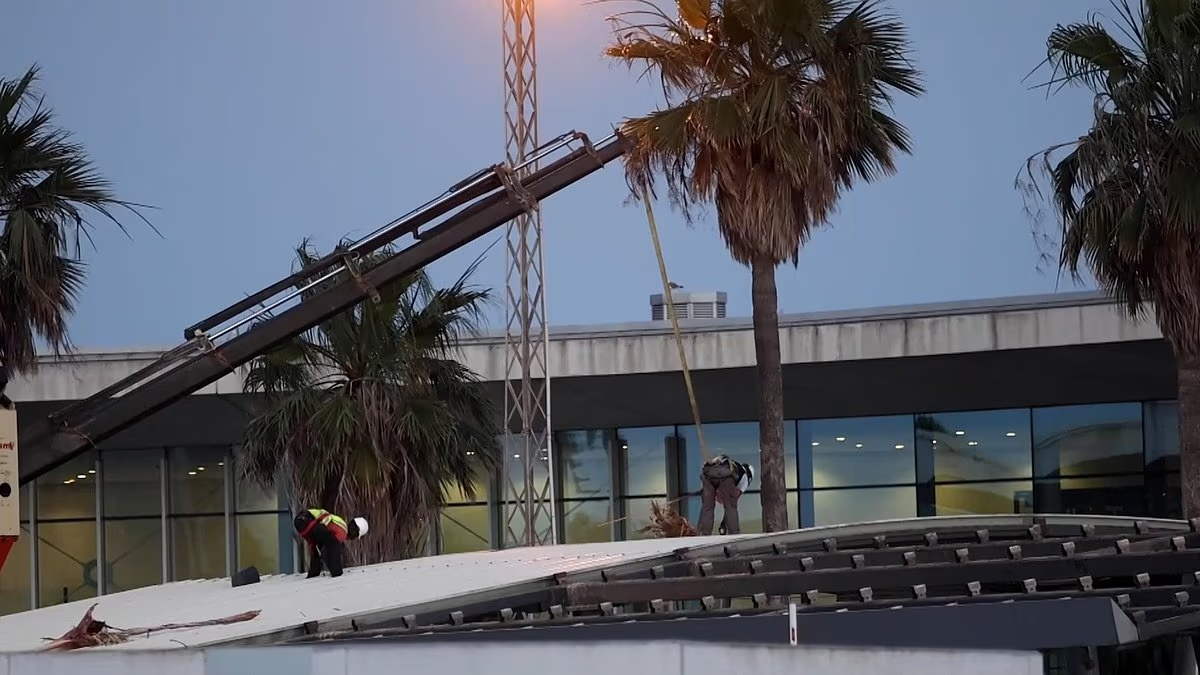
Checkpoints along the border separating Spain from Gibraltar are being dismantled for the first time in more than 300 years in the wake of a landmark post-Brexit deal. Under the new agreement, due to take effect on 15 July, the land border between the British overseas territory and Spain will effectively disappear and move to Gibraltar's airport.The change will allow around 15,000 cross-border workers to travel freely each day without routine land border checks.Footage showed workers tearing down buildings and checkpoints on the Spanish side of the crossing, while machinery removed auxiliary police structures ahead of a frictionless land border.On the Gibraltar side, scaffolding has been put up around canopies that are also set to be removed, with work expected to begin shortly. Royal Gibraltar Police checkpoint booths will also disappear as Gibraltar becomes part of the EU's Schengen travel area for border purposes, along with the eventual removal of the wire fence marking the border across Gibraltar's isthmus. Spanish workmen operating machinery can be seen removing checkpoints along the border Spain shares with Gibraltar, which will effectively disappear in the wake of a post-Brexit deal The landmark move comes over 300 years since the Anglo-Dutch forces captured Gibraltar during a conflict with Spain in 1704, creating a border between the two countries British travellers arriving in Gibraltar by air or sea will face a new entry system, where passports will first be checked by Gibraltar officials and then by Spanish officers, who will have the final say on entry.The move comes more than three centuries after Anglo-Dutch forces captured Gibraltar during a conflict with Spain in 1704. Following Brexit, Gibraltar faced the prospect of a hard EU border, raising concerns over severe disruption to its economy, which relies heavily on thousands of daily cross-border workers. But, after four years of negotiations, the UK and European Commission reached an agreement last June, with the full treaty text published this spring and expected to receive final approval from the European Council soon. According to Spanish media reports, the agreement could be formally signed in Brussels on 13 July by Foreign Secretary Yvette Cooper and EU Commissioner Maroš Šefčovič, as reported by The Telegraph. The treaty is being described as one of the most significant agreements affecting a British Overseas Territory since the 1984 Hong Kong accord with China.While sovereignty over Gibraltar was not part of the negotiations, the new agreement gives Spain greater influence. Spanish authorities will take part in entry checks and have veto powers over Gibraltar residency permits. As a result, Gibraltar's government says residency applications have surged as people seek to secure their status before the treaty takes effect.And there's good news for those who can't leave Spain without stocking up on cheap cigarettes, as the territory has also agreed to align tobacco prices more closely with its neighbour and introduce a VAT-style sales tax. Checkpoint booths will disappear as Gibraltar becomes part of the EU's Schengen travel area for border purposes British travellers arriving in Gibraltar by air or sea will face a new entry system, where passports will first be checked Gibraltar officials and then by Spanish officers The treaty is being described as one of the most significant agreements affecting a British Overseas Territory since the 1984 Hong Kong accord with ChinaIn return, Gibraltar residents will regain some EU freedom of movement rights lost after Brexit, including the ability to work across the EU as though they were EU citizens. However, they will not be entitled to their former EU-wide rights to reside and study across the bloc without restriction. Gibraltar Chief Minister Fabian Picardo called the agreement 'truly historic', describing it as the first major international accord affecting Gibraltar since the 1713 Treaty of Utrecht. He also encouraged businesses to invest in the neighbouring Campo de Gibraltar region, promoting what he called a future 'shared zone of prosperity' on both sides of the border.Meanwhile, an ambitious plan to create a colossal underwater tunnel connecting Africa to Europe has been given a fresh boost. The £7.4bn project, which could see the railway tunnel built under the Strait of Gibraltar crossing between Spain and Morocco, has been found to be 'technically viable' by scientists in a recent feasibility study. The study, conducted by German tunnel experts Herrenknecht and commissioned by the Spanish government in October 2025, found that drilling a railway tunnel using current technology is possible.However, the project presents a number of technical challenges, with researchers further analysing the practicalities of building critical sections under the Camarinal Threshold, an area characterised by complex geological conditions. A blueprint is now set to be developed by Spanish consultancy firm Ineco by 2027, with hopes for government approval expected to be secured as early as that year. The tunnel will be around 26 miles long, with almost 17 miles of the route submerged underwater, according to the Express. Though a final depth hasn't yet been set, it's predicted to lie about 420m below sea level, dwarfing the likes of the Channel Tunnel, which has a maximum depth of 74m under sea level.
Spain-Gibraltar border checks set to be removed under new Brexit deal
Border controls between Spain and Gibraltar are being torn down under a new post-Brexit agreement.
TL;DRAI
UK-EU accord removes Gibraltar-Spain border checkpoints July 15, enabling 15,000 daily workers' free movement and EU Schengen integration. Tech sector gains unrestricted EU workforce access and residency rights, strengthening talent sourcing and operational capacity.
844 words~4 min read