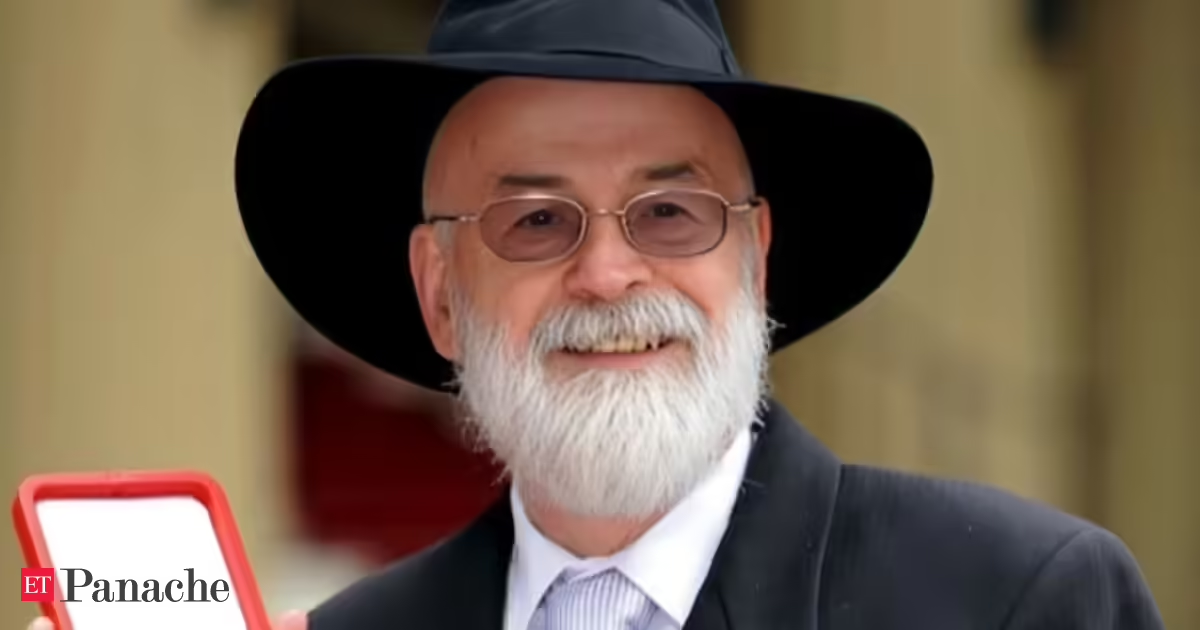
Some of the most powerful words are born from personal struggles. They do not just describe an experience; they reveal the emotions hidden behind it. For legendary author Terry Pratchett, his battle with Alzheimer's disease became the source of one of his most painful reflections. Known for his humour and imagination, the Discworld creator offered a deeply human perspective on what it feels like to live with an illness while being aware of its impact.One of Pratchett's most heartbreaking quotes, as reported by The Telegraph, was: “It occurred to me that at one point it was like I had two diseases - one was Alzheimer's, and the other was knowing I had Alzheimer's.”The quote reflects the emotional weight of Alzheimer's, where the challenge is not only facing memory loss but also understanding what is happening as it unfolds. Pratchett’s words captured the fear, awareness and grief that can accompany such a diagnosis.Meaning of the quoteTerry Pratchett's quote captures one of the most painful realities of living with Alzheimer's disease: the suffering is not limited to the loss of memory itself, but also the awareness of that loss. The "first disease" refers to Alzheimer's slowly taking away memories, abilities and parts of one's identity. The "second disease" is the emotional burden of knowing it is happening, of watching yourself change while still being aware of what is slipping away. It reflects the fear, grief and helplessness of facing a future where the mind recognises a loss that it cannot stop.Born Sir Terence David John Pratchett on April 28, 1948, he became one of the most celebrated English authors, humorists and satirists. He was best known for the Discworld series, a collection of 41 comic fantasy novels published between 1983 and 2015.The Discworld books became some of the best-selling works in English fiction worldwide, combining fantasy, humour and sharp observations about society. Pratchett also co-wrote the apocalyptic comedy novel Good Omens with Neil Gaiman in 1990.His writing journey began with The Carpet People, which was published in 1971. More than a decade later, the first Discworld novel, The Colour of Magic, arrived in 1983. After that, Pratchett maintained an extraordinary pace, often writing around two books a year. The final Discworld novel, The Shepherd's Crown, was published in August 2015, five months after his death.Over his career, Pratchett sold more than 100 million books worldwide across 43 languages, becoming the UK's best-selling author of the 1990s. His contribution to literature was recognised with several honours. He was appointed an Officer of the Order of the British Empire in 1998 and was knighted in 2009 for services to literature.His Alzheimer's Pratchett announced in December 2007 that he had been diagnosed with early-onset Alzheimer's disease. He used his public platform to raise awareness about the condition, donating to Alzheimer's research, documenting his experiences through BBC programmes and becoming a patron of Alzheimer's Research UK.He died on March 12, 2015, at the age of 66. Yet his words continue to resonate, especially his reflection on Alzheimer's, which remains a reminder of the emotional realities of illness beyond what can be seen.
Quote of the day by Terry Pratchett: 'It occurred to me that at one point it was like I had two diseases - one was Alzheimer's, and the other was knowing I had Alzheimer's', the British author's heartbreaking quote on awareness and suffering
Renowned author Terry Pratchett, celebrated for his Discworld series, bravely shared his personal battle with Alzheimer's. His poignant words, "It occurred to me that at one point it was like I had two diseases - one was Alzheimer's, and the other was knowing I had Alzheimer's," captured the profound emotional toll of the illness.
516 words~2 min read