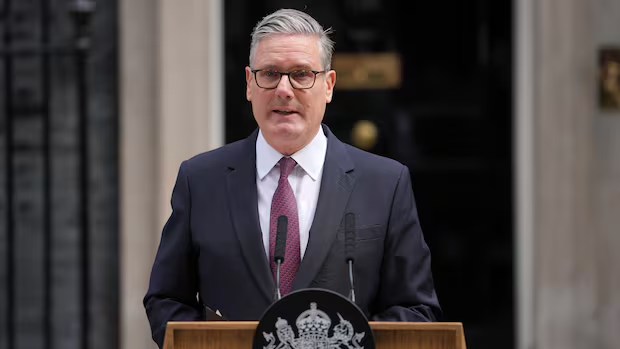
Prime Minister Keir Starmer said on Monday he would resign, with a new leader to be in place by the time Parliament returns in September, paving the way for Britan to have its seventh leader in 10 years. Starmer, less than two years after he won a landslide election victory that promised to end chaos in British politics, said it was clear that his party wanted him to go."The question my party is asking now is whether I am best placed to lead us into the next general election," he said. "I have heard the answer of my parliamentary party to that question, and I accept that answer with good grace."Starmer thanked his colleagues for their support, his voice cracking with emotion as he also paid tribute to his wife and children.The pound and British government bonds were steady in the immediate aftermath of Starmer's announcement, which investors had widely expected.Members of the public watch as Starmer stepped down in a speech outside 10 Downing Street in London. (Alastair Grant/The Associated Press)The threat to Starmer's leadership, which had been building for months, increased sharply on Friday when Andy Burnham, the Greater Manchester mayor, decisively won a parliamentary election to return to Westminster, beating a candidate from Nigel Farage's Reform UK party, which has led national opinion polls for more than a year.That victory gave hope to Labour lawmakers that Burnham, a career politician known for his communication skills, could transform the fortunes of a party. He is being sworn in as a Labour MP later Monday.Burnham confirmed he will bid to become the next leader while thanking Starmer for his "leadership and dedication during such a challenging period."Starmer had said on Friday he would stand in any formal Labour leadership contest that sought to replace him. But that appeared to change over the weekend. Farage, in a social media post, called for an immediate election. "If Labour thinks it can shove another professional politician into No 10, it has another thing coming," he said.WATCH | Burnham's win opened the door to challenge:'Dump Starmer' momentum grows with popular U.K. Labour MP's returnJune 19|Duration 2:06Former Manchester mayor Andy Burnham's sweeping federal byelection victory raises more speculation about a Labour Party leadership challenge to unseat Britain's unpopular prime minister Keir Starmer. Polls suggest Burnham could beat Nigel Farage's surging far right Reform UK party in a national election.New PM expected before SeptemberThough the timeline is officially decided by the party's governing body, Starmer said nominations would open on July 9 and close before Parliament goes into recess, which is scheduled for July 16.He said if there were to be a contest, it should be completed by the time Parliament returns, set for Sept. 1.Britain's Prime Minister Keir Starmer is consoled by his wife, Victoria, after announcing his resignation. (Kin Cheung/The Associated Press)Whoever replaces Starmer will become Britain's seventh prime minister since the Brexit vote to leave the European Union which took place 10 years ago this week. "The British people are sick of being let down by an endless merry-go-round of Prime Ministers while nothing really changes," Liberal Democratic Leader Ed Davey said in a social media post. "This time must be different. It can't just be about changing who's in No. 10; it has to be about changing our broken politics so we can fix our country."The level of turnover — the highest in Britain in nearly two centuries — underlines the struggle of maintaining the support of voters angry at successive failures to improve living standards, public services and tackle illegal immigration. Despite the attempt at a smooth handover, the change is not without risk. Labour's Andy Burnham wins byelection, setting up showdown with Keir Starmer to lead BritainBritish defence minister quits Keir Starmer's government, levelling scathing critique of his policiesBeyond saying that the country needs fundamental change and to bring down the cost of living, Burnham has yet to make clear his approach to foreign affairs, the economy and defence. To add to Starmer's woes, Defence Secretary John Healey and Armed Forces Minister Al Carns resigned earlier this month, due to what they viewed as insufficient government spending to meet Britain's military needs.Any candidate wishing to replace Starmer would need to secure the support of 20 per cent of Labour members of Parliament. With Labour currently holding 403 seats, that equates to 81 lawmakers. Candidates also must hit thresholds for support from grassroots Labour Party organizations, and from affiliated organizations such as trade unions.If more than one candidate qualifies, a ballot of all Labour Party members and affiliates will decide the winner, who then becomes prime minister. If only one candidate meets the threshold for support, there is no vote; they are elected unopposed as Labour leader and will become prime minister. Wes Streeting is shown speaking on June 16 in London. Streeting said Monday he would not make a bid for Labour Party leadership. (Gareth Fuller/PA/The Associated Press)Starmer struggled to deliver promised economic growth, repair tattered public services and ease the cost of living. He has also been hamstrung by repeated missteps, including appointing Peter Mandelson, a scandal-tarnished friend of Jeffrey Epstein, as the U.K. ambassador to the United States.A dismal performance in May's local elections spurred scores of Labour lawmakers to demand Starmer's resignation. Health Secretary Wes Streeting was the first senior minister to resign then, raising speculation that he could challenge Starmer.Streeting on Monday threw his support behind Burnham, encouraging others in the party to follow suit. "Having spoken at length with Andy in recent days, I'm convinced that there is a place for those ideas under his leadership; that he is committed to building an inclusive party that draws on the best of our political traditions; and that he can win the fight of our lives against the forces of nationalism," he said.Burnham, for his part, was health minister from 2009-2010 in Gordon Brown's government. He failed in two previous leadership contests, in 2010 and 2015.Starmer's successor will be confronted by great domestic challenges.Britain already has the highest borrowing costs in the G7 wealthy nations due to its high debt and interest payments, years of anemic economic growth, its struggles to cut spending and the need to invest in areas like defence.There is also the matter of managing the relationship with the unpredictable Donald Trump. Starmer ingratiated himself after the U.S. president began his second term in 2025, but the relationship was soured in recent months, with Trump embittered by what he saw as a lack of support for Washington's war with Iran. Labour MP Neil Coyle, in a post that argued Starmer had been treated unfairly, alluded to that relationship as well as the influence of Elon Musk, owner of X, who has railed against the British government and encouraged anti-immigration protests. "When the next leader cannot change Trump, Iran, Ukraine, [Russian President Vladimir Putin], Musk, broadcast editorial & algorithm bias overnight, they'll bay for his blood, too."
British Prime Minister Keir Starmer to resign, will stay on until successor chosen | CBC News
British Prime Minister Keir Starmer says he is stepping down as leader of the governing Labour Party. Starmer says he will remain caretaker prime minister until a new Labour leader is chosen in the next few weeks.
1,153 words~5 min read